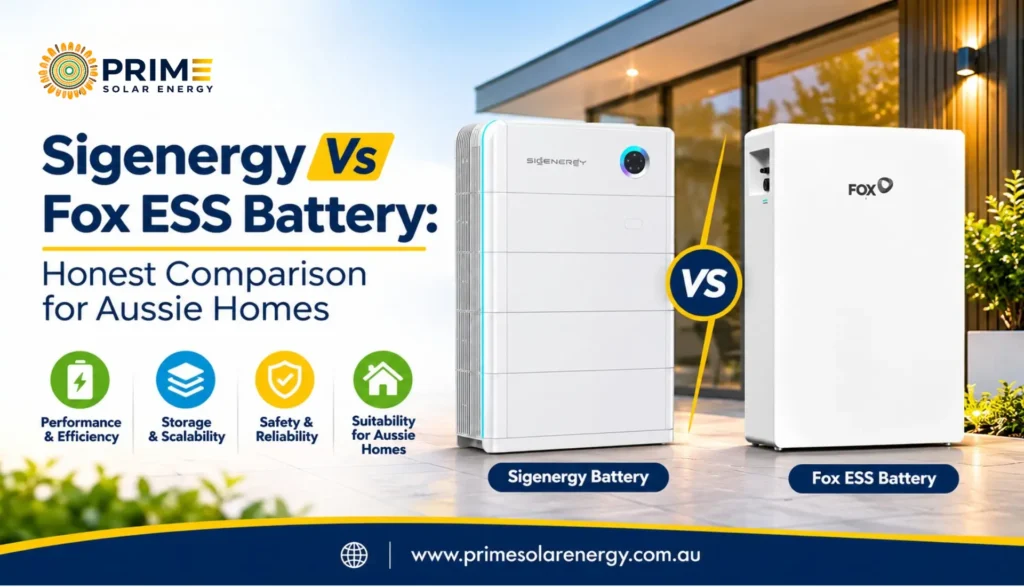
If you are comparing Sigenergy Vs Fox ESS battery options for a home in Canberra or elsewhere in NSW, you are really choosing between two different ways of building a solar battery system.
Sigenergy sells a tightly integrated platform where the inverter, battery, and controller work as one unit.
Fox ESS takes a modular approach, with its CQ7 high-voltage battery stacking alongside Fox’s own hybrid inverters. Both use lithium iron phosphate (LFP) cells, and both are backed by long warranties in Australia.
Quick verdict: Sigenergy suits households that want a polished all-in-one system with detailed monitoring, while Fox ESS suits those who want a flexible, expandable stack from an established inverter brand.
Sigenergy Vs Fox ESS Battery: Brand Background
Before getting into specs, it helps to know who stands behind each product. You’ll live with a battery for a decade or more, so support and track record matter just as much as kilowatt-hours.
About Sigenergy
Sigenergy is the newer name of the two. The company was founded in 2022 and introduced its SigenStor system to Australia at the 2023 All Energy conference. It markets SigenStor as a “five-in-one” solution, bringing a PV hybrid inverter, battery pack, and power conversion together in a single platform that can connect to the AC or DC side of your solar.
Sigenergy Australia runs from an office in Sydney and handles warranty claims for local customers. The Sigenergy battery has become popular quickly, though it simply hasn’t spent as many years in Australian homes as some of its rivals.
About Fox ESS
Fox ESS was established in 2019 and is headquartered in Wenzhou, China. It joined the Forbes Global Unicorn list in 2023, and its Australian operation is based in Melbourne. Fox ESS batteries have been approved by the Clean Energy Council (CEC) for use in Australia since 2022.
The Australian range includes the EQ4800, CQ6, CQ7, and EQ5500, plus the EP series. The CQ7 is the larger-capacity option in the lineup, and it works with Fox’s single-phase and three-phase hybrid inverters, which makes it a natural fit for bigger households and future expansion.
Side-by-Side of Sigenergy & Fox ESS Battery
Here’s a simple Sigenergy Vs Fox ESS battery comparison drawn from the manufacturers’ Australian documents. Always confirm the exact variant written on your quote.
| Feature | Sigenergy SigenStor | Fox ESS CQ7 |
| Models | SigenStor BAT 5.0, BAT 8.0, BAT 10.0 | CQ7-L2 to CQ7-L14 |
| Chemistry | LFP | LFP |
| Module size | Roughly 5 to 10 kWh per module | 6.96 kWh per module |
| Scalability | Stacked modules with Sigenergy controller | Up to 14 modules, 97.44 kWh |
| System style | Hybrid inverter, controller, and battery platform | Modular high-voltage battery paired with a Fox hybrid inverter |
| Ingress rating | IP65 | IP65 |
| Operating temperature | -10°C to 50°C | Charge 0°C to 55°C, discharge -10°C to 55°C (the heated “w” version suits colder sites). |
| Product warranty | 10 years | At least 10 years under the Fox ESS policy |
| Performance guarantee | 70% capacity or throughput limit, whichever comes first | 70% capacity or published throughput limit, whichever comes first |
| Monitoring | Sigen App with cell-level data | Fox ESS Cloud |
| Australian office | Sydney | Melbourne |
Which Battery Is Better, Sigenergy Battery or Fox ESS Battery?
Honestly, there’s no single winner, and anyone who tells you otherwise is probably selling one of them. The better pick depends on how your household uses energy and how you like your system built.
The Sigenergy battery shines on integration. Because the controller, inverter, and battery come from one maker, the setup is neat, and there’s one app and one support pathway to deal with. That app goes deep, too, showing detail right down to individual cell voltages and temperatures. SigenStor has also been integrated with several virtual power plant (VPP) platforms in Australia, which matters if you plan to earn from grid services. If you’re going for the federal rebate, keep in mind that on-grid batteries need to be on the approved list and VPP-capable under the Cheaper Home Batteries Program.
The Fox ESS battery wins on flexibility. The CQ7 lets you start with a smaller stack and add modules later, all the way up to 97.44 kWh. That’s handy if an EV, a pool, or a growing family is on the horizon. Fox also lists round-trip efficiency above 95% for the CQ7 and offers a heated “w” version for sites that see colder conditions, which can be useful for inland and alpine parts of NSW.
So if you want a neat, one-brand ecosystem, Sigenergy is hard to ignore. If you want room to grow and the freedom to size up later, Fox ESS makes a strong case.
Which One Suits Which Household?
Choose Sigenergy if
- You like the idea of one brand handling the inverter, battery, and controller.
- You enjoy digging into app data and plan to join a VPP, and you’ve checked the NSW demand response eligibility rules.
- You’re adding a battery to existing solar and want flexible AC or DC coupling.
- You prefer a cleaner, more compact-looking install
Choose Fox ESS if
- You’d rather start modest and expand the battery later
- You already have, or plan to install, a Fox ESS hybrid inverter
- You have the wall or floor space for a stackable tower
- You want a clearly published throughput figure for each configuration
Whichever way you lean, double-check that your exact model appears on the Clean Energy Regulator battery page pathway, because rebate eligibility depends on the specific model number installed, not just the brand.
Warranty and Long-Term Support
On paper, Sigenergy Vs Fox ESS battery warranty and lifespan look close, with both brands offering 10 years or more.
Sigenergy covers the battery and energy controller for 10 years, guaranteeing 70% usable capacity or a throughput limit, whichever comes first. For its 7.8 kWh nominal battery, that throughput figure is 23.77 MWh. One detail worth knowing is that if a Sigenergy system is disconnected for over a year, coverage can drop to 5 years from activation, so keep your system online.
Fox ESS backs the CQ7 with a performance warranty built on the same idea: 70% of nominal energy retained, or a minimum energy throughput, whichever comes first. The policy publishes a throughput figure for every CQ7 configuration, for example, 70.76 MWh for the 13.92 kWh CQ7-L2. The battery needs to be registered on the Fox ESS website at commissioning, and only the installer or authorized Fox personnel can lodge a claim. Fox’s warranty also assumes ambient temperatures between -10°C and 50°C, so placement matters.
Both batteries use LFP chemistry, which is known for handling thousands of cycles. In practice, though, long-term support comes down to the installer behind your system. A local team that registers your battery properly and handles claims quickly is worth more than any small difference on a datasheet. It’s also worth checking your battery against the CEC-approved list before you commit.
Rebate and Government Incentives in Canberra
The big incentive right now is the federal Cheaper Home Batteries Program. Since 1 May 2026, it has used a tiered, capacity-based approach, with support applying to the first 50 kWh of usable capacity and stepping down each January and July through to 2030. Smaller systems still receive the strongest support, so sizing your battery to your evening usage makes more sense than buying the biggest unit you can.
In the ACT, the Sustainable Household Scheme offers low-interest loans through Brighte with no upfront fees, and eligible Canberrans can pair it with the federal program. Battery systems made up over half of loan applications in the latest financial year, which shows how popular that combination has become.
Rules change often, so confirm current details before signing anything. Both Sigenergy and Fox ESS models can qualify when the exact model is approved, which is why any Sigenergy Vs Fox ESS battery quote should include a model-number check.
Why Choose Prime Solar Energy
At Prime Solar Energy, we install both brands across Canberra and the surrounding NSW region, so we’ve got no reason to push you towards one over the other. We look at your usage pattern, your roof, your existing system, and your plans for the next ten years, then recommend what actually fits.
We also take care of rebate paperwork, registration, and warranty setup, so your system is covered from day one. If you’d like a proper side-by-side assessment for your home, get a quote, and we’ll walk you through it in plain English. Got questions first? Feel free to contact us anytime.
Conclusions of Sigenergy Vs Fox ESS Battery
The Sigenergy Vs Fox ESS battery decision is less about which product is “better” and more about which approach suits your home. Sigenergy offers a refined, integrated experience with deep monitoring. Fox ESS offers modular flexibility and plenty of room to grow. Both are credible choices, and both belong in any conversation about the best solar battery for Australian homes.
Pick Sigenergy if you want everything working together as one smart system. Pick Fox ESS if scalability and inverter flexibility matter most. Either way, confirm CEC approval, read the warranty terms, and choose an installer who’ll still be around in ten years.
Frequently Asked Questions
Which is better, Sigenergy or Fox ESS?
Neither wins for everyone. Sigenergy suits households wanting an integrated system and detailed monitoring, while Fox ESS suits those wanting an expandable modular stack.
How long do Sigenergy and Fox ESS batteries last?
Both come with long performance warranties guaranteeing 70% capacity or a set throughput. Real-world life depends on how you use the battery and how well it’s installed.
Can I add more capacity later?
With the Fox ESS CQ7, yes, you can add modules up to 97.44 kWh in total. Sigenergy is also modular, but expansion depends on the controller and tower configuration, so confirm this with your installer before buying.
Do both batteries qualify for the federal battery program?
They can, as long as the exact model installed is on the approved list and meets the program’s requirements.
Can I use the ACT loan with either battery?
Eligible ACT homeowners can use the Sustainable Household Scheme with either brand, provided the system meets the scheme’s requirements.