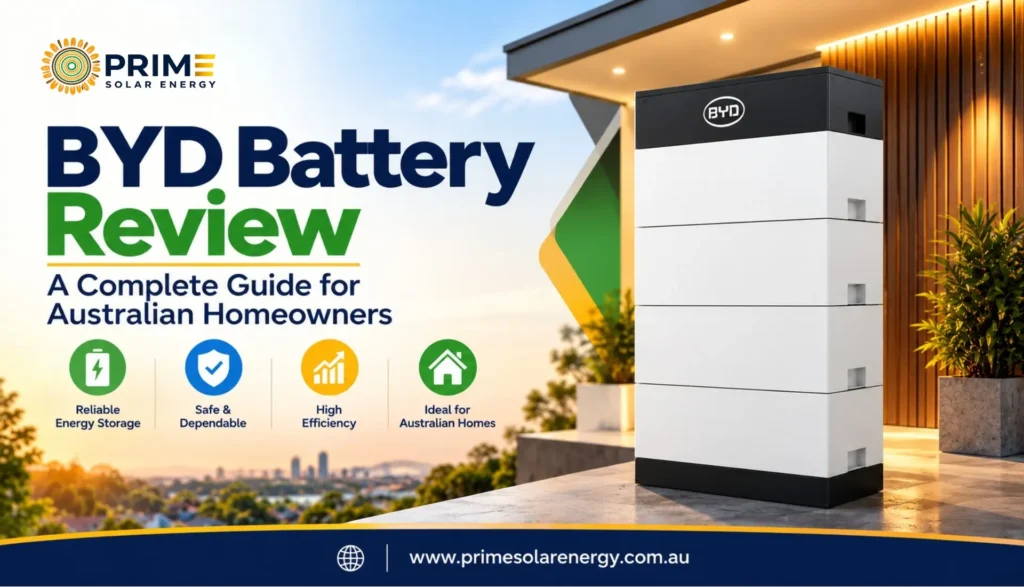
If you’re weighing up a home battery, BYD’s Battery-Box Premium is probably on your shortlist. This BYD Battery Review covers the range sold in Australia, based on BYD’s own datasheets and its Australian warranty documents.
We’ll go through the HVS, HVM, LVS, and LVL models, see how they stack up against Tesla and Sungrow, and finish with the questions worth asking your installer before you sign anything.
Quick Answer: BYD’s Battery-Box Premium is a modular lithium iron phosphate (LFP) battery that you expand one module at a time. The low-voltage LVS covers 4 kWh to 24 kWh, while the high-voltage HVS and HVM cover 5.12 kWh to 22.08 kWh, and every model comes with a 10-year product warranty. It’s a good fit if you want room to grow and already have, or plan to buy, a compatible inverter. Before you buy, make sure the battery is on the Clean Energy Council approved list.
Company Overview of BYD Battery
BYD stands for “Build Your Dreams.” The company is based in Shenzhen and is best known for electric vehicles and batteries. Its home batteries use LFP cells developed in-house, and BYD says it has worked with that chemistry since 2002. It also claims more than a million systems installed across over 100 countries.
Here in Australia, the batteries are imported by BYD Australia Pty Ltd, and Alps Power Pty Ltd is the authorized service partner. That local backing counts for a lot when you expect the battery to run for ten years or more.
If home storage is new to you, the government’s Solar Consumer Guide is a good neutral place to start before you compare brands.
BYD Battery Review: At a Glance
Here are the BYD Battery specifications at a glance, taken from the current datasheets.
| Model | Voltage | Module size (usable) | System range (usable) | Maximum system | Protection | Location |
| HVS | High | 2.56 kWh | 5.12–12.8 kWh | 38.4 kWh | IP55 | Indoor/outdoor |
| HVM | High | 2.76 kWh | 8.28–22.08 kWh | 66.2 kWh | IP55 | Indoor/outdoor |
| LVS | Low (51.2 V) | 4 kWh | 4–24 kWh | 256 kWh | IP55 | Indoor/outdoor |
| LVL | Low (51.2 V) | 15.36 kWh unit | 15.36 kWh | 983 kWh | IP20 | Indoor only |
Those maximum figures are theoretical limits for parallel installations. No home system gets anywhere near them. Usable energy is DC, measured at 100% depth of discharge, 0.2C, and 25°C, so what you actually get will vary a little depending on your inverter brand.
BYD Battery Range and Options
Four Battery-Box Premium models are covered by BYD’s Australian warranty documents. Your installer will confirm what’s currently in stock, and the team at Prime Solar Energy can help match a model to your inverter and daily usage.
HVS. This compact high-voltage option is built from 2.56 kWh modules. You can start with the HVS 5.1 (two modules, 5.12 kWh) and go up to the HVS 12.8 (five modules, 12.8 kWh). It delivers up to 25 A, with a 50 A peak for three seconds. A full five-module tower weighs around 205 kg.
HVM. The HVM uses bigger 2.76 kWh modules, so it reaches larger sizes, from the HVM 8.3 (8.28 kWh) up to the HVM 22.1 (22.08 kWh). Output is up to 50 A continuous, with a 75 A peak for three seconds. Weights vary a bit because two cell versions exist, and the biggest eight-module tower can hit 319 kg.
LVS. Built from 4 kWh modules at 51.2 V, this one runs from the LVS 4.0 to the LVS 24.0. Output grows as you add modules, starting at 65 A for a single module and topping out at 250 A from four modules onward. One module weighs 64 kg, and a six-module stack comes in at about 289 kg.
LVL. A larger low-voltage unit made for indoor installs only. The LVL 15.4 packs 15.36 kWh into two modules, delivers 250 A continuous, weighs 168 kg, and measures 660 × 650 × 575 mm.
BYD Battery Performance
Round-trip efficiency is at least 96% on the high-voltage models and at least 95% on the low-voltage ones. The operating range is -10°C to +50°C, though charging power drops between -10°C and +5°C. If you’re in Canberra, where winter mornings often sit close to that range, it’s worth talking to your installer about a sheltered spot like the garage.
Low & Higher-Voltage Versions of BYD Battery
Whether you go low or high voltage mostly comes down to your inverter. The HVS and HVM run at several hundred volts with lower current (25 to 50 A), and they pair with high-voltage hybrid inverters. The LVS and LVL run at 51.2 V with much higher current, up to 250 A, and suit 48 V inverters.
So the order is simple: pick the inverter first, then the battery. For the HVS and HVM, BYD’s Australian warranty also requires an inverter from its compatible list, which is one more reason to sort out compatibility well before installation day.
How to Size a BYD Battery for Your Home
Bigger isn’t automatically better. Buy too large, and the battery sits half empty for most of the year, so you’ve paid for capacity you never use. Buy too small, and it runs flat around 9 pm, and you’re back to buying grid power at peak rates.
Here’s a practical way to work it out:
- Start with your evening and overnight usage. Your bill or smart meter data will show what you use after the sun goes down. That number, not your total daily usage, is what the battery has to cover.
- Check your solar surplus. The battery only charges from what your panels produce beyond what you use during the day. If you’re home all day with a 6.6 kW system, there may never be enough spare energy to fill a 20 kWh battery.
- Think about the next five years or so. An EV, a heat pump, or a pool pump can change your usage fast. Since BYD is modular, you can start smaller and add modules later, as long as they’re compatible.
- Match the output to your loads. If you want the battery to run a ducted air conditioner or an induction cooktop, the continuous current rating matters just as much as the kWh figure.
Many Australian homes use somewhere between 15 and 20 kWh a day, but your own data will always beat an average.
Installation Considerations: Location, Weight and Clearances
BYD towers are heavy, and that affects where they can go. A full-height stack can weigh well over 200 kg, so the floor or wall has to carry the load, and the spot needs to be level and stable.
Most models are rated IP55, so outdoor installation is fine, but a sheltered position still helps. Try to avoid direct afternoon sun, standing water, and tight, unventilated cupboards. The LVL is IP20, so it has to go indoors in a dry space.
Your installer will also need to plan safe access, clearances around the unit, distance from doors and windows, and the cable run back to the inverter and switchboard. Rules vary by state and by network, so leave the design and sign-off to a licensed, accredited installer. And don’t leave the site question until after you’ve bought. Often the location decides which model is actually practical.
Cost and Government Incentives
Pricing depends on the model, how many modules you add, your inverter, and how tricky the install is, so quoting a single figure here would be misleading. What you can do is ask for a fully itemized quote that separates the battery, the inverter (if you need a new one), installation, switchboard work, and any monitoring hardware.
On incentives, the Australian Government’s Cheaper Home Batteries Program offers a discount on eligible systems. Generally, the battery needs to be CEC-listed, VPP-capable, and fitted by an accredited installer. Rules and rates change over time, so check the program’s current terms or ask your installer to confirm what applies to you before you commit. State and territory schemes may also be available, and ACT residents can find local details on the ACT Government’s home battery page.
Pros and Cons of BYD Batteries
Pros
- Modular, so you can add modules later as your needs grow.
- LFP chemistry with high round-trip efficiency.
- Four models, covering both high-voltage and low-voltage inverters.
- Most models are IP55 rated for indoor or outdoor mounting.
- Listed certifications include IEC 62619, UN38.3, and CEC.
Cons
- It’s battery-only, so you need a compatible inverter.
- The modules are heavy, and taller towers go over 300 kg.
- The LVL is indoor only (IP20).
- Charging power drops in cold conditions.
- Monitoring runs through your inverter’s app, so the experience depends on the brand.
BYD Battery vs Tesla Powerwall vs Sungrow
| Feature | BYD Battery-Box Premium | Tesla Powerwall 3 | Sungrow SBR (HV) |
| Design | Battery only, needs compatible inverter | Battery with built-in inverter | Battery only, pairs with Sungrow hybrid inverters |
| Usable capacity | 4–24 kWh (LVS); 5.12–22.08 kWh (HVS/HVM) | 13.5 kWh per unit | 9.6–25.6 kWh per unit |
| Scaling | Up to 38.4 kWh (HVS), 66.2 kWh (HVM) | Expansion units, up to 54 kWh | Up to 4 units in parallel |
| Output | Varies by model and inverter | Up to 11.04 kW AC per unit | 30 A continuous per battery |
| Warranty | 10 years | 10 years, 70% retention | 10 years |
The Tesla Powerwall 3 is the better pick if you want one integrated unit and a single app. Sungrow works best alongside its own hybrid inverter. BYD’s real strength is flexibility, because it works with a wide range of inverter brands.
BYD Battery Warranty and Lifespan
BYD gives a 10-year product warranty against defects. The performance warranty is where the fine print matters. For HVS and HVM systems bought and installed in Australia on or after 1 November 2024, BYD guarantees 70% of usable energy for ten years or until a minimum throughput is reached, whichever comes first. The Australian LVS and LVL residential letters list 60%.
That throughput limit works out to roughly 3 MWh for every kWh of usable energy. For the HVS 5.1, BYD lists 15.41 MWh against 5.12 kWh. If you cycled the battery fully every single day, you’d hit that limit in about eight years, so lighter daily use stretches the cover further.
There are a few conditions too. The battery has to be installed within a month of the invoice, run on a BYD-certified inverter, and not sit unused for six months or more. You also need to report faults within 30 days and let BYD access performance data remotely.
Warranty and lifespan aren’t the same thing. Plenty of LFP batteries keep working well past ten years, but BYD’s cover stops there. Your rights under Australian Consumer Law sit alongside the warranty, and the ACCC explains them in plain terms.
Questions to Ask Your Installer Before You Sign
A good quote will answer most of these without being asked, but it’s still worth checking each one:
- Which BYD model and how many modules do you recommend, and why that size?
- Is my inverter on BYD’s current compatible list, and does it need a particular firmware version?
- Will the system qualify for the Cheaper Home Batteries Program, and is the discount shown on the quote?
- Where will the battery be mounted, and does the site meet the clearance and weight requirements?
- Who handles warranty claims, and what happens if the installer stops trading?
- Does the quote include backup wiring, and if so, which circuits will it cover during an outage?
Final Verdict: Is BYD Battery Worth It?
For most households with a compatible inverter, yes. You get a proven LFP product, flexible sizing, local service support, and a clear 10-year warranty. It’s less suited to anyone who wants an all-in-one unit or who plans to cycle the battery hard every day beyond the throughput limit.
Looking for a BYD battery installer in Canberra? Ask us for a quote, and we’ll size a system around your inverter and usage. You’re also welcome to contact us with any questions first.
Frequently Asked Questions
Does a BYD battery work during a blackout?
The datasheets list on-grid plus backup as a supported application. How well backup works depends on your inverter and wiring, so confirm it with your installer.
Can I add modules later?
Yes. The range is modular, and any modules you add get their own warranty from their sale date. They need to be compatible and fitted by an accredited installer.
Can I install a BYD battery outdoors?
The HVS, HVM, and LVS are rated IP55, so they’re fine indoors or outdoors. The LVL is IP20 and has to stay indoors.
Which inverters work with BYD batteries?
Only the ones on BYD’s compatible inverter list. Using an uncertified inverter can void the HVS and HVM warranty.
Can I add a BYD battery to my existing solar system?
Often, yes, but it depends on your current inverter. If it isn’t compatible, you may need a hybrid inverter or a battery-ready replacement. An installer can check this from your existing system details.
How long does a BYD battery installation take?
Many installs wrap up in one to two days, but switchboard upgrades, tricky cable runs, or backup wiring can add time. Your installer should give you a realistic timeline in the quote.