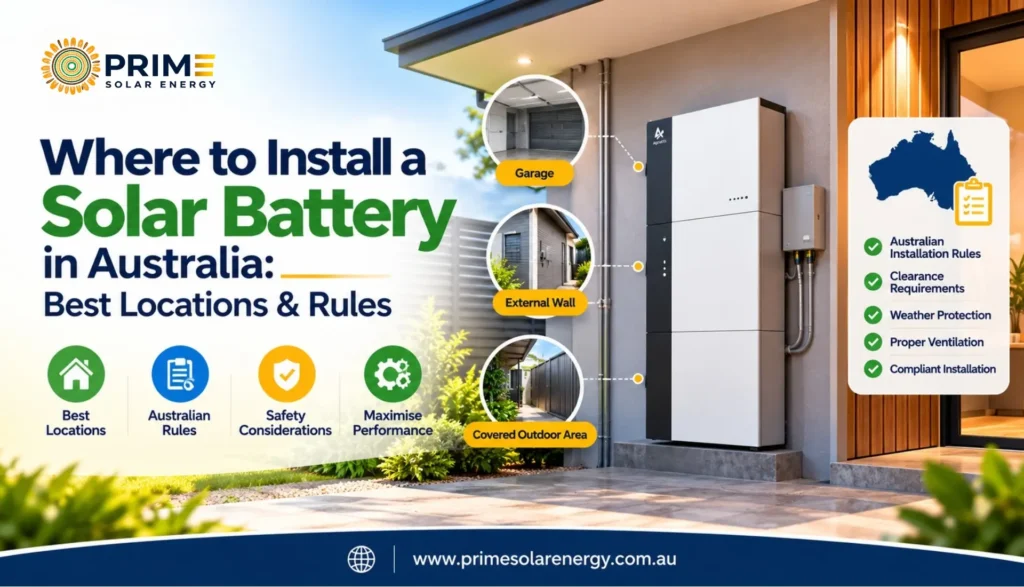
So, where to install a solar battery? It’s the first question worth settling, because the spot you pick affects safety, performance, and whether the system gets signed off at all. Here in Australia, the answer isn’t just “wherever there’s space.” A national safety standard decides a lot of it, and state and territory electrical rules add their own layer on top.
Below, we walk through the rules, the clearances, the indoor and outdoor options, and what Canberra homeowners should sort out before anyone picks up a drill.
Quick answer: Install a solar battery in a cool, ventilated, low-traffic spot, like a garage wall or an outdoor-rated external wall, away from bedrooms, living areas, and exits. The job must follow AS/NZS 5139 and be done by a licensed, accredited electrician. Ask your installer to confirm the exact clearances in writing.
Where to Install a Solar Battery: Start With the Standard
Every home battery installation in Australia must comply with AS/NZS 5139:2019, the key safety standard for battery energy storage systems. The standard was updated by Amendment 1:2025, which added further clarification around battery location, clearances, openings, access and fire-safety requirements.
It explains where a battery can and cannot be installed, how it must be protected and what clearances and safety measures may apply. In practice, the chosen location should provide safe access, suitable ventilation and protection from impact and environmental conditions. Exact placement depends on the battery model, the property and the current applicable requirements.
Solar Battery Installation Rules Australia: Who Does What
Meeting the installation standard is only one part of a compliant battery system. To qualify for the federal Cheaper Home Batteries Program, the battery must be on the Clean Energy Council approved list and be installed by a Solar Accreditation Australia (SAA)-accredited installer with the appropriate battery endorsement.
The installation must also comply with applicable state or territory electrical safety requirements. The Clean Energy Regulator outlines the current eligibility and installation requirements for solar battery systems.
Solar Battery Installation Requirements: What Your Installer Assesses
A good installer looks at your actual site, not just the product. NSW Government guidance suggests agreeing on the location with your installer, with bushfire and flood risk and any fuels or chemicals stored nearby all part of the conversation (NSW Government’s guide to owning a battery). The same logic holds in Canberra, where bushfire-prone edges and garages full of paint, petrol, and gas bottles are pretty normal.
In a proper site assessment, expect your installer to think about:
- How far the battery sits from the switchboard and inverter, because long cable runs mean more work
- Airflow and how hot or cold the spot gets across the year
- Room to service the unit and for emergency crews to reach it
- Protection from car bumps, water, and harsh weather
- What’s on the other side of the wall it’s mounted to
- Whether the switchboard needs an upgrade first
If your quote doesn’t mention any of this, ask how the location was chosen. Good planning is as much about the site as the product.
Solar Battery Clearance Requirements: Space Around the Unit
Clearances are where installs tend to get fiddly. The point of solar battery clearance requirements is to keep the battery a set distance from exits, windows, vents, and certain other equipment so heat or fire can’t spread easily, and people can still get out. The exact distances depend on the product, the type of space, and the version of the rules your installer is working on. So skip the number you saw on a forum or heard from a mate with a garage battery.
Ask your installer which clause applies to your wall, and get the clearances written on the quote or site plan. Two things are worth knowing now. Bedrooms and living areas count as habitable rooms, and batteries generally can’t go in them. And an escape route isn’t a storage spot, which is why Fire and Rescue NSW (FRNSW) advises keeping batteries away from entries and exits.
Where a Solar Battery Can’t Go: Restricted Locations
Some spots are off the table, however neat they look on a floor plan. Under AS/NZS 5139, batteries generally can’t be installed in habitable rooms such as bedrooms and living areas or in places that block an escape route or sit too close to exits. Spaces holding stored fuels, paint, or gas bottles also need a hard look, because they raise the fire risk. If your preferred spot falls into any of these, your installer should suggest an alternative rather than push it through.
Why These Locations Are Restricted
These restrictions are mainly about reducing fire risk and keeping escape routes clear. Batteries should be kept away from bedrooms, living areas and exits so occupants have more time and space to respond safely if a fault occurs. Flammable fuels or chemicals nearby can increase the severity of an incident, so installers should avoid these areas wherever possible.
Solar Battery: Indoor vs Outdoor Installation
Solar battery indoor vs outdoor installation isn’t a contest with one clear winner. “Indoor” usually means a garage or utility space rather than the living part of the house, and “outdoor” means an external wall, a side passage, or a sheltered corner.
Garages are popular for good reason: they’re sheltered, and they’re often close to the switchboard. Outdoor spots suit homes where the garage is jammed full, or the wall isn’t right, but the battery has to be built for outdoor use and kept out of the harshest sun and weather. Either way, Fire and Rescue NSW recommends a cool, ventilated, low-traffic area away from entries and exits, with accredited technicians, and the installer’s and manufacturer’s contact details kept near the meter box.
Its safety advice is worth remembering too. If a battery has been hit, burnt, or flooded, don’t try to restart it. In an emergency, get out straight away, call Triple Zero (000), and tell them a battery system is involved.
Where to Put a Solar Battery at Home: A Quick Comparison
Here’s how the usual options compare. Think of it as a starting point for the chat with your installer, not a ruling on your property.
| Location | Why it works | Watch-outs | Verdict |
| Garage wall | Sheltered, close to the switchboard, easy to service | Vehicle impact, stored fuels and chemicals, clearance to doors and windows | Often suitable with protection |
| External wall | Frees up the garage, keeps the unit away from living areas | Needs an outdoor-rated unit; sun, rain, and bushfire exposure | Suitable for outdoor-rated batteries |
| Side passage | Out of the way | Tight access, clearance to openings, water flow in heavy rain | Case by case |
| Utility or storage room | Contained and out of the weather | Ventilation, fire separation, what sits behind the wall | Needs careful assessment |
| Bedroom or living area | None worth the risk | Habitable rooms are restricted under AS/NZS 5139. | Not suitable |
Solar Battery Installation Canberra / ACT: Local Points to Check
In the ACT, battery work is electrical work, so it needs a licensed electrician, who lodges a Certificate of Electrical Safety with Access Canberra and gives you a copy. The ACT Government points out that keeping that certificate helps with safety compliance and insurance. Access Canberra has also brought in a licence endorsement for electricians installing PV and battery systems, so it’s fair to ask yours whether they hold it.
Temperature matters here too, with Canberra’s cold winters and hot summers. A spot that stays out of the afternoon sun and gets decent airflow is usually kinder to a battery than a stuffy corner.
And if you’d like a second opinion on where yours should go, Prime Solar Energy can talk through the options for your home.
Solar Battery Installation Cost Australia: What Shapes the Final Quote
Solar battery installation costs Australia-wide depend on more than the battery itself. Location drives a lot of the extra work. Longer cable runs, switchboard upgrades, wall preparation, protection from vehicles, and inverter compatibility can all change the scope, which is why two quotes for the same battery can look quite different.
Incentives play a part too. The federal discount comes through small-scale technology certificates, and the Clean Energy Regulator’s schedule shows the rate stepping down over the next few years, so timing counts. In the ACT, the Sustainable Household Scheme offers loans for eligible upgrades, with a low interest rate applying to all new loans since 1 July 2025. The regulator also says to check whether you can claim both state and federal programs, because some state programs may not be available if you claim certificates.
When you’re ready, get a quote that lists location-related work as its own line, so you can compare like with like.
Final Checks Before You Book
A home battery system Australia homeowners can trust comes down to three things: an approved product, an accredited installer, and a location that passes the safety check. Before you sign anything:
- Confirm the battery is on the Clean Energy Council approved list
- Check your installer’s SAA accreditation and electrical license.
- Ask which clause of the standard supports the proposed location
- Request a written scope that covers labeling, protection, and paperwork
- Book a yearly safety check once the system is running
Still working out where to install a solar battery at your place? Contact us, and we’ll help you find a spot that’s safe and practical.
Frequently Asked Questions
Can I install a solar battery in my garage?
Often, you can. The spot needs to meet the standard’s clearances, have protection from vehicle bumps, and stay clear of stored fuels and chemicals. Your installer will confirm it on site.
Can a solar battery go inside the house?
Not in habitable rooms like bedrooms and living areas. A utility space might work, as long as ventilation and fire separation requirements are met.
Are outdoor solar batteries safe?
They can be, provided the unit is rated for outdoor use, and an accredited installer puts it in a cool, ventilated, low-traffic spot away from exits.
Who can install a home battery?
A licensed electrician. For the federal program, they also need SAA accreditation with a battery endorsement.
How often should a battery be checked?
The Clean Energy Regulator recommends a safety check every year by a licensed electrician accredited by SAA.
Can I add a battery to solar panels I already have?
Yes. The Clean Energy Regulator says a battery can be installed with a new or existing solar system. The existing system has to comply with your state or territory’s electrical safety rules, and the inverter the battery connects to must be able to join a virtual power plant.
What should I do if my battery is damaged?
Don’t restart it. Follow the shutdown procedure only if it’s safe to do so, then contact the manufacturer or your installer for an inspection. If there’s smoke or fire, leave immediately and call Triple Zero (000).