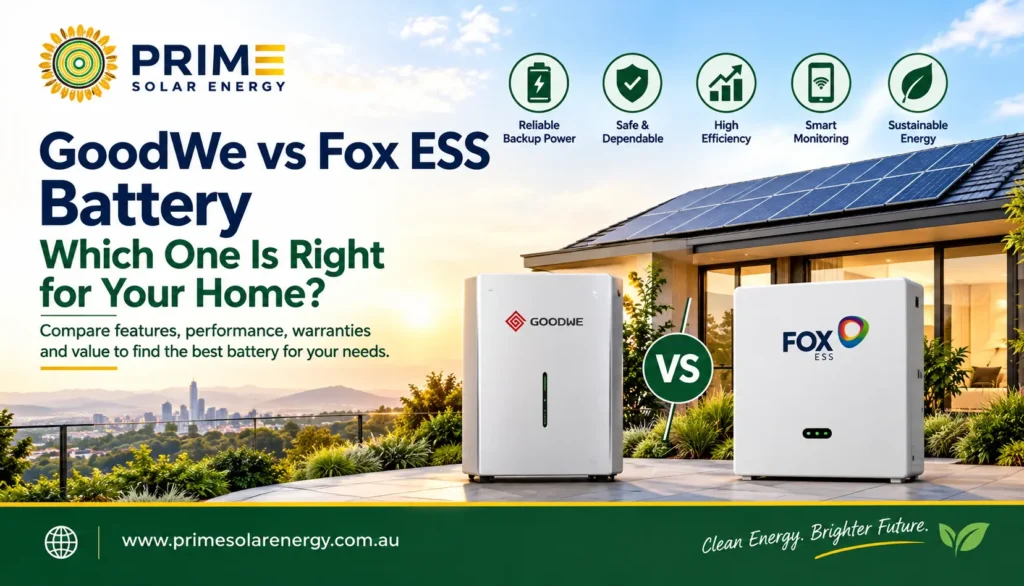
Picking a home battery usually comes down to two or three brands, and GoodWe and Fox ESS keep turning up in the same quotes. Both use LiFePO₄ chemistry, both are sold widely in Australia, and both can handle a typical household. They go about it in different ways, though.
GoodWe’s ESA is a single pre-wired unit that combines the inverter and battery. Fox ESS sells the battery on its own (the CQ7 is the main one), and you pair it with a Fox hybrid inverter. That one difference shapes almost everything else: installation, expansion, backup power, and how the quote is put together.
This guide compares the two side by side, using the manufacturers’ own datasheets and warranty documents, so you can see which approach suits your home.
GoodWe Vs Fox ESS Battery: Quick Verdict
GoodWe is worth a close look if you want a choice between an integrated all-in-one system and several Lynx battery configurations, with a long-established Australian inverter presence. Its ESA system combines inverter and battery components in one cabinet, while Lynx models provide other capacity and voltage options.
Fox ESS may suit households prioritizing modular storage and competitive value, particularly when installing a matched Fox hybrid inverter and battery. Prime Solar Energy’s Fox ESS review notes that the EQ series has a longer local track record than newer families such as CQ6 and CQ7.
Neither brand is automatically best for every home. Confirm the exact model, usable capacity, backup output, inverter compatibility, and warranty terms before choosing.
GoodWe Vs Fox ESS Battery: side-by-side Comparison
| Feature | GoodWe | Fox ESS |
| Australian entity | GoodWe Australia Pty Ltd (Rowville, VIC) | FoxESS Australia Pty Ltd (Springvale, VIC) |
| Main battery approach | All-in-one: inverter and battery in one pre-wired system | Modular batteries paired with a Fox ESS hybrid inverter |
| Battery chemistry | LiFePO₄ | LiFePO₄ |
| Battery size range | From 5 kWh up to 108 kWh | From 9.32 kWh up to 97.44 kWh |
| Home inverter range | Single-phase 3–10 kW; three-phase 5–30 kW | Single-phase 3–10.5 kW; three-phase 5–30 kW |
| Whole-home backup | Built-in, up to 63 A bypass | Depends on the Fox inverter paired with the battery. |
| Weather protection | IP66 | IP65 |
| Warranty | 10-year product + 10-year performance | 10 years on most batteries (12 years on the CQ6) retains at least 70% of nominal energy or minimum throughput. |
| Best suited to | New solar + battery installations wanting one integrated unit | Homes wanting modular sizing, larger systems, or already running a Fox inverter |
The two efficiency figures are measured differently, so they shouldn’t be compared directly.
GoodWe Battery Overview
GoodWe has been sold in Australia since 2012 and is best known for inverters. Its current home battery lineup is built around the ESA series, which combines a hybrid inverter and LiFePO₄ battery modules in one pre-wired, modular system. There’s also an AC-coupled ESA version for adding storage to an existing solar system. The ESA battery modules are based on GoodWe’s Lynx DG2 technology.
GoodWe battery model names and specifications
ESA battery modules
| Model | Rated energy | Usable energy | Cycle life* |
| GW5.1-BATD-G20 | 5.12 kWh | 5.0 kWh | ≥ 8,000 |
| GW8.3-BATD-G20 | 8.32 kWh | 8.0 kWh | ≥ 8,000 |
| GW6.0-BATD-G20 | 6.0 kWh | 5.9 kWh | ≥ 10,000 |
| GW9.0-BATD-G20 | 9.0 kWh | 8.85 kWh | ≥ 10,000 |
*Based on laboratory test conditions, per GoodWe’s datasheet.
ESA single-phase inverters: GW3K, GW3.6K, GW5K, GW6K, GW8K, and GW9.999K (all “-EHA-G20”), covering 3 kW to 9.999 kW.
All battery modules are rated IP66. Weights run from 57.5 kg (5 kWh) to 79 kg (8 kWh).
Potential Advantages of GoodWe
- Integrated design. Inverter, battery, and switchgear come pre-wired as one system, which GoodWe says keeps installation quick.
- Strong backup specs. Up to 63 A bypass for whole-home backup, switching to backup in under 4 ms, and a surge rating of twice the nominal output for 10 seconds.
- Quiet. The inverter is rated at 30 dB or less (35 dB on the 8 kW and 10 kW models).
- Flexible expansion. You can mix different module capacities and old and new modules in the same system.
- Long warranty. 10 years of product cover and 10 years of performance cover.
Fox ESS Battery Overview
Fox ESS offers several high-voltage battery lines in Australia, all LiFePO₄ modules that stack to the size you need. The CQ7 is the current flagship, and the CQ7 V6+ was launched for larger systems.
Fox ESS battery model names and specifications
| Model | Energy per module | Capacity range | Warranty |
| CQ7 | 6.96 kWh | 13.92 – 97.44 kWh (L2–L14) | 10 years |
| CQ7 V6+ | 6.96 kWh | 41.76 – 83.52 kWh (L6–L12) | See Fox ESS policy |
| EQ5500 | 5.46 kWh | 10.92 – 49.14 kWh (L2–L9) | 10 years |
| EQ4800 | 4.66 kWh | 9.32 – 41.94 kWh (L2–L9) | 10 years |
| CQ6 | 5.98 kWh | 11.96 – 83.72 kWh (L2–L14) | 12 years |
On the CQ7, each system uses one master module (CQ7-M, which holds the controller) plus up to 13 additional battery modules (CQ7-S). Versions marked “(w)” include a warm-up function for cold conditions.
Potential Advantages of Fox ESS
- Fine-grained sizing. Capacity grows in 6.96 kWh steps, with 100% depth of discharge.
- Scales up. Up to 97.44 kWh per system, with three-phase options up to 83.52 kWh on the H3 Smart inverter.
- Wide inverter choice. It pairs with Fox’s single-phase and three-phase hybrid inverters, which suit homes already running a Fox inverter.
- Built for tough conditions. IP65 rating, built-in fire protection, and a charge range from 0°C to 55°C. Warm-up models operate down to −25°C.
- Quick setup. Plug-and-play connections, which Fox says allow system setup in about 30 minutes.
GoodWe ESA Vs Fox ESS CQ7: What Are the Key Differences?
The ESA and CQ7 are the two models most homeowners end up comparing, so here’s how they stack up in practice.
GoodWe ESA Vs Fox ESS CQ7: Practical Comparison
| Feature | GoodWe ESA | Fox ESS CQ7 |
| Best suited to | New solar + battery installations wanting one integrated unit | Homes wanting modular sizing, or already using a Fox inverter |
| What you buy | Inverter and battery as one system | Battery modules and inverter chosen separately |
| Single-phase limit | Up to 10 kW inverter | H1 and KH single-phase inverters support CQ7 stacks up to 48.72 kWh. |
| Three-phase | 5–30 kW inverters | H3 Smart supports up to 83.52 kWh. |
| Smallest system | One 5 kWh module | 13.92 kWh (one master + one battery module) |
| Backup | 63 A bypass built in | Check the paired inverter’s backup rating. |
| Warranty | 10 + 10 years | 10 years, 70% capacity retention |
See Fox ESS CQ7 Series Datasheet and GoodWe ESA Series Datasheet
The Main Differences to Consider
1. System Design and Inverter Compatibility
The ESA arrives as a complete system, so there’s one product to install and one app to manage. If you’re also installing new solar, that simplicity helps. GoodWe also have an AC-coupled ESA version for homes that already have a solar inverter they want to keep.
The CQ7 is only the battery. You choose a Fox hybrid inverter to go with it, which gives you more control but also one more decision. If you already own a Fox inverter, adding a CQ7 is a straightforward upgrade.
2. Capacity and Future Expansion
The ESA can start as small as 5 kWh and, per GoodWe’s latest Australian datasheet, grow to 108 kWh, with up to six modules in a single stack. Different module sizes can be mixed.
The CQ7 starts at 13.92 kWh, which suits households with higher evening usage but is more than some small homes need. Single-phase Fox inverters support CQ7 stacks up to 48.72 kWh, which is plenty for most households. If you want to go bigger, three-phase is where the CQ7 stretches out.
3. Backup Power During Blackouts
The ESA’s backup is part of the package: up to 63. A bypass current for whole-home backup, a switchover under 4 ms, and a peak output of twice the nominal rating for 10 seconds. If you use heavy appliances like air conditioners, ask your installer how they’ll be handled on backup.
With the CQ7, backup performance comes from the inverter you pair it with, not the battery itself. The CQ7 datasheet doesn’t state a backup rating, so get the inverter’s backup specs in writing before you decide.
4. Efficiency and Daily Savings
GoodWe quotes battery-to-AC efficiency of up to 98.0% (97.8% on the larger inverters). Fox quotes round-trip efficiency above 95% at 25°C. These are different measurements, so don’t treat the gap as a real-world difference.
What really drives your savings is battery size, your electricity tariff, how much solar you produce, and when you use power. A well-sized system from either brand will do far more for your bill than a point of efficiency.
5. Warranty and Long-Term Support
On paper, GoodWe offers a 10-year product warranty plus a 10-year performance warranty. Fox ESS offers 10 years on the CQ7, guaranteeing at least 70% of nominal energy over that period (or a minimum energy throughput, whichever comes first).
Warranty conditions matter as much as the headline number. Fox requires the battery to be registered on its website when commissioned, and the operating temperature needs to stay between −10°C and 50°C. GoodWe’s warranty also carries installation and registration conditions. Ask your installer for both documents.
6. Price and Overall Value
Prices change with battery size, inverter choice, backup requirements, and installation complexity, so there’s no honest single figure for either brand. When you compare quotes, make sure they’re like-for-like: the usable kWh, the inverter size, whether a backup gateway is included, and what installation is covered. An all-in-one quote and a battery-plus-inverter quote can look very different on paper while costing about the same.
GoodWe Vs Fox ESS: Which Should You Choose?
Go with GoodWe if you’re building a new system, want one integrated unit, and care about built-in whole-home backup and a flexible start size.
Go with Fox ESS if you want to build your battery in small steps, plan a larger three-phase setup, or already have a Fox inverter that’s ready for a battery.
If you’re still on the fence, the best next step is to look at your own usage rather than the spec sheets. Your evening consumption, your phase, and your backup needs will usually point to one clear answer.
Check Home Battery Rebate Eligibility First
The federal Cheaper Home Batteries Program can take a meaningful chunk off the cost of a battery, so check eligibility before you pick a model. The program requires:
- A battery approved by the Clean Energy Council
- Installation by a Solar Accreditation Australia-accredited installer
- A battery that is VPP-capable (for on-grid systems). You don’t have to join a VPP.
- A battery connected to a new or existing solar system
The program changed on 1 May 2026, with the level of support now varying by battery size and stepping down over time through to 2030. That means timing and size both affect your rebate. You can read the full details on the DCCEEW’s Cheaper Home Batteries page, and your installer should confirm the exact model is on the approved list before you sign.
Why Choose Prime Solar Energy?
Size a battery around how your household actually uses power, not around whichever brand has the biggest number on the box. At Prime Solar Energy, we start with your usage, phase, existing solar or inverter, and backup needs, then recommend a system that fits. We’ll also check rebate eligibility for the exact model before you commit and explain the warranty terms in plain language.
Get a quote that compares GoodWe and Fox ESS for your home? Contact us, and we’ll walk you through it.
FAQs
Is the GoodWe ESA an all-in-one battery?
Yes. It combines a hybrid inverter and LiFePO₄ battery modules in one pre-wired system.
Does the Fox ESS CQ7 need a separate inverter?
Yes. The CQ7 is a battery-only device designed to pair with a Fox ESS hybrid inverter such as the H1, KH, or H3 Smart.
Which battery has the better warranty?
GoodWe offers 10 years of product and 10 years of performance coverage. Fox ESS offers 10 years on the CQ7 with a 70% capacity guarantee. The headline lengths are similar, so compare the conditions in each document.
Can I run my whole home during a blackout?
The ESA supports whole-home backup through a 63 A bypass. With Fox ESS, backup depends on the inverter paired with the CQ7, so confirm the inverter’s rating.
Do both batteries qualify for the home battery rebate?
Eligibility depends on the specific model being on the Clean Energy Council’s approved list and being installed by an accredited installer. Confirm this before you buy.
Final Verdict
GoodWe ESA is the simpler, more integrated choice, with whole-home backup built in. Fox ESS CQ7 is the more modular choice, with finer sizing and room to scale up. Both are solid LiFePO₄ options backed by long warranties, so the better pick is the one that matches your solar setup, your backup needs, and your budget.