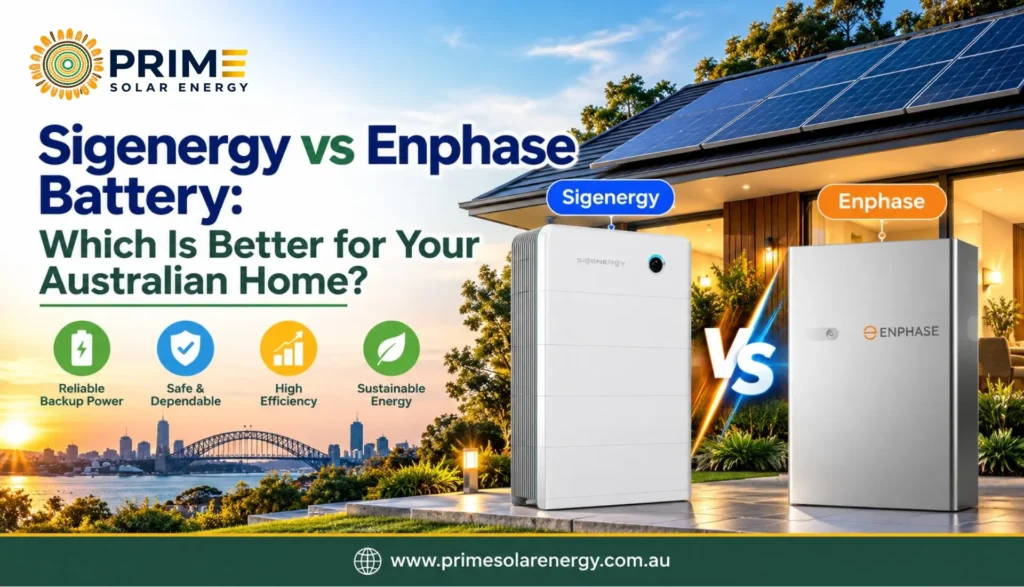
Picking a home battery gets much easier once you know how each system is built. This Sigenergy vs Enphase battery guide covers specs, warranty terms, and the real trade-offs for Australian homes.
Sigenergy uses a modular, high-voltage design that runs off its own hybrid inverter. Enphase takes a different route, placing microinverters inside every battery and keeping the DC side low voltage.
Below, we compare both side by side so you can decide which one suits your roof, your switchboard, and your plans for the next decade or two.
Sigenergy vs Enphase Battery: Company Overview
Sigenergy is a Chinese energy storage company that arrived in Australia in 2023 with the SigenStor, a modular platform that combines a hybrid inverter, battery modules, and energy management. Its local importer, Sigenergy Australia Pty Ltd, is based in North Sydney, and the brand has climbed the Australian sales charts quickly since launch.
Enphase Energy is a US company headquartered in Fremont, California, and best known for its microinverters. Its Australian arm, Enphase Energy Aust. Pty Ltd, is based in South Melbourne. Instead of one big inverter feeding a battery stack, each Enphase battery carries its own microinverters, so the whole system is AC-coupled.
That design split drives almost everything in this Sigenergy vs Enphase battery comparison, from how you expand the system to how long the warranty runs.
Sigenergy Battery 6.0 / 10.0 Specifications
The Sigenergy battery line uses 314Ah lithium iron phosphate cells in stackable modules, and the BAT 6.0 and BAT 10.0 are the newer sizes. These figures come from Sigenenergy’s datasheet.
| Specification | SigenStor BAT 6.0 | SigenStor BAT 10.0 |
| Battery chemistry | LiFePO₄ | LiFePO₄ |
| Cell capacity | 314 Ah | 314 Ah |
| Total energy capacity | 6.02 kWh | 9.04 kWh |
| Usable energy capacity | 5.84 kWh | 8.76 kWh |
| Max. charge/discharge power | 3,000 W | 4,600 W |
| Peak power (10 seconds) | 4,500 W | 6,900 W |
| Cycle life (cell manufacturer rating) | 10,000 | 10,000 |
| Weight | 62 kg | 78 kg |
| Dimensions (W / H / D) | 767 / 270 / 265 mm | 767 / 270 / 265 mm |
| Operating temperature | -20 to 55°C | -20 to 55°C |
| Ingress protection | IP66 | IP66 |
| Modules per controller | 1 to 6 | 1 to 6 |
| Product warranty | 10 years | 10 years |
See the official datasheet.
Two notes before moving on. Sigenergy asks owners to recharge the battery within seven days after a full discharge, and the power figures above depend on the controller you pair it with. Up to six modules can connect to one controller, which is how a system grows over time.
Enphase IQ Battery 5P Specifications
You may come across searches for Sigenergy Battery 6.0 / 10.0 vs Enphase IQ Battery 10T, but the 10T is sold in North America. Australian homes get the Enphase IQ Battery 5P, a single 5 kWh unit with six built-in microinverters. Two units give you roughly 10 kWh of usable storage.
| Specification | Enphase IQ Battery 5P (Australia) |
| Model number | IQBATTERY-5P-1P-ROW |
| Battery chemistry | Lithium iron phosphate (LFP) |
| Usable capacity | 5.0 kWh |
| Rated output power | 3.84 kVA |
| Peak output power | 7.68 kVA (3 seconds), 6.14 kVA (10 seconds) |
| Nominal voltage/frequency | 230 VAC / 50 Hz |
| Round-trip efficiency | 90% AC (at 50% power), 96% DC |
| Dimensions (H x W x D) | 980 x 550 x 188 mm |
| Weight | 66.3 kg lifting, 78.9 kg installed |
| Operating temperature (discharging) | -20 to 55°C |
| Enclosure | IP55 outdoor |
| Mounting | Wall or pedestal |
| Backup operation | Requires IQ System Controller 3 INT |
| Warranty | Up to 15 years or 6,000 cycles, above 60% capacity |
See the official datasheet.
Enphase also stresses that its batteries run on low-voltage DC. It says the IQ Battery range was the first microinverter-based storage system to meet the UL 9540A performance criteria for thermal runaway fire propagation in indoor wall-mounted installs.
Sigenergy vs Enphase Battery Comparison Table
Here’s how the two systems stack up on the points buyers ask about most.
| Feature | Sigenergy Battery 6.0 / 10.0 | Enphase IQ Battery 5P |
| Design | DC-coupled, high voltage, runs with a Sigenergy hybrid inverter | AC-coupled, low-voltage DC, microinverters inside |
| Chemistry | LiFePO₄ | LFP |
| Usable capacity per unit | 5.84 kWh / 8.76 kWh | 5.0 kWh |
| Power per unit | 3.0 kW / 4.6 kW continuous | 3.84 kVA continuous |
| Cycle life | 10,000 (cell rating) | 6,000 (warranty limit) |
| Warranty | 10 years, 70% usable energy or throughput limit | Up to 15 years, above 60% capacity |
| Ingress protection | IP66 | IP55 |
| Weight | 62 kg / 78 kg | 78.9 kg installed |
| Mounting | Floor-standing or wall-mounted | Wall or pedestal |
| Round-trip efficiency | Not listed on the datasheet | 90% AC, 96% DC |
Don’t read the power rows one for one. Sigenergy lists module-level figures, and total output depends on the controller, while Enphase lists output per unit.
Battery Lifespan and Cycle Life
On paper, 6,000 cycles at one cycle a day work out to about 16 years, and 10,000 cycles to roughly 27. The catch is that the two numbers don’t measure the same thing. Sigenergy’s 10,000 cycles is a cell manufacturer rating, tested at room temperature down to 60% state of health. Enphase’s 6,000 cycles is the limit written into its warranty. So any of these battery lifespan claims only holds up once you read the fine print.
The warranties give a clearer picture. Enphase covers its battery for up to 15 years or 6,000 cycles, whichever comes first, with more than 60% capacity retained. Sigenergy’s Australian warranty is 10 years with at least 70% usable energy, or a minimum throughput of 22.19 MWh for the BAT 6.0 and 33.29 MWh for the BAT 10.0. It also expects the system to stay online and cover drops to five years if it is disconnected for over a year.
Heat affects both. Sigenergy recommends 10 to 30°C for everyday operation, and Enphase lists 0 to 30°C as its optimum, so a shaded garage or south-facing wall is a smarter spot than a hot west wall.
Sigenergy vs Enphase Battery Pros and Cons
Sigenergy Battery
Pros
- Full 100% depth of discharge on usable capacity, with LiFePO₄ cells and an IP66 enclosure
- Modular growth, from one to six modules per controller
- High cell cycle rating of 10,000 cycles and five-layer battery protection
- Optional EV DC charging module within the same platform
Cons
- Works with Sigenergy’s own controllers and hybrid inverters, so adding it to existing solar may mean replacing your inverter
- Shorter 10-year warranty, with conditions around staying online
- Heavy modules at 62 kg and 78 kg
- In November 2025, the ACCC published a voluntary recall covering some single-phase 8, 10 and 12 kW Sigenergy energy controllers over AC plug overheating. It applies to the controller rather than the battery modules, and affected owners get a free replacement. Read the ACCC product safety recall notice if you’re considering a single-phase system.
Enphase Battery
Pros
- Longer 15-year warranty
- Low-voltage DC design with passive cooling and no fans
- Field-replaceable components and monitoring through the Enphase App
- Easy to expand in 5 kWh steps
Cons
- Only 5 kWh per unit, so bigger homes need several
- IP55 enclosure rather than IP66
- Backup needs the IQ System Controller 3 INT.
- Warranty capped at 6,000 cycles, and each unit weighs 78.9 kg installed
Which Is Better, Sigenergy or Enphase?
There’s no single winner, and any list of the best home battery Australia 2026 can offer will tell you the same. It comes down to your setup.
Sigenergy tends to suit homes building a new solar and battery system, especially those with big evening loads or plans for an EV charger. Enphase tends to suit homes that already run Enphase microinverters, owners who put the 15-year warranty first, and anyone who prefers low-voltage DC and wants to add storage in small steps.
Rebates apply either way. Under the Australian Government’s Cheaper Home Batteries Program, the battery must be on the Clean Energy Council-approved list and installed by an accredited installer, and it covers systems from 5 to 100 kWh nominal capacity. The discount calculation changed on 1 May 2026, so confirm current details before you sign.
The simplest way to compare is to get a quote for both systems based on your roof, switchboard, and daily usage.
Canberra and Sydney: Rebates and Local Considerations
In Canberra, the ACT Government’s Sustainable Household Scheme offers low-interest loans through partner Brighte. They can cover household battery storage and be repaid over up to 10 years, and the ACT Government says eligible Canberrans can pair a loan with the federal program.
Sydney and wider NSW households are in a different spot. The NSW Government has suspended its own battery installation incentive under the Peak Demand Reduction Scheme because it can’t be combined with the federal program, but it still offers an incentive for connecting a battery to a virtual power plant. The NSW Government battery page explains the details.
Both cities swing between cold mornings and hot afternoons, and both batteries are rated to operate from -20°C to 55°C, so placement and ventilation matter more than the rating. Prime Solar Energy works with Canberra and NSW homeowners and can explain how each scheme fits the battery you’re considering.
Frequently Asked Questions
Is Sigenergy better than Enphase?
Neither wins every category. Sigenergy offers more capacity per module and a built-in path to EV charging, while Enphase offers a longer 15-year warranty and a low-voltage design.
Which battery lasts longer?
Enphase’s warranty runs up to 15 years or 6,000 cycles, versus Sigenergy’s 10 years. Sigenergy’s 10,000-cycle figure is a cell rating, not a warranty promise.
Can I add more capacity later?
Yes, on both. Sigenergy supports one to six modules per controller, and Enphase says you can add more batteries as your energy needs grow.
Can Sydney households get a battery rebate?
Yes, through the federal Cheaper Home Batteries Program. For NSW-specific options, see the NSW Government guide to owning a battery.
Ready to Choose Your Battery?
Still weighing up Sigenergy vs Enphase battery options? Our team can match either system to your home, your usage, and your budget. Contact us for honest, no-pressure advice.