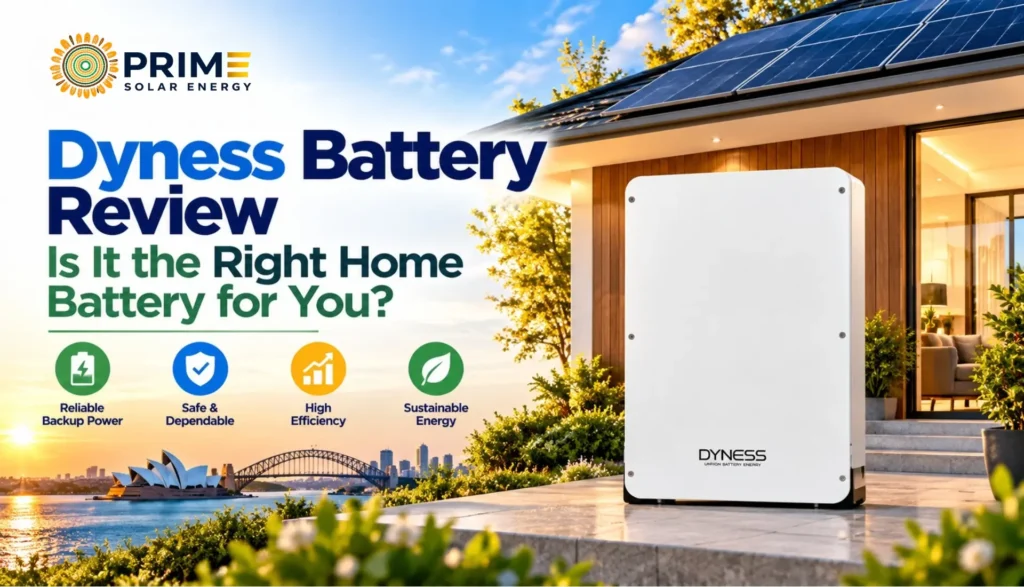
Not sure if a Dyness battery suits your home? In this Dyness Battery Review, we break down the Powerbox G2, Powerbox Pro, and Cygni, the three home models Dyness lists for Australian households.
We use official Australian datasheets and warranty terms, not marketing claims, so you can see what each model really delivers.
By the end, you will know which model, if any, belongs on your Canberra shortlist.
Company Overview: Who Is Dyness?
Dyness Digital Energy Technology Co., Ltd. was founded in 2017 and is headquartered in Suzhou, China. It says it has served more than 500,000 users in over 100 countries, across both residential and commercial storage. In Australia, products are imported by Dyness Aus Pty Ltd, as named in the Australian warranty terms. Dyness makes every model in China, and each uses lithium iron phosphate (LiFePO₄) chemistry. Dyness also offers its own Dyness Smart App for monitoring.
Dyness Battery Review Australia: Which Models Can You Buy?
The Powerbox G2 is a low-voltage battery with 10.24kWh per unit. It is only 165 mm deep, mounts on a wall or the floor, and up to 50 units can run in parallel.
The Powerbox Pro also stores 10.24kWh, but it uses a taller, narrower cabinet and carries a lower IP65 rating.
The Cygni is an all-in-one tower, sold as an 8kW or 10kW system. You stack two to four battery modules for 7.68kWh to 15.36kWh of usable energy. The hybrid version takes solar input directly, while the AC version has no PV input.
Dyness Battery Specification: Model by Model
Here is how the three compare in this Dyness Battery, taken from the Australian datasheets.
| Specification | Powerbox G2 | Powerbox Pro | Cygni (Hybrid / AC) |
| Type | Low-voltage battery | Low-voltage battery | All-in-one inverter and battery |
| Nominal energy | 10.24kWh | 10.24kWh | Not listed |
| Usable energy | 9.728kWh | 9.216kWh | 7.68–15.36kWh |
| Nominal voltage | 51.2V | 51.2V | 192–384V |
| Charge/discharge power | 5.12kW recommended, 10.24kW max discharge | 5.12kW | 7.68–11kW |
| Depth of discharge | 95% | 90% recommended | 95% |
| Cycle life | 8000 cycles or more | 6000 cycles or more | 8000 cycles or more |
| IP rating | IP66 | IP65 | IP66 |
| Weight | 99.7kg | 99.3kg | 113.2–193.7kg |
| Expansion | Up to 50 units | Up to 50 units | 2–4 modules |
| Connectivity | Built-in Wi-Fi, CAN/RS485 | Optional Wi-Fi, CAN/RS485 | Wi-Fi, Bluetooth, RS485 |
Powerbox cycle life is tested at 0.2°C and 25°C. The Powerbox datasheets also list CEC compliance, but always confirm your exact model on the Clean Energy Council approved battery list. The Clean Energy Regulator requires eligible systems to be listed before they can earn Small-Scale Technology Certificates.
Safety, Cold Weather and Power in Real Use
The strongest points in this battery are safety and cold-weather design. The G2 and Cygni both include a built-in aerosol fire extinguisher, and Dyness says the G2 detects and extinguishes a fire within five seconds.
Canberra frosts matter too. The G2 has a self-heating function and can discharge from -20°C to 55°C, although the datasheet lists charging at 0°C to 55°C. Ask your installer how it behaves on frosty mornings.
On power, the G2 can discharge at 1C, up to 10.24kW, with a 300A peak for two minutes. That helps when several household loads run at once.
Dyness Battery vs Other Batteries: What to Compare
When you weigh a Dyness battery vs other batteries, look past the headline kWh figure. This checklist keeps the comparison fair.
| Factor | Dyness (per datasheet) | Ask every brand |
| Usable energy | 9.728kWh from 10.24kWh nominal (G2) | Is the figure usable or nominal? |
| Cycle life | 8000 cycles or more at 0.2°C, 25°C (G2) | What are the test conditions and end-of-life point? |
| Protection | IP66 (G2), IP65 (Pro) | Is it rated for outdoor mounting? |
| Warranty | 10 years from the warranty start date (Pro, Australian terms) | What does it guarantee on capacity and throughput? |
| Expansion | Up to 50 parallel units | How much can you add later? |
The warranty wording above comes from the Powerbox Pro Australian terms. Check the terms for the model you are quoted, and ask whether installation details must be submitted to activate cover.
Rebates and Finance for Canberra and NSW Households
Incentives change often, so we have not listed amounts here. In the ACT, the Sustainable Household Scheme offers low-interest loans for household battery storage to eligible residents.
Across the border, NSW households can read the NSW Government battery page. It explains the Virtual Power Plant connection incentive and why the state’s installation discount was suspended once the federal Cheaper Home Batteries Program began.
Dyness Battery Installation: What to Expect
Dyness battery installation should always be done by an accredited installer. Each Powerbox weighs about 99kg, so the mounting surface and floor position need planning. The datasheets list compatibility with inverters from SMA, Victron, Solis, GoodWe, Growatt, Solplanet, and others.
The ACT Government’s household battery buyers guide is a handy checklist before you sign anything. If you are in Canberra, Prime Solar Energy can size the system around your home and usage.
How to Connect Dyness Battery to WiFi?
Start with the Dyness Smart App. Dyness says it lets you view and control the system remotely over Wi-Fi or 4G and connect over Bluetooth for live data and settings even without a network.
The Powerbox G2 has a built-in Wi-Fi module with app updates, the Powerbox Pro offers Wi-Fi as an option, and the Cygni includes Wi-Fi and Bluetooth. Most installers link the battery to your account and home network at commissioning, so keep your router details handy on the day. If you change your router later, follow the manual or ask your installer, rather than changing system settings yourself.
How to Reset Dyness Battery?
This is not a do-it-yourself job. Home batteries carry high currents, and the cover should stay closed. If the battery shows a fault, loses communication with the inverter, or has no output, note the model, photograph the indicator and label, and call your installer or Dyness Australia support.
Only use a reset or wake control if your installer showed you exactly how at handover. If you are unsure, contact us, and we will point you in the right direction.
Pros and Cons of Dyness Battery
Here is a quick summary of this Dyness battery.
Pros
- Long cycle life, 8000 cycles or more on the G2 and Cygni
- Slim G2 design with 95% depth of discharge
- IP66 rating on the G2 and Cygni for outdoor-friendly installs
- Built-in aerosol fire protection on the G2 and Cygni
- Scalable, with up to 50 Powerbox units in parallel
- Works with many popular inverters
- Ten-year warranty stated in the Australian terms (Pro)
Cons
- Made in China, which matters to some buyers
- Powerbox Pro has a lower IP65 rating and a 6000-cycle rating, with Wi-Fi optional.
- Datasheets carry no warranty details, so read the full terms.
- Each Powerbox weighs about 99kg and needs solid mounting.
- Cygni is a full system, not a drop-in battery.
Why Choose Prime Solar Energy?
Choosing a battery is easier with a local team that explains your options clearly. At Prime Solar Energy, we help Canberra households find a battery that fits their home, solar system, and daily use, not just the biggest number on a datasheet. We compare brands honestly, check inverter compatibility before you commit, and guide you through the rebates and finance options available in the ACT and NSW.
When you are ready, our accredited installers handle the installation properly, and we stay on hand to answer your questions afterwards. Ready to find the right battery? Get a quote today.
Final Verdict
So, is it right for you? Our Dyness Battery suggests the Powerbox G2 is the strongest all-rounder for Canberra homes with a compatible inverter. The Cygni suits households wanting an all-in-one system, and the Powerbox Pro is simpler if your installer already designs around it.
Demand is growing across the ACT. The ACT Government reports that batteries made up more than half of Sustainable Household Scheme loan applications this financial year. Ready to compare options? Get a quote, and we will help you choose.
FAQs
Is Dyness a good home battery brand?
The datasheets show LiFePO₄ cells, long cycle ratings, and built-in fire protection. Check installer support and warranty terms before deciding, as this Dyness Battery recommends for any brand.
How long is the Dyness battery warranty?
The Australian terms for the Powerbox Pro state ten years from the warranty start date. Confirm the terms for your exact model.
How many Dyness batteries can be connected?
Up to 50 Powerbox units in parallel, which reaches 512kWh. The Cygni takes two to four modules.
Can a Dyness battery be installed outdoors?
The G2 and Cygni are rated IP66, and the Pro is IP65. Your installer must still follow location rules for the site.
Does a Dyness battery work with my solar inverter?
The datasheets list SMA, Victron, Ingeteam, Solis, GoodWe, Growatt, Solplanet, Luxpower, Deye, and Apsystem, among others. Confirm your specific inverter model.
Is a Dyness battery eligible for rebates?
That depends on the Clean Energy Council listing, an accredited installer, and current program rules. Check the official pages before you commit.