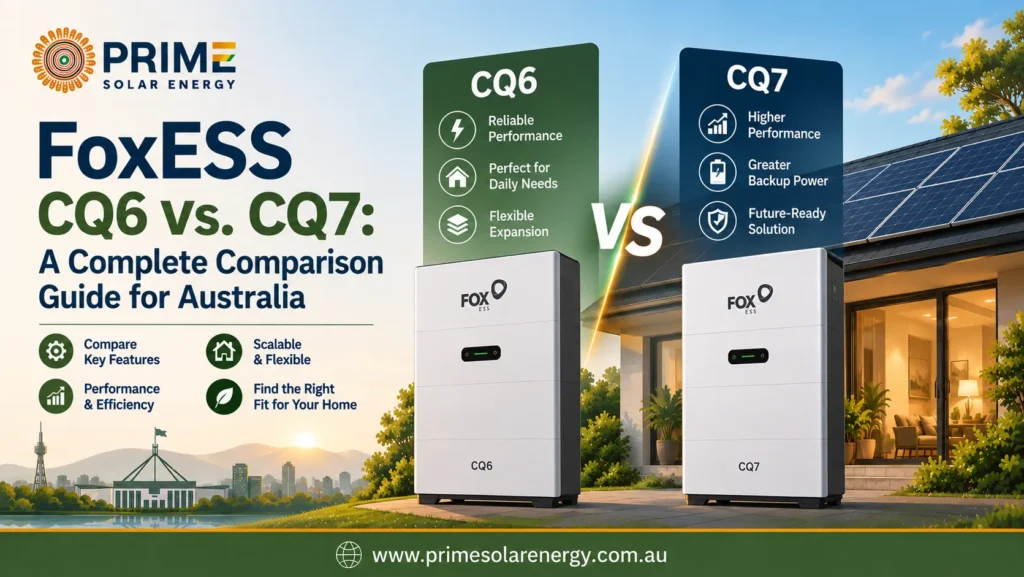
While FoxESS has quickly turned into a go-to name for Australian home energy storage, deciding between the CQ6 and CQ7 usually comes down to one big question: how much battery space do you actually need? Both systems run on the same reliable, stackable LFP tech with heavy-duty IP65 weatherproofing, but they handle energy density quite differently.
The CQ6 stays flexible and budget-friendly with 5.99 kWh building blocks. On the flip side, the CQ7 squeezes roughly 7.0 kWh into each layer, giving you way more storage capacity without taking up extra wall space.
In this guide, we break down their real-world performance, physical dimensions, warranty terms, and government rebate eligibility across NSW and the ACT—making your FoxESS CQ6 vs. CQ7 decision simple and straightforward for 2026.
Company Overview: The Rise of FoxESS
FoxESS is a globally recognized pioneer in high-voltage energy storage technology and smart solar inverters. Established in 2019, the company operates with the powerful industrial backing of Tsingshan Group—a Global Fortune 500 entity and the world’s largest producer of stainless steel and nickel. This parentage allows FoxESS to maintain full vertical integration, controlling the entire manufacturing chain from raw battery cell production and firmware architecture to precision quality testing. Known for its robust research and development structure, FoxESS engineers systems featuring advanced LFP cell chemistry, high round-trip efficiency, and heavy-duty IP65 enclosures built for maximum long-term durability.
FoxESS CQ6 vs. CQ7: Detailed Breakdown
When analyzing FoxESS CQ6 vs. CQ7 Australia installations, the core distinction rests on module capacity, spatial footprint, and overall power density. Both ranges utilize advanced, ultra-safe Lithium Iron Phosphate (LFP) cell chemistry, but they cater to slightly different consumption profiles and site configurations.
FoxESS CQ6 Overview
The CQ6 series is tailored for standard suburban residential homes looking for step-by-step modular expansion. Built around 5.99 kWh sub-units, the CQ6 allows homeowners to expand their battery bank as their household energy needs grow over time.
- FoxESS CQ6 specifications:
- Module Capacity: 5.99 kWh per stackable unit
- Scalable Range: 11.98 kWh up to 83.86 kWh total
- Continuous Power Output: Up to 10 kW depending on inverter pairing
- Enclosure Protection: IP65 weatherproof rating
- Round-Trip Efficiency: >95%
FoxESS CQ7 Overview
The CQ7 series is FoxESS’s high-density offering for larger households, properties with multiple electric vehicles, or light commercial settings. Utilizing roughly 7.0 kWh per module layer, it enables significantly higher total storage capacity within a smaller physical footprint.
- FoxESS CQ7 specifications:
- Module Capacity: ~7.0 kWh per stackable unit
- Scalable Range: 13.92 kWh up to 97.44 kWh total
- Depth of Discharge: 90%–100% usable capacity
- Enclosure Protection: IP65, outdoor-suited
- Round-Trip Efficiency: >95%
Detailed Specification Tables
Module-Level Comparison
| Specification Feature | FoxESS CQ6 Module | FoxESS CQ7 Module |
| Cell Chemistry | Lithium Iron Phosphate (LFP) | Lithium Iron Phosphate (LFP) |
| Single Module Energy | 5.99 kWh | ~7.0 kWh |
| Minimum System Size | 11.98 kWh (2 modules) | 13.92 kWh (2 modules) |
| Maximum Stack Capacity | 83.86 kWh | 97.44 kWh |
| Ingress Rating | IP65 | IP65 |
| Operating Temperature | -10°C to 55°C | -10°C to 55°C |
Here is the official Datasheet. You can check more details by visiting this Datasheet. FoxESS CQ6 Module & FoxESS CQ7 Module
Model Lineup & Capacity Profile
| System Profile | Total Storage Capacity | Incremental Steps | Recommended Application |
| FoxESS CQ6 Entry | 11.98 kWh | 5.99 kWh steps | Standard 3-4 Bedroom Homes |
| FoxESS CQ6 Max | 83.86 kWh | Multi-unit array | Rural Properties / Multi-Phase Homes |
| FoxESS CQ7 Entry | 13.92 kWh | ~7.0 kWh steps | High-Energy Homes / EV Owners |
| FoxESS CQ7 Max | 97.44 kWh | Multi-unit array | Commercial Sites / Microgrids |
Market Comparison: FoxESS vs. Tesla Powerwall 3 vs. Sigenergy SigStor
To understand how FoxESS stacks up against key competitors in the Australian market, we examined FoxESS vs. Tesla Powerwall 3 vs. Sigenergy SigStor.
| Feature / System | FoxESS CQ Series | Tesla Powerwall 3 | Sigenergy SigStor |
| Chemistry | LFP (Cobalt-Free) | LFP | LFP |
| System Architecture | Modular High-Voltage Stack | Integrated Unit | Modular Stack (5-8 kWh) |
| Max Scalability | Up to 97.44 kWh | Multi-unit installations | Up to 48 kWh per stack |
| Efficiency | >95% Round-Trip | ~90% Round-Trip | ~92% Round-Trip |
| Outdoor Suitability | IP65 Protection | IP67 Protection | IP66 Protection |
While Tesla provides an integrated all-in-one system, the FoxESS CQ series delivers far greater modular scaling capabilities and industry-leading efficiency. Sigenergy brings AI features, but FoxESS offers unmatched physical cell quality thanks to its Tsingshan supply chain integration.
Government Rebates and Compliance in NSW & ACT
Installing solar storage in Canberra or NSW allows homeowners to leverage valuable government initiatives and state energy incentives. Before finalizing your battery system design, it is important to review local standards and financial assistance programs. ACT residents can explore zero- to 3%-interest loan eligibility through the ACT Sustainable Household Scheme or check broader sustainability goals on the ACT Climate Choices portal. For NSW homeowners, energy savings options can be reviewed via NSW Climate & Energy Action, while installation compliance guidelines are outlined by NSW Fair Trading and grid safety rules can be confirmed through NSW Smart Energy.
Warranty & Local Australian Support
The FoxESS CQ series warranty Australia program provides a comprehensive 10 to 12-year product and performance guarantee. FoxESS promises at least 70% retained battery capacity at the end of the 10-year mark, supported by dedicated onshore technical support teams and established CEC-accredited distributor channels across Australia.
Pros and Cons of the FoxESS CQ Series
Pros:
- Flexible modular scalability reaching up to 97.44 kWh per stack array.
- Thermally stable, cobalt-free Lithium Iron Phosphate (LFP) technology.
- Outstanding >95% round-trip energy efficiency.
- Rugged IP65 weatherproof casing suited for harsh outdoor environments.
- Backed by a dependable 12-year manufacturer warranty.
Cons:
- Heavy modular units require two people for floor stacking and wall securing.
- Stack expansion requires strict matching of high-voltage controller units.
Which FoxESS Battery Is Right for Your Australian Home?
Choosing between the FoxESS CQ6 and CQ7 ultimately comes down to your household’s daily energy demand and available installation footprint. If you own a typical suburban home looking to store excess daytime solar for evening usage, the CQ6 provides a cost-effective, easily expandable modular path starting at 11.98 kWh. However, if your home runs heavy electrical loads—such as ducted air conditioning, heated swimming pools, or multiple electric vehicles—the higher energy density of the CQ7 gives you maximum storage power in a compact physical footprint. Both systems deliver robust safety, superior outdoor protection, and long-term grid independence for Australian conditions.
Final Verdict: FoxESS CQ6 vs. CQ7
Selecting the right FoxESS Battery model depends directly on your daily household consumption profile and expansion plans:
- Choose the FoxESS CQ6 if: You have a standard 3 to 4-bedroom home consuming 8 to 15 kWh per day. The 5.99 kWh module increments allow you to scale affordability without paying for unused baseline capacity upfront.
- Choose the FoxESS CQ7 if: You run energy-intensive appliances (like ducted HVAC or heated pools), charge electric vehicles, or require commercial/off-grid reliability. The ~7.0 kWh per-module density yields maximum kilowatt-hours per square meter of wall or floor space.
Ready to Upgrade Your Energy Storage?
Ready to protect your household from rising power prices and unexpected grid outages? Contact us today to consult with our solar design team, or click here to get a quote directly from our accredited installation experts at Prime Solar Energy.
Frequently Asked Questions (FAQ)
What is the primary difference between FoxESS CQ6 and CQ7?
The main difference is capacity density per module—CQ6 uses 5.99 kWh modules, while CQ7 uses ~7.0 kWh modules for higher total storage.
Is the FoxESS CQ Series suitable for outdoor installation in Australia?
Yes, the IP65 rating ensures complete protection against rain, dust, and harsh ambient temperature shifts.
How long is the FoxESS CQ series warranty in Australia?
It comes with a standard 12-year product and performance warranty guaranteeing at least 70% capacity retention at year 12.
Can I expand my FoxESS battery capacity later?
Yes, the plug-and-play, high-voltage modular design lets you add additional sub-modules as your power demands grow.
Are FoxESS batteries eligible for Australian government rebate schemes?
Yes, FoxESS batteries are CEC-approved, making them eligible for state programs like the ACT Sustainable Household Scheme.
Which hybrid inverters are compatible with the CQ series?
They integrate seamlessly with FoxESS single-phase and three-phase high-voltage hybrid inverters, as well as CEC-approved third-party HV units.
Is the FoxESS CQ Series suitable for installation in Canberra?
Yes, the IP65-rated CQ Series handles Canberra’s cold winters and hot summers well, with a wide operating temperature range that keeps performance stable across the city’s seasonal extremes.