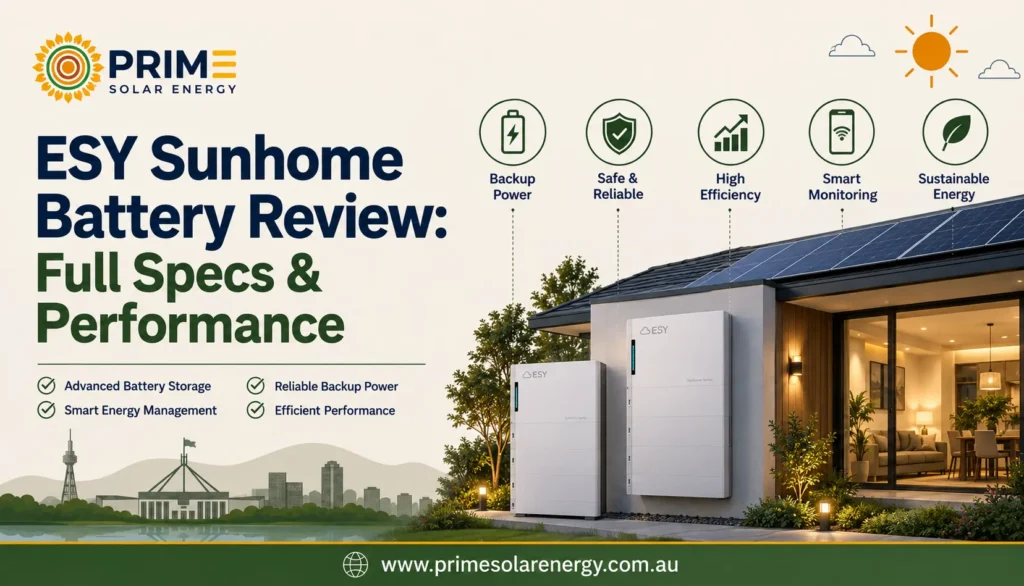
If you’re comparing home battery storage options in Canberra or across the ACT and southern NSW, chances are the ESY Sunhome battery has already come up with your installer. It’s a name spreading fast through the industry, but is it actually worth putting on your shortlist?
This ESY Sunhome Battery Review digs into where the brand comes from, what the HM6 platform really offers, and how it holds up next to established names like Sungrow and Fox ESS. We’ll get into the warranty fine print and Clean Energy Council approval too, since those details matter more than the glossy marketing pages let on.
By the end, you should have a straight answer to the question Canberra homeowners keep asking us: is the ESY Sunhome battery actually good enough for an Australian rooftop?
Company Overview: Who Is ESY Sunhome?
ESY Sunhome started in Shenzhen back in 2004, originally making batteries and battery management systems for smaller devices. It wasn’t until later that the company moved into residential energy storage and rolled out its flagship HM6 all-in-one home battery. In Australia, the brand trades as ESY Sunhome Australia Pty Ltd, run out of Greenacre in New South Wales, handling distribution, technical support, and warranty claims. Worth being upfront about one thing: compared to brands with a decade or more of local runway, ESY Sunhome is still a fairly recent arrival here. That doesn’t make it a bad option, but it’s context worth keeping in mind as you read through the specs below.
ESY Sunhome Battery Specifications
The HM6 series sits at the center of the ESY Sunhome lineup. It’s an all-in-one unit, meaning the hybrid inverter, battery modules, and control electronics all live inside a single enclosure rather than being sold as separate components. The chemistry is Lithium Iron Phosphate (LiFePO₄/LFP), which most installers will tell you is the safer, longer-lasting choice compared to older NMC batteries. Each unit is built from 5.12kWh modules that stack together, so households aren’t locked into one fixed capacity from day one.
| Specification | Detail |
| Chemistry | LiFePO₄ (LFP) |
| Module capacity | 5.12kWh per module |
| Max stack | 6 modules |
| Rated backup output | 6kW (6,000W / 6,000VA) |
| Inverter | Integrated hybrid, 2 MPPTs |
| Max solar input | Up to 8kW |
| Efficiency | Up to 97.8% (MPPT efficiency 99.9%) |
| Ingress protection | IP66 |
| Noise level | < 25 dB |
| Operating temperature | -25°C to +60°C (derates above 45°C) |
| Connectivity | Wi-Fi / Bluetooth, mobile app monitoring |
| Cycle life | 6,000+ cycles at 25°C |
Model-by-Model Specification Tables
Since the HM6 is modular, the capacity and physical footprint shift depending on how many modules go in. Here’s roughly how that plays out:
| Modules | Usable Capacity | Weight | Dimensions (single module) |
| 1 module | 5.12 kWh | 93 kg | 600 x 305 x 778 mm |
| 2 modules | 10.24 kWh | 186 kg | Stacked footprint |
| 3 modules | 15.36 kWh | 279 kg | Stacked footprint |
| 4 modules | 20.48 kWh | 372 kg | Stacked footprint |
| 6 modules (max) | 30.72kWh | Up to 558 kg (stack-dependent) | Stacked footprint |
Push it to a full six-module stack, and you’re looking at roughly 30.72kWh usable, which is plenty for a large household. Most Canberra homes we come across, though, land somewhere between 2 and 4 modules once actual daily usage is factored in.
Battery Capacity and Expandability
This is one of the more sensible parts of the ESY Sunhome design. Because everything’s built around individual 5.12kWh modules, you don’t have to guess your future energy needs and buy for them upfront. Start with what makes sense now, and if you add an EV charger or more solar panels later, extra modules can go in rather than replacing the whole system. ESY Sunhome has also mentioned a three-phase HM10 series with a bigger inverter, aimed at larger homes and light commercial jobs, but that range isn’t available or CEC-approved here yet. For a typical residential property, the single-phase HM6 range covers you comfortably, running from around 5kWh right up past 30kWh if you need it.
Backup Power and Performance
Blackout protection is usually top of mind for anyone shopping for a battery, and this is one area where ESY Sunhome doesn’t cut corners. The system is rated for up to 6 kW of backup output, generally enough to keep the essentials running when the grid drops: fridge, lights, and a few key circuits. Don’t expect to run the whole house as if nothing happened, though. Switching over to backup mode happens in milliseconds, so in practice most households barely notice the blip. One detail that stands out: the battery can keep charging from solar even during an outage, which is genuinely useful if the power’s out for a while and the sun’s still shining. How well backup actually performs comes down to system configuration and which circuits get wired in, so it’s worth a proper conversation with your installer rather than assuming.
Smart Monitoring and App Control
Day-to-day, the battery is run through a companion app on iOS and Android. It shows what’s charging, what’s discharging, and how the system’s tracking over time. There are a handful of operating modes built in—normal, off-grid, economic, and emergency—so the battery isn’t stuck running one generic setting regardless of what’s happening in the house. ESY Sunhome also pushes an AI-assisted mode that factors in usage patterns, weather forecasts, and time-of-use pricing to try to get more value out of stored solar. Firmware updates roll out over the same connection, and the system stays connected around the clock, which ties into a point we’ll get to shortly: the warranty actually requires that stable internet connection to stay valid.
CEC Approval and Safety
The HM6 series is Clean Energy Council approved for use here, which matters for two reasons. First, safety compliance. Second, and just as important for most buyers, only CEC-listed batteries installed by an accredited installer are eligible for the government rebates covered further down. On the safety side, the IP66 rating means it’s well sealed against dust and moisture, so it holds up fine whether it’s mounted indoors or in a more exposed spot like a Canberra carport.
ESY Sunhome Battery Warranty
The HM6 carries a 10-year product warranty, though it’s not quite “10 years and done.” Coverage is throughput-based: it runs for 10 years or until the battery has discharged a set amount of energy per module, whichever happens first. For most households cycling the battery roughly once a day, that threshold isn’t something you’ll come close to hitting early. The warranty also guarantees a minimum level of retained capacity for the whole coverage period. One thing to flag before signing anything: it requires a stable internet connection, and if yours drops out for an extended stretch, you’re expected to let ESY Sunhome know.
Government Rebates for Canberra & NSW Homeowners
Before locking in a quote, it’s worth checking what incentives are actually on the table. The ACT Government’s Home Batteries page covers how the Sustainable Household Scheme and Home Energy Support Program apply to eligible Canberra households, with a separate rebate pathway for pensioners and concession card holders worth checking too. On top of state-level support, the federal Cheaper Home Batteries Program run by the Clean Energy Regulator currently discounts eligible CEC-listed installations nationwide, with more detail on energy.gov.au. Just across the border in NSW, the battery installation and VPP incentive guide is the one to look at, since it rewards connecting your battery to a Virtual Power Plant. These programs shift fairly often, so it’s genuinely worth talking it through with your installer or reaching out to Prime Solar Energy directly before anything’s finalized.
ESY Sunhome Battery vs. Sungrow vs. Fox ESS
| Feature | ESY Sunhome (HM6) | Sungrow | Fox ESS |
| Chemistry | LFP | LFP | LFP |
| Design | All-in-one, modular | Modular, stackable | Modular, stackable |
| Australian track record | Newer entrant | Long-established | Established |
| CEC approved | Yes | Yes | Yes |
| Warranty | 10 years (throughput-based) | 10 years | 10 years |
| IP rating | IP66 | Varies by model | IP65 (typical) |
| Best suited for | Value-focused buyers wanting flexible sizing | Buyers wanting a longer local history | Buyers wanting broad installer familiarity |
Line them up side by side, and the specs aren’t wildly different. LFP chemistry and 10-year warranties are pretty much standard across this category now, so nobody’s winning on paper alone. What actually separates them is track record. Sungrow and Fox ESS have simply been installed in Australian homes for longer, and that counts for something. ESY Sunhome is still earning its stripes here.
Pros and Cons
Pros:
- Modular design means you size capacity to your actual usage, not a guess
- LFP chemistry brings strong thermal stability and a long cycle life
- IP66 rating handles both indoor and outdoor Canberra installs
- CEC approved, so current rebates are on the table
- App control with several operating modes to choose from
- Solid 6kW backup output with a near-instant switchover
Cons:
- Shorter local track record than the more established brands
- Warranty depends on a stable internet connection staying up
- Not much independent long-term data available yet
- The standard range is single-phase only, which won’t suit every larger home.
Is ESY Sunhome Battery Good? Our Verdict
So, is the ESY Sunhome battery good for an Australian rooftop? Going purely on specs, CEC approval, and warranty terms, yes, it holds up well, especially for households who like the idea of starting smaller and expanding later without switching brands entirely. Where it comes up a bit short is simply time. It hasn’t had the years in Australian homes that some competitors have, so the long-term performance picture is still filling in. If you’re comfortable backing a newer but well-specified brand, it’s a fair addition to your shortlist. If a long local track record matters more than anything else on this page, weigh it against the more established alternatives before deciding.
Final Thoughts
The ESY Sunhome battery brings a solid spec sheet to the Australian market: modular capacity, LFP chemistry, IP66 protection, decent app control, and a warranty that holds its own against the bigger names. If you’re in Canberra or nearby NSW and want a straight answer on whether it suits your household, the team at Prime Solar Energy can talk you through current model availability, installation, and which rebates you might qualify for. Contact us today or get a quote, and we’ll help you work out how an ESY Sunhome system stacks up for your situation.
Frequently Asked Questions (FAQ)
Is ESY Sunhome a CEC-approved battery in Australia?
Yes. The HM6 series carries Clean Energy Council approval, which is required to be eligible for the current government battery rebates.
How long is the ESY Sunhome battery warranty?
It’s a 10-year warranty, but it’s built around a minimum energy throughput per module rather than being a flat time period.
Can the ESY Sunhome battery be installed outdoors in Canberra?
Yes, its IP66 rating means it’s built to handle dust and moisture, so it’s suited to outdoor spots as well as indoor installs.
Is the ESY Sunhome battery good compared to the Sungrow or Fox ESS?
On paper, they’re closely matched: all three run LFP chemistry with 10-year warranties. The real difference is that Sungrow and Fox ESS have simply been on Australian roofs for longer.
Can I combine ACT and federal battery rebates?
In some cases, yes, ACT-specific support can be combined with the federal Cheaper Home Batteries Program, but eligibility comes down to individual circumstances. It’s worth checking the current criteria before applying rather than assuming.