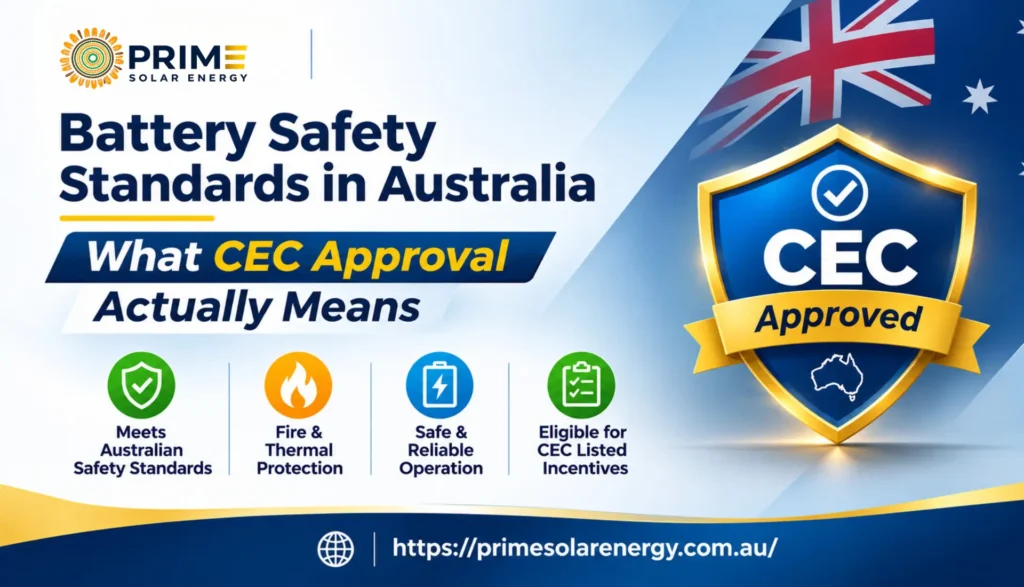
Battery Safety Standards in Australia help ensure solar batteries are safe to use, correctly installed, and suitable for Australian conditions. But when a battery is advertised as CEC-approved, what does that actually mean?
CEC approval confirms that a specific battery model meets the Clean Energy Council’s product-listing requirements. It does not guarantee that every installation is safe. For homeowners, understanding the difference between product approval and installation compliance is essential before choosing a solar battery.
What Does CEC Approval Actually Mean?
The Clean Energy Council (CEC) is responsible for the maintenance of Australia’s Approved Batteries List. Products are evaluated against the appropriate safety standards, testing and certification requirements, and other consumer protection conditions.
Manufacturers will need to submit supporting technical documentation as well as demonstrate compliance with the applicable product requirements to gain approval.
CEC approval indicates that:
- The listed battery model has met applicable product safety requirements.
- Relevant testing and certification evidence has been reviewed.
- The product meets the requirements for inclusion on the approved list.
- The battery may qualify for relevant government incentive programs, subject to other eligibility conditions.
However, CEC approval is not an installation certificate or a guarantee against battery failure.
The CEC administers the product approval process, while licensed electricians, accredited installers and electrical regulators have separate responsibilities for installation safety.
Battery Safety Standards in Australia: Key Requirements
Australian battery safety involves several standards covering equipment design, electrical protection and installation.
| Standard | What It Covers |
| AS/NZS 5139:2019, including Amendment 1:2025 | Battery installation safety, location, clearances and electrical protection. |
| AS/NZS 3000 | Electrical wiring and installation safety requirements. |
| SA TS 5398:2025 | Safety requirements for electrical energy storage equipment. |
| AS IEC 62619:2023 | Safety testing requirements for secondary lithium cells and batteries used in industrial and stationary applications. |
These standards serve different purposes. Meeting a battery product-testing standard alone does not establish compliance with Australian installation requirements.
Important Battery Safety Updates for 2026
Australia’s battery safety requirements have undergone significant updates.
- SA TS 5398 transition
Standards Australia published SA TS 5398:2025 in October 2025 to update the requirements previously established under the Battery Safety Guide.
According to the Clean Energy Council’s transition guidance:
- From 1 January 2026, battery applications can use SA TS 5398 or the existing Best Practice Guide.
- From 1 January 2027, new applications must use SA TS 5398.
- By 31 December 2027, remaining approvals based on the earlier guide will expire.
This is a phased transition, so a battery does not automatically lose its current approval simply because it was assessed under the earlier guide.
- AS/NZS 5139 Amendment 1:2025
Published in December 2025, this amendment clarifies installation requirements involving battery clearances, building materials, barriers and electrical protection.
The updated requirements are already mandatory in NSW.
CEC Approval vs SAA Installer Accreditation
CEC product approval and Solar Accreditation Australia (SAA) installer accreditation have different roles.
| CEC Approval | SAA Accreditation |
| Applies to specific battery and inverter products. | Applies to qualified individual installers and designers. |
| Confirms relevant product-listing requirements have been met. | Demonstrates competency in relevant solar or battery work. |
| Managed by the Clean Energy Council. | Managed by Solar Accreditation Australia. |
For eligible grid-connected battery installations, the installer needs the appropriate battery accreditation, not simply solar panel installation accreditation.
Homeowners can verify accreditation through the SAA installer status checker.
Does CEC Approval Guarantee a Safe Battery?
Whilst CEC approval offers significant product safety assurance, the quality of installation and condition of the product also have an impact on safety.
Even if the battery is approved, it can cause problems in the event that it is not installed, operated, or damaged within the manufacturer’s specifications.
Potential hazards include:
- Electrical faults or short circuits caused by incorrect wiring.
- Overheating from unsuitable installation locations.
- Fire risks associated with equipment faults or battery damage.
- Physical damage from vehicles, moisture or environmental exposure.
Modern battery systems are protected, but there are not all the possible risks removed.
Installation of the safe is dependent on approved equipment, proper system design, appropriate electrical protection, and conformance to Australian Standards.
How to Check if a Solar Battery Is CEC Approved
You can verify battery approval before accepting an installation quote.
Step 1: Open the official CEC list
Visit the Clean Energy Council Approved Batteries List.
Step 2: Search for the exact model
Check the manufacturer’s name and complete model number. A recognised brand does not mean every model it sells is approved.
Step 3: Check the listing status
Confirm that the product is currently approved and review its expiry date. Listings can be suspended, removed, or expire when certification requirements change.
Step 4: Verify the complete system
For modular batteries, check that the proposed configuration matches the approved listing. Also confirm that the associated inverter meets applicable approval requirements.
Step 5: Confirm installer accreditation
Ask for the responsible installer’s SAA accreditation number and verify the appropriate battery accreditation.
Keep the product information, installation certificate, warranty, and electrical compliance documentation for future reference.
What Safety Rules Apply During Battery Installation?
AS/NZS 5139 establishes requirements for installing battery systems used with power conversion equipment.
Important installation considerations include:
- Location: Batteries must not be installed in prohibited areas, and required separation distances from openings and exits must be maintained.
- Fire protection: Suitable non-combustible barriers or materials may be required, depending on the installation.
- Electrical protection: Appropriate isolation, overcurrent protection and safe wiring are essential.
- Environmental protection: Equipment must be protected against conditions such as excessive heat, moisture and physical damage.
- Labelling: Safety warnings and emergency shutdown information must be correctly provided.
In October 2026, Building Commission NSW specifically reminded installers that battery systems must be protected from direct sunlight and vermin.
Exact placement requirements depend on the battery type, configuration, and applicable standards. For more practical guidance, read our solar battery installation location guide.
Does CEC Approval Affect Solar Battery Rebates?
Yes. CEC product approval is a requirement for the federal Cheaper Home Batteries Program.
Under the program’s rules updated on 1 May 2026:
- The battery and applicable inverter must be on the relevant CEC-approved product lists.
- Installation must involve appropriately accredited SAA installers.
- Eligible systems must have 5–100 kWh of nominal battery capacity.
- Small-scale technology certificates (STCs) apply to a maximum of 50 kWh of usable capacity, with tiered support.
- The installation must meet relevant electrical safety and program requirements.
The battery must also be connected to an eligible solar PV system. Grid-only batteries are not eligible.
For grid-connected installations, VPP technical capability is another eligibility condition.
You can review the current requirements through the Australian Government’s battery eligibility guidance.
CEC approval alone does not guarantee a rebate. The entire installation must qualify.
Final Thoughts
Understanding Battery Safety Standards in Australia means looking beyond a CEC approval label. Product certification, compliant installation, and appropriate installer accreditation all matter.
Before purchasing, confirm the exact battery model, its current approval status, and the proposed installation arrangements.
For homeowners in Canberra and NSW, get a quote from Prime Solar Energy to explore suitable battery options, system compatibility, and installation requirements.
Frequently Asked Questions
Are all lithium batteries CEC approved?
No. Only battery models that are listed on the CEC Approved Batteries List have this approval. Look for the actual model, not the manufacturer’s brand name.
Can I install a battery that is not CEC approved?
Federal battery STC eligibility and electricity networks approval of equipment may be required. Obviously, an unlisted product is not necessarily illegal in every instance, but to install an unlisted product in any instance requires compliance with any applicable electrical safety and network requirements.
Can a battery lose its CEC approval?
Yes. A listing can expire, be suspended, or be removed due to certification issues, compliance concerns, or changes in product requirements. A later delisting does not necessarily mean an existing installation is unsafe; the specific reason should be checked.