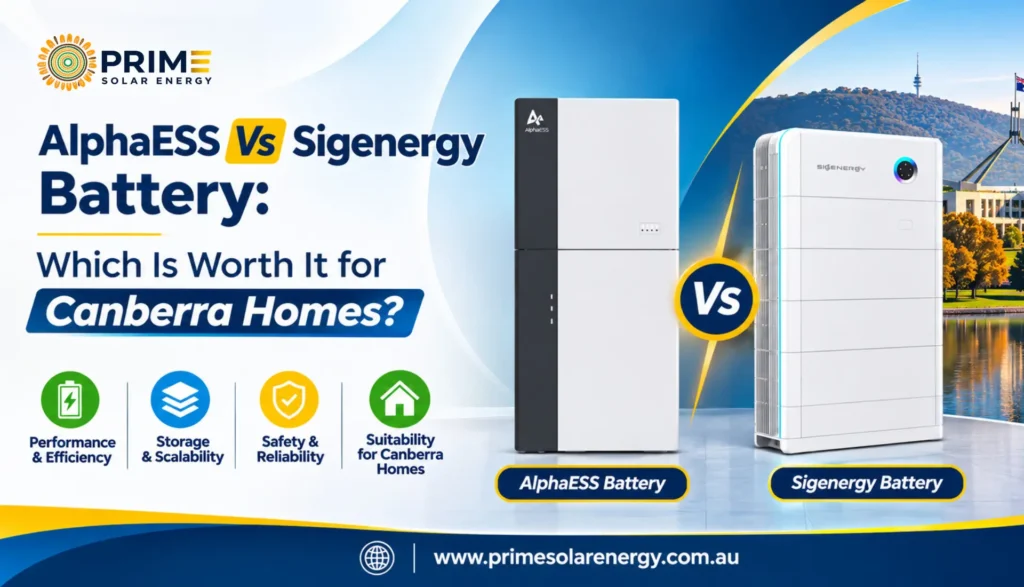
AlphaESS Vs Sigenergy Battery is the comparison we hear most from Canberra households who’ve already decided a battery makes sense. Both brands are well established in Australia, but they suit quite different homes.
AlphaESS keeps things simple: a 5 kW all-in-one with modular 10.1 kWh batteries. Sigenergy goes wider, bundling the solar inverter, battery, and optional EV charger into one platform.
The short version: pick AlphaESS for a straightforward, expandable home battery, and Sigenergy if you want three-phase support, EV charging, or a more integrated system.
Quick answer: AlphaESS is the simpler single-phase pick with built-in backup, while Sigenergy suits three-phase homes and EV owners. Both offer a 10-year, 70% warranty, so your power supply, backup needs, and installer decide.
Company Overview: AlphaESS and Sigenergy
About AlphaESS
AlphaESS has built energy storage since 2015, and its Australian arm, Alpha ESS Australia Pty Ltd, handles warranty and technical support from Chatswood, NSW. Its home range centers on the SMILE G3 series, plus the compact SMILE M series for tighter installs. The company says its systems work with more than 30 VPP programs, which matters because the federal battery program has its own VPP-related conditions. You can check them on the Clean Energy Regulator’s battery page before you commit to any model.
About Sigenergy
Sigenergy is the newer name here. The manufacturer is based in Shanghai, with Sigenergy Australia Pty Ltd handling local service from Sydney, and its Australian warranty covers installs from November 2023. Its SigenStor is a five-in-one system: solar inverter, EV DC charger, battery power conversion, battery pack, and energy management. Sigenergy builds it around 314Ah cells, quotes 100% usable depth of discharge, and rates the system IP66. The mySigen app handles monitoring and service requests.
AlphaESS Vs Sigenergy Battery Comparisons: Side by Side
This table compares the AlphaESS and Sigenergy battery ranges side by side, based on published specs for each brand’s home systems.
| Feature | AlphaESS Battery | Sigenergy Battery |
| Design | Hybrid all-in-one, plus an AC-coupled option for retrofits | Modular platform with separate battery packs and an energy controller |
| Power options | 5 kW single-phase | Single-phase 5 to 12 kW, three-phase 5 to 30 kW |
| Battery size | 10.1 kWh modules | Packs from 5.2 to 8.76 kWh usable |
| Expansion | Up to 60.5 kWh | Modular, stackable packs |
| Chemistry | Lithium iron phosphate | Lithium iron phosphate |
| Protection | IP65 | IP66 |
| Backup | Built-in changeover and switchover in about 20 ms | Via Sigen Energy Gateway |
| EV charging | Not built-in | Optional 25 kW DC charging module |
| Warranty | 10 years, 70% usable capacity | 10 years, 70% usable energy |
| Throughput limit | 3.12 MWh per usable kWh | About 3.05 MWh per usable kWh |
| Operating temperature (warranty) | -10°C to 50°C | -20°C to 55°C |
| Australian support | Chatswood, NSW | Sydney, NSW |
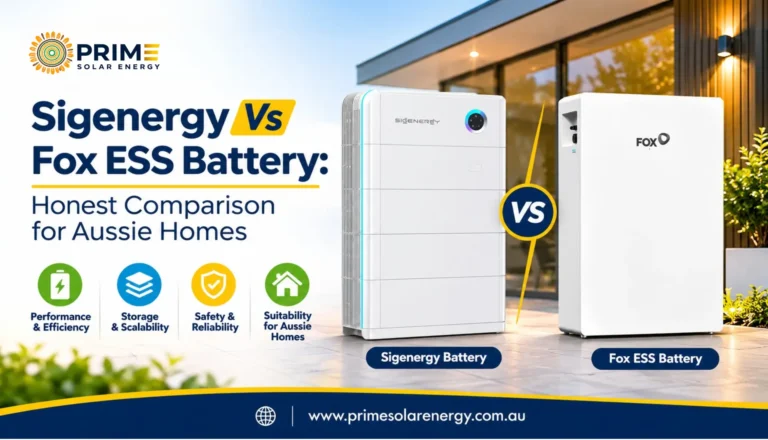
In the AlphaESS Vs Sigenergy Battery Australia debate, the table shows the real split. AlphaESS is a tidy, single-phase package. Sigenergy is a platform you build up around your home.
AlphaESS Vs Sigenergy Battery Warranty & Lifespan
On paper, the warranties look almost identical. Both promise 10 years and 70% of usable capacity, and both cap the guarantee with a throughput limit. The detail is where they differ.
AlphaESS’s current Australian warranty, dated October 2024, limits throughput to 3.12 MWh per kWh of usable capacity. Sigenergy’s works out at roughly 3.05 MWh per usable kWh (15.84 MWh across 5.2 kWh, or 23.77 MWh across 7.8 kWh). That’s a tiny gap, and for a normal household it takes well over a decade to reach either limit.
The bigger difference is the internet rule. Both brands expect your system to stay online. Sigenergy spells out that if it’s disconnected for over a year, the warranty drops to five years. AlphaESS requires a connection for monitoring and asks for an on-site inspection if a claim is made on an offline unit. Keep your Wi-Fi stable, and this won’t trouble you.
Backup Power, Safety, and Monitoring
When you weigh up AlphaESS Vs Sigenergy Battery, blackout protection deserves its own look. AlphaESS builds a changeover switch into its all-in-one systems, switches over in about 20 ms, and can run from both the grid and a diesel generator. It also places aerosol fire suppression inside the battery. Sigenergy handles backup through its Sigen Energy Gateway, supports generator connection, and adds five layers of battery protection.
Both brands also look after the grid side. AlphaESS says its systems work with more than 30 VPP programs, and Sigenergy uses AI-assisted energy planning with VPP scheduling. For day-to-day monitoring, AlphaESS uses its cloud platform, and Sigenergy uses the mySigen app, which is also where you lodge a warranty request.
Installation and Warranty Conditions to Know
The AlphaESS Vs Sigenergy Battery decision also depends on who installs it. Both warranties only apply when a qualified, certified installer commissions the system, so a shortcut on workmanship can void your cover.
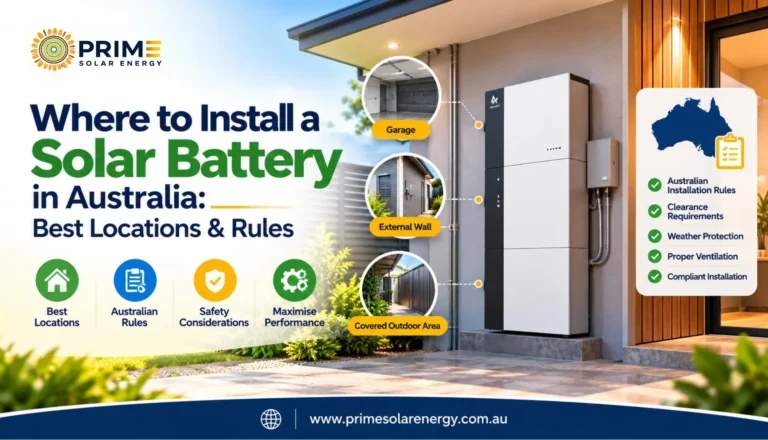
Placement matters in Canberra’s hot summers and frosty winters. AlphaESS excludes units exposed to direct sunlight and expects proper ventilation, while Sigenergy recommends a working temperature of 10°C to 30°C. A shaded, ventilated spot suits both.
Also keep the claim windows in mind. AlphaESS expects faults to be reported within ten working days and claims lodged within four weeks. Sigenergy asks for a claim within 30 days of the failure. Both may supply a refurbished unit as a warranty replacement.
Which Battery Is Better, AlphaESS Vs Sigenergy Battery?
Honestly, neither wins every time. It comes down to your house, your switchboard, and what you plan to plug in next.
Choose AlphaESS if
You’re on single-phase power, want a plain and reliable setup, and don’t need an EV charger tied into the battery. It also suits homeowners who’d rather start with one 10.1 kWh module and add more later. If you already have solar, its AC-coupled option is an easy retrofit.
Choose Sigenergy if
You have a three-phase supply, an EV, or plans for either. Because Sigenergy’s packs sit behind their own optimizers, you can add capacity down the track rather than guess your future needs today. If you’re comparing the best solar battery for Australian homes with bigger, busier energy use, this is where Sigenergy earns its place.
Whichever way you lean, size the battery to your evening usage, not to a rebate tier. The Cheaper Home Batteries Program overview on energy.gov.au explains how the federal scheme works. Canberra’s cold winter evenings also push heating load later into the night, so check how each battery storage system copes with that peak.
Rebates and Government Incentives for Canberra and NSW
The federal Cheaper Home Batteries Program is the main support available. It covers eligible systems from 5 kWh to 100 kWh nominal and supports step-downs in size and over time. Canberra households can also look at the ACT’s Sustainable Household Scheme, which offers low-interest loans for household batteries and works alongside the federal program. If you’re just over the border in NSW, note that the older state battery incentive can’t be combined with the federal one. The NSW Government’s battery page lays out what applies now.
Why Choose Prime Solar Energy
Prime Solar Energy is a Canberra-based installer working across the ACT and NSW. We install both brands, so our advice isn’t tied to one product. We’ll look at your switchboard, your usage, and your plans, then recommend the battery that fits. Ready to compare real options for your home? Get a quote today, or contact us with your questions.
Conclusion
The AlphaESS Vs Sigenergy Battery choice isn’t about one brand being better overall. AlphaESS is a dependable, modular single-phase system with a solid backup feature. Sigenergy is the stronger pick for three-phase homes, EV owners, and anyone planning to grow their system. Both carry a 10-year, 70% warranty, so the decision rests on how you live and what your property needs.
Frequently Asked Questions
Is AlphaESS or Sigenergy better for a Canberra home?
It depends on your supply and plans. AlphaESS suits single-phase homes wanting a simple battery, while Sigenergy suits three-phase homes or households adding an EV charger.
Do both batteries have the same warranty?
Both offer 10 years and 70% usable capacity. AlphaESS’s limit is 3.12 MWh per usable kWh, and Sigenergy’s is roughly 3.05 MWh.
Can I add more capacity later?
Yes. AlphaESS G3 systems expand up to 60.5 kWh, and SigenStor uses modular, stackable packs.
Do I need to keep the battery online?
Yes. Sigenergy’s warranty drops to five years if the system is offline for over a year, and AlphaESS expects a connection for monitoring and claims.
Can I claim the federal rebate on either battery?
Eligibility depends on the specific model, installer, and current program rules. Check the Clean Energy Regulator and ask your installer to confirm before you buy.