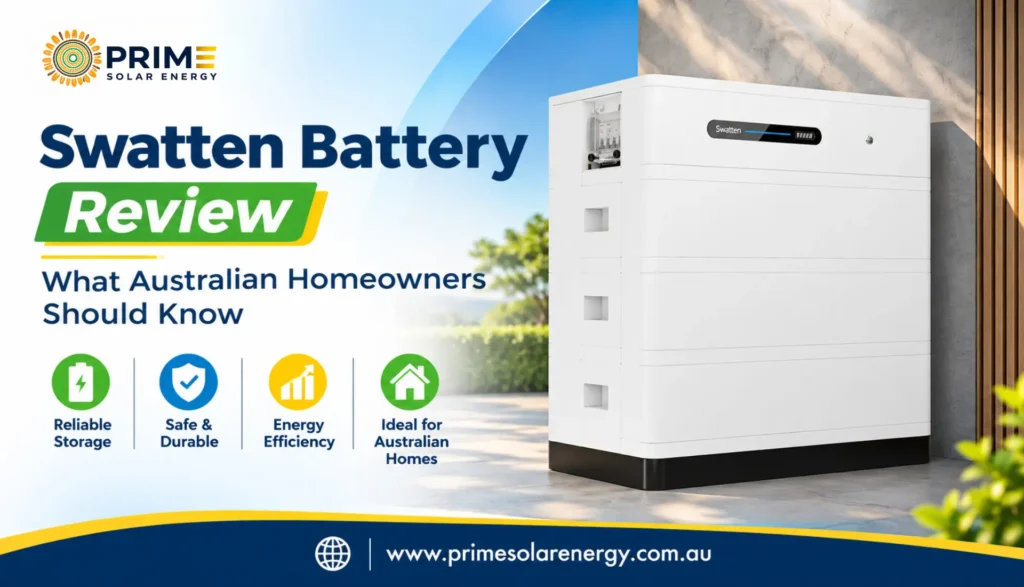
This Swatten Battery Review looks at the F1 Series stackable battery from Swatten, a brand that is still fairly new on Australian roofs.
If you live in Canberra or anywhere in NSW, you may have spotted the name on a solar quote and wondered how it compares with the brands you already know.
Below you’ll find the specs, warranty, app details, a side-by-side with Fox ESS, and an honest list of pros and cons.
Quick Verdict: The Swatten F1 is a well-specified, modular LFP battery with a 10-year warranty, IP65 protection, and sizes from 9.6 kWh to 25.6 kWh. The trade-off is a short track record in Australia, so your installer’s quality and after-sales support matter as much as the hardware itself.
Company Overview of Swatten Battery
Swatten is the energy storage brand of Shanghai Sieyuan Watten Technology, which is part of the power equipment group Sieyuan Electric. The company showcased its residential and commercial range at Smart Energy 2026 in Sydney, highlighting a four-layer safety design that includes fire suppression inside each battery module.
Swatten Battery Review: Specifications at a Glance
The F1 Series is a stackable battery. You pick the number of modules (3 to 8) to get the capacity you need.
| Specification | F1 Stackable Battery |
| Models | SieB-H9600-F to SieB-H25K6-F (3 to 8 modules) |
| Technology | LFP (LiFePO₄), 64V 50Ah modules |
| Capacity | 9.6–25.6 kWh nominal, 8.64–23.04 kWh usable |
| Max power | 5.76–15.36 kW continuous |
| Efficiency | Not stated in the datasheet |
| Voltage | 192–512 V nominal |
| Protection rating | IP65, indoor or outdoor |
| Size and weight | Module 615×360×175 mm, 35 kg; systems 120–295 kg |
| Operating temperature | Charge 0–50°C, discharge -20–50°C. |
| Communication | CAN / RS485 |
| Warranty/life | 10 years, 6,000 cycles |
| Standards | IEC 62619, IEC 61000-6-1/3, UN38.3, RoHS, REACH |
Official datasheet: F1 Stackable BESS (PDF)
A few things stand out. Each module weighs 35 kg, so an installer can lift one without heavy gear. The battery also passed a 1,000-hour salt spray test, which is a good sign for coastal homes. Usable energy is about 90% of nominal, so a 9.6 kWh system gives you 8.64 kWh in practice. Power output can also drop with temperature, charge level, and humidity, so treat the kW figures as maximums rather than everyday numbers. And whichever battery you pick, check that the exact model on your quote appears on the Clean Energy Regulator’s battery page requirements, because your eligibility for the federal discount depends on it.
Swatten Battery App: Monitoring From Your Phone
The Swatten battery app gives you live monitoring, instant alerts, and a view of your savings. In everyday terms, you can see how much solar went into the battery and how much power you still pulled from the grid. App quality varies a lot from brand to brand, so ask your installer for a live demo before you commit.
Swatten Battery Warranty and Lifespan
The datasheet lists a 10-year warranty and a 6,000-cycle life. At one full cycle a day, that’s well over 16 years on paper. In real homes, though, lifespan depends on temperature, how deeply you cycle the battery, and how you use it.
The actual warranty terms are in Swatten’s SieB-H-F Limited Warranty letter. Before you sign, ask your installer for a copy and check three things: how much capacity the battery must still hold at the end of the term, whether there’s a cap on total energy throughput, and who handles claims locally. In Australia, a warranty is only as good as the company that services it.
Swatten Battery Vs Fox ESS: Head-to-Head Comparison
Fox ESS is the obvious comparison. It’s well established here, and its EQ4800 is also a stackable, high-voltage LFP battery.
| Feature | Swatten F1 | Fox ESS EQ4800 |
| Chemistry | LFP | LFP |
| Module size | 3.2 kWh | 4.66 kWh |
| Capacity range | 9.6–25.6 kWh | Scalable to 41.93 kWh |
| Modules per stack | 3–8 | Up to 9 in series |
| Usable capacity | About 90% of nominal | 100% depth of discharge |
| IP rating | IP65 | IP65 |
| Warranty | 10 years | 10 years |
| Local track record | Emerging brand | Well established |
The biggest difference is scale. Fox ESS reaches a larger stack with bigger modules and quotes full usable capacity. Swatten answers with lighter modules and its module-level safety design. Honestly, 25.6 kWh is more storage than most households will ever need, so the deciding factor usually comes down to installer support and who stands behind the warranty. Demand is strong either way: the ACT Government says battery systems now make up just over half of Sustainable Household Scheme loan applications. Fox ESS also sells a newer CQ series, so check its current range before comparing like for like.
Rebates and Incentives in Canberra and NSW
Incentives change often, so confirm everything on the official pages before you buy. The federal Cheaper Home Batteries Program began on 1 July 2025 and was reworked from 1 May 2026. Support is now tiered by battery size and steps down each January and July through to 2030. In NSW, the state’s own battery installation discount is no longer available, but the government’s The Virtual Power Plant incentive can be combined with the federal program. Canberra households can also look at the ACT’s Sustainable Household Scheme, which offers low-interest loans for home batteries.
Why Choose Prime Solar Energy
A battery is a long-term purchase, and the advice behind it matters as much as the product. Prime Solar Energy focuses on home batteries and solar for Australian households, and its guides compare brands such as Fox ESS, GoodWe, and Growatt in plain language, so you can see the differences before you commit.
Here’s what that means in practice:
- Honest comparisons. You get a clear look at capacity, warranty, and limitations, not just the highlights.
- Right-sized systems. The team looks at your usage and your solar setup, so you don’t pay for storage you won’t use.
- Rebate checks. Eligibility depends on the specific battery and installation, so it’s worth confirming before you sign.
- Straightforward quotes. Ask questions in plain English and expect plain answers.
If you’re weighing up Swatten against other options, you can get a quote or contact us, or call 1300 899 294 to talk it through.
Pros and Cons of the Swatten Battery
Pros
- LFP chemistry, known for stable and long-lasting performance
- 10-year warranty and 6,000-cycle rating
- Lightweight 35 kg modules make installation easier
- IP65 rating and salt spray testing suit harsh conditions
- Flexible sizing from 9.6 kWh to 25.6 kWh
- Fire suppression and fault isolation at module level
- App with live monitoring and alerts
Cons
- Short track record in Australia compared with established brands
- Usable capacity is about 90% of nominal
- Maximum stack is smaller than some rivals
- Round-trip efficiency isn’t published on the datasheet
Is the Swatten Battery Good for Australian Homeowners?
For the right home, yes. If you want a modular LFP battery with a solid warranty on paper, light modules that are easy to install, and a serious approach to safety, the F1 ticks those boxes.
If you want the largest possible stack, or you’d rather stick with a brand that has a long local history, Fox ESS or a similar system may suit you better. Canberra homeowners should also check how the ACT Sustainable Household Scheme could help finance the system. Whichever way you lean, choose an installer who’ll still be around to honor the warranty. Ready to compare options? Get a quote, and we’ll size a system for your home.
Frequently Asked Questions
Is the Swatten battery any good?
It’s a modular LFP battery with a 10-year warranty, an IP65 rating, and a safety-focused design. Its main weakness is a shorter Australian track record than some competitors.
What sizes does the Swatten battery come in?
The F1 Series runs from 9.6 kWh (3 modules) to 25.6 kWh (8 modules) in 3.2 kWh steps.
How long does a Swatten battery last?
It’s rated for 6,000 cycles with a 10-year warranty. Real-world life depends on how you use it and the temperature it lives in.
Can I monitor it from my phone?
Yes. The Swatten app shows live data, instant alerts, and your savings.
Can I get a rebate in NSW or Canberra?
Federal support comes through the Cheaper Home Batteries Program, and ACT residents can also use the Sustainable Household Scheme. NSW offers a VPP incentive. Rules change, so check the official pages.