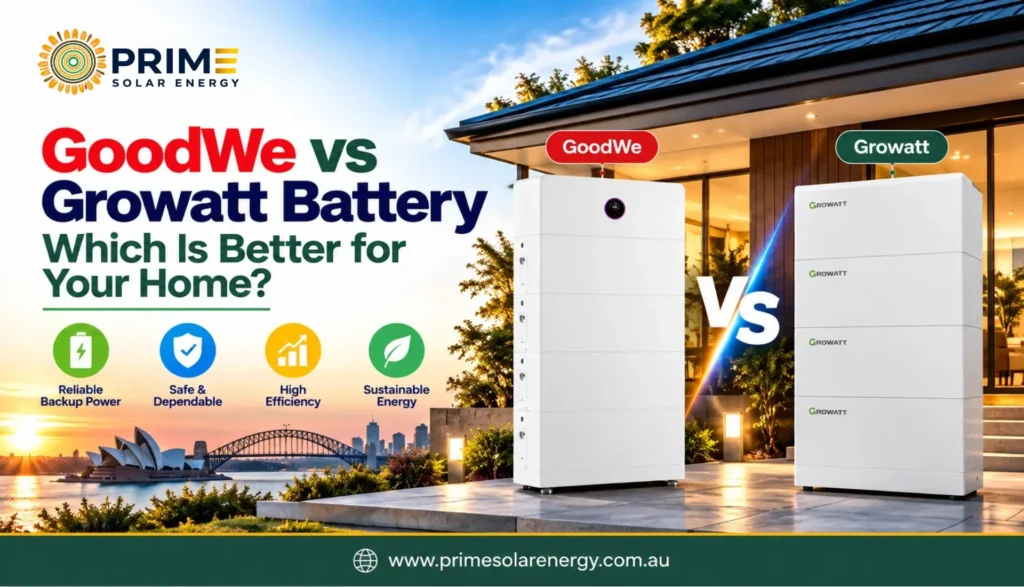
Choosing between GoodWe vs Growatt Battery systems is less about finding a winner and more about matching the battery to your home.
Both brands use lithium iron phosphate (LFP) cells and offer 10-year warranties across their Australian battery ranges, though the exact terms vary by model. The real differences sit in voltage options, published cycle life, and inverter pairing, so we have checked the latest Australian datasheets with Canberra and NSW homes in mind.
GoodWe and Growatt Company Overview
GoodWe
GoodWe was founded in Suzhou, China, in 2010 and has had an office in Australia since 2012. The company was listed on the Shanghai Stock Exchange in 2020 and now makes inverters, batteries, EV chargers, and energy management software for homes and businesses.
Growatt
Growatt was founded in Shenzhen, China, in 2011 and has been active in the Australian market for more than 15 years. It is one of the longer-established inverter brands here, and it now supplies inverters, battery storage, and EV chargers in over 180 countries.
GoodWe vs Growatt Battery Comparison at a Glance
Before the model details, here is the quick view. One rule applies to both brands: to qualify for the federal discount, the battery and inverter must be on the Clean Energy Council approved list, and the final configuration must match the approved listing. The Cheaper Home Batteries Program applies to systems from 5 kWh to 100 kWh nominal capacity, but the discount only covers the first 50 kWh of usable capacity. Since 1 May 2026, the discount also tapers as battery size increases.
| Feature | GoodWe | Growatt |
| Cell chemistry | LFP | LFP (cobalt-free) |
| Ranges covered | ESA (HV all-in-one), Lynx Home U (LV), Lynx Home F Plus (HV), Lynx F G2 (HV) | ALP E1 and E2 (LV), APX S0 (HV single phase), APX S2 (HV three phase) |
| Capacity range | Lynx U 5.4 to 32.4 kWh; Lynx F Plus 6.55 to 16.4 kWh; Lynx F G2 6.4 to 28.8 kWh; ESA up to 48 kWh single phase (108 kWh three-phase) | ALP 5 to 50 kWh; APX 5 to 30 kWh per stack |
| Protection rating | IP66 (ESA), IP65 (Lynx U), IP55 (Lynx F ranges) | IP66 on all four |
| Warranty | 10 years (confirm exact terms for your model) | 10 years on all four |
| Published cycle life | At least 8,000 to 10,000 (ESA), over 4,000 (Lynx F G2) | Not stated on the AU datasheets |
| Mixing old and new modules | ESA | APX |
GoodWe Battery Models and Specifications
The GoodWe battery lineup is broader, with both low-voltage and high-voltage options. The ESA is the all-in-one choice, while the Lynx ranges are battery-only and pair with GoodWe inverters.
| Specification | ESA (single-phase, all-in-one HV) | Lynx Home U (LV) | Lynx Home F Plus (HV) | Lynx F G2 (HV) |
| Capacity | Modules of 5.12 / 8.32 kWh (G20, G21) and 6.0 / 9.0 kWh | 5.4 to 32.4 kWh (1 to 6 units) | 6.55 to 16.4 kWh (3.27 kWh modules) | 6.4 to 28.8 kWh (3.2 kWh modules) |
| Nominal voltage | 350 to 550 V range | 51.2 V | 204.8 to 512 V | 128 to 576 V |
| Power | Inverter sizes range from 3 kW to 9,999 kW. | 2.56 kW (one unit), 5.12 kW (two or more) | 6.1 to 15.3 kW | 4.48 to 20.16 kW nominal |
| Backup | 63. A bypass, switching under 4 ms | Not listed | Not listed | Not listed |
| Round-trip efficiency | Not listed | Not listed | Not listed | 94% |
| Cycle life | At least 8,000 (10,000 on 6.0 and 9.0 kWh modules) | Not listed | Not listed | Over 4,000 |
| Protection | IP66 | IP65 | IP55 | IP55 |
| Warranty | 10 years (confirm terms) | 10 years | 10 years of performance and product | 10 years (confirm terms) |
View the GoodWe ESA, Lynx Home U, Lynx Home F, and Lynx F G2 battery datasheets.
Growatt Battery Models and Specifications
The Growatt battery range is simpler: one low-voltage family and one high-voltage family, all IP66 and all rated for 100% depth of discharge.
| Specification | ALP 5.0L-E1 (LV) | ALP 5.0L-E2 (LV) | APX 5.0-30.0P-S0 (HV, single phase) | APX 5.0-30.0P-S2 (HV, three-phase) |
| Capacity | 5 to 50 kWh, up to 10 in parallel | 5 to 50 kWh, up to 10 in parallel | 5 to 30 kWh (5 kWh modules) | 5 to 30 kWh per stack |
| Nominal voltage | 51.2 V | Not listed | 450 V (380 to 550 V) | 650 V (600 to 980 V) |
| Power | 3.5 kW (5 kWh unit); 5 kW rated, 6.2 kW max (10 kWh and up) | 3.5 kW (5 kWh unit); 6.5 kW (10 kWh and up) | 2.5 kW (5 kWh) up to 6.2 kW (15 kWh and up) | 2.5 kW (5 kWh) up to 15 kW (30 kWh) |
| Current | 100 A rated, 125 A max | 130 A rated, 150 A max | Not listed | Not listed |
| Compatible inverters | Not listed | Not listed | MIN 2500-6000 TL-XH | MOD, MID, and HU three-phase series |
| Extras | None listed | Heating film and aerosol fire suppression | None listed | None listed |
| Protection | IP66 | IP66 | IP66 | IP66 |
| Warranty | 10 years | 10 years | 10 years | 10 years |
View the Growatt ALP 5.0L-E1, ALP 5.0L-E2, APX 5.0-30.0P-S0 & APX 5.0-30.0P-S2 battery datasheets.
Battery Lifespan and Cycle Life: Which Battery Lasts Longer, GoodWe or Growatt?
This is the question most people ask, and the honest answer is that the paperwork only partly settles it. On GoodWe vs Growatt battery warranty and cycle life, GoodWe publishes more: the ESA batteries list at least 8,000 cycles (10,000 on the 6.0 and 9.0 kWh modules), and the Lynx F G2 lists over 4,000 cycles tested to 80% end of life.
Growatt’s Australian datasheets give a 10-year warranty but no cycle figure, so we would not quote one. Ask for the full warranty document, because throughput and capacity-retention terms decide real-world battery lifespan and cycle life more than any headline number. The ACT’s household battery buyers guide is a useful independent checklist for these questions.
GoodWe vs Growatt Battery Performance
On power, Growatt’s ALP E2 delivers up to 6.5 kW from 10 kWh upward, a little more than the 5.12 kW ceiling of the Lynx Home U. For larger three-phase homes, the APX S2 reaches 15 kW at 30 kWh, while the Lynx F G2 stretches to 20.16 kW nominal at nine modules, though a single stack paired with an EH inverter is capped at 19.2 kWh.
Backup is where the GoodWe ESA stands out, with a 63 A whole-home bypass and sub-4 ms switching. Cold also matters in Canberra. The ALP E2 has an integrated heating film, and GoodWe’s heated ESA modules charge down to minus 18 to minus 20 degrees, while the G21 variant charges from 2 degrees upward, so check which version is quoted.
Pros and Cons
GoodWe Battery
Pros:
- Wide choice across LV and HV
- Published cycle life
- All-in-one ESA with strong backup
- Mixes old and new batteries on ESA
Cons:
- Lynx F ranges are IP55 (outdoor-capable but lower than IP66)
- Lynx U tops out at 32.4 kWh
- Some datasheets are older
Growatt Battery
Pros:
- IP66 across the range
- Large LV scalability to 50 kWh
- Module-level optimization with mixed old and new modules on APX
- 10-year warranty on every model
Cons:
- No cycle life on the AU datasheets
- APX modules are 50 kg each
- Battery-only systems need a compatible Growatt inverter
Best Home Battery Australia: Rebates and Finance for Canberra and NSW
The best home battery Australia has to offer is the one you can actually finance and install properly. In the ACT, the Sustainable Household Scheme provides low-interest loans for household battery storage, with eligibility rules set by the ACT government. In NSW, the Home Energy Saver program offers zero-interest loans for eligible upgrades, including batteries, subject to income limits.
Because rules change often, confirm current eligibility on those pages before you commit. If you want a second pair of eyes, get a quote, and we will check your setup against both schemes.
About Prime Solar Energy
We are Prime Solar Energy, a Canberra-based business that has been working across the ACT and surrounding areas since 2021, with an additional office in Smithfield, NSW. Our work covers solar and batteries, EV chargers, heat pumps, air conditioning and switchboard upgrades, using Tier 1 components and an in-house team.
Batteries are where most of our questions come from lately, and two brands come up again and again: GoodWe and Growatt. This guide is our plain-English take, built only on manufacturer datasheets, so you can compare properly before you speak to anyone.
FAQs
Which is better, GoodWe or Growatt?
Neither wins outright. GoodWe suits homes that want an all-in-one system or published cycle data, while Growatt suits those who want IP66 protection and high-capacity low-voltage stacking.
Do both qualify for the federal battery discount?
Only if your exact battery and inverter combination is on the Clean Energy Council approved list and installed as listed.
Can I mix old and new modules?
Growatt APX and GoodWe ESA both advertise it, but confirm limits with your installer.
Are they suitable for Canberra winters?
Yes, with the right variant. Look for integrated heating and check the charging temperature range.
Can I use a GoodWe or Growatt battery with any solar inverter?
Not usually. GoodWe’s Lynx batteries are battery-only and pair with GoodWe inverters, while Growatt’s APX and ALP batteries need a compatible Growatt inverter. The GoodWe ESA avoids the pairing question because the inverter and battery come as one system.
Can I install these batteries outdoors?
Growatt’s four ranges and the GoodWe ESA are IP66 rated, while the Lynx Home U is IP65 and the Lynx F ranges are IP55. Even so, a sheltered position is usually best, so ask your installer which location suits your home.
Where can I ask a specific question?
Please contact us, and we will help.
Final Verdict
In the GoodWe vs Growatt Battery decision, choose GoodWe for an all-in-one system or published cycle data, and Growatt for IP66 and flexible stacking. Either way, the installation quality and the approved configuration matter most. Ready to compare real options for your home? Get a quote from Prime Solar Energy today.