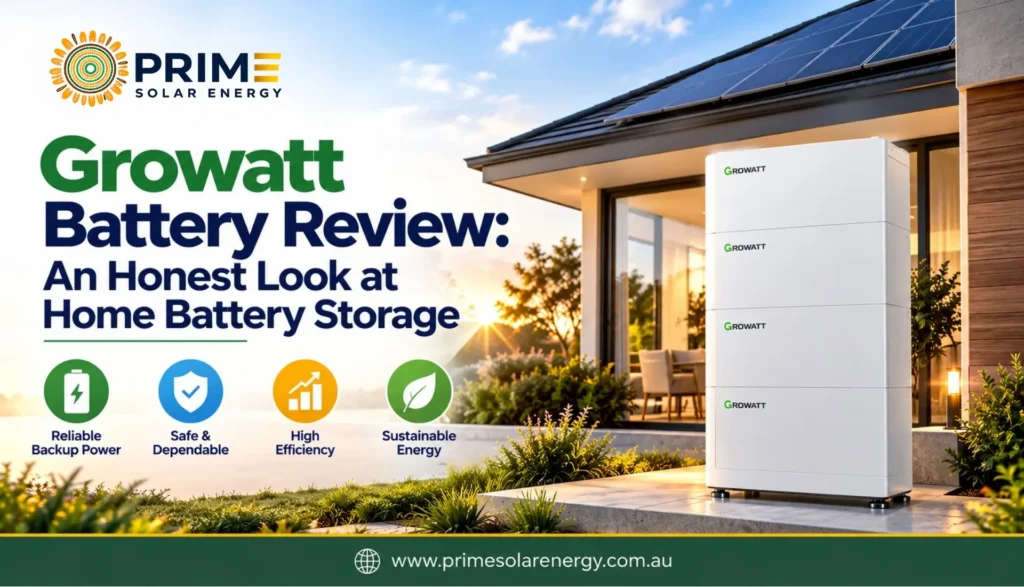
Growatt offers Australian households two battery systems: the high-voltage APX HV (S0/S2 AU) and the low-voltage ALP LV (E1/E2 AU). This Growatt Battery Review assesses both against the manufacturer’s current datasheets. Each system is built on cobalt-free LFP cells, housed in an IP66 enclosure and backed by a 10-year warranty.
Capacity scales from 5kWh to 30kWh on the APX and up to 50kWh on the ALP. Compatibility is tightly defined, though: each range works only with specific Growatt inverters, so your inverter and phase matter as much as the storage size you choose.
If you’re weighing up a Growatt battery for your home, this review will help you work out which system fits and what to check before you commit.
Who Is Growatt? A Quick Company Overview
Growatt is a Shenzhen-based manufacturer of solar inverters, battery storage and other home energy equipment. The company says it runs R&D centres in China and Germany with more than 1,100 engineers, and it has steadily widened its Australian residential range. At SEC 2026 in May, it showed a new MINA all-in-one system, a three-phase MOD 5-15KTL3-HU inverter, and the APX HV Battery 2.0 AU.
The specifications in this review come from the S0/S2 and E1/E2 datasheets published on Growatt’s Australian site. The company claims the Fox ESS comparison, and the government rules are drawn from the sources named in each section, so check the current documents before you buy.
Growatt Battery Review Australia: APX HV and ALP LV Explained
A Growatt battery storage system comes in two families here, and they suit different setups.
The APX HV is a high-voltage system: one power module on top of stacked 5kWh battery modules. Each module has its own energy optimiser, so modules charge and discharge independently, and you can mix old and new modules, even at different states of charge and health, in one stack. The S0 is the single-phase version, and the S2 is the three-phase version.
The ALP LV is a low-voltage system built from 5 kWh, 51.2 V modules that stack in parallel, up to ten for 50kWh. The E1 and E2 look alike, but the E2 datasheet lists higher current and power on multi-module stacks, plus a heating film and aerosol protection.
For the federal Cheaper Home Batteries Program, the Clean Energy Regulator says the battery must be on the Clean Energy Council-approved list and installed by an accredited installer. The AU variants of both Growatt ranges appear on that list at the time of writing, but approvals change, so always match the exact model number on your quote.
Growatt Battery Specifications by Model
These Growatt battery specifications come from the 2026 Australian datasheets. Dimensions are width/depth/height in mm. APX figures include the power module and base. ALP figures exclude the base.
APX HV Battery S0 AU (single phase)
| Model | Energy | Max power | Peak power (60s) | Dimensions (mm) | Weight |
| APX 5.0P-S0 AU | 5kWh | 2.5kW | 4kW | 690/185/585 | 62 kg |
| APX 10.0P-S0 AU | 10kWh | 5kW | 8kW | 690/185/880 | 112 kg |
| APX 15.0P-S0 AU | 15kWh | 6.2kW | 10kW | 690/185/1175 | 162 kg |
| APX 20.0P-S0 AU | 20kWh | 6.2kW | 10kW | 690/185/1470 | 212 kg |
| APX 25.0P-S0 AU | 25kWh | 6.2kW | 10kW | 690/185/1765 | 265 kg |
| APX 30.0P-S0 AU | 30kWh | 6.2kW | 10kW | 690/185/2060 | 315 kg |
View APX HV Battery S0 AU Datasheet.
The power module is the APX 55027-P0. Each battery module (APX 5.0P-B1) is 5 kWh, 385 V, and 50 kg. The system nominal voltage is 450 V (380–550 V). It pairs with the MIN 2500-6000TL-XH inverter. The inverter and battery capacity also limit the actual output.
APX HV Battery S2 AU (three-phase)
| Model | Energy | Max power | Peak power (60s) | Dimensions (mm) | Weight |
| APX 5.0P-S2 AU | 5kWh | 2.5kW | 4kW | 690/185/660 | 68 kg |
| APX 10.0P-S2 AU | 10kWh | 5kW | 8kW | 690/185/955 | 118 kg |
| APX 15.0P-S2 AU | 15kWh | 7.5kW | 12kW | 690/185/1250 | 168 kg |
| APX 20.0P-S2 AU | 20kWh | 10kW | 16kW | 690/185/1545 | 218 kg |
| APX 25.0P-S2 AU | 25kWh | 12.5kW | 20kW | 690×2/185/1840 | 271 kg |
| APX 30.0P-S2 AU | 30kWh | 15kW | 20kW | 690×2/185/2135 | 321 kg |
View APX HV Battery S2 AU Datasheet.
The power module is the APX 98034-P2 (16 kg, up to 15kW). The system nominal voltage is 650V (600–980V). Compatible inverters are the MOD 3-10KTL3-XH (BP), MID 11-30KTL3-XH, MOD 3-15KTL3-HU, and MID 29.9-50KTL3-HU.
Both APX versions share the same basics: cobalt-free LFP, IP66, 100% depth of discharge, -10°C to 50°C operation, natural cooling, wall or floor mounting, and a 10-year warranty.
ALP LV Battery E1 AU
| Model | Energy | Rated current / power | Max current | Dimensions (mm) | Weight |
| ALP 5.0L-E1 | 5kWh | 75A / 3.5kW | 80A | 690/185/295 | 44 kg |
| ALP 10.0L-E1 | 10kWh | 100A / 5kW | 125A | 690/185/590 | 88 kg |
| ALP 20.0L-E1 | 20kWh | 100A / 5kW | 125A | 690/185/1180 | 176 kg |
| ALP 30.0L-E1 | 30kWh | 100A / 5kW | 125A | 690/185/1770 | 264 kg |
| ALP 40.0L-E1 | 40kWh | 100A / 5kW | 125A | 690/185/2360 | 352 kg |
| ALP 50.0L-E1 | 50kWh | 100A / 5kW | 125A | 690/185/2950 | 440 kg |
View ALP LV Battery E1 AU Datasheet.
Sizes in between come in 5kWh steps. Rated power is 3.5kW on a single 5kWh unit and 5kW on larger stacks, while the datasheet lists maximum figures of 4kW and 6.2kW respectively. Nominal voltage is 51.2 V (46.4–57.6 V), with 100% depth of discharge, IP66, -10°C to 50°C operation, CAN communication, and up to ten units in parallel. Floor installs need an extra base.
ALP LV Battery E2 AU
| Model | Energy | Rated current / power | Max current | Dimensions (mm) | Weight |
| ALP 5.0L-E2 | 5kWh | 75A / 3.5kW | 80A | 690/185/295 | 44 kg |
| ALP 10.0L-E2 | 10kWh | 130A / 6.5kW | 150A | 690/185/590 | 88 kg |
| ALP 20.0L-E2 | 20kWh | 130A / 6.5kW | 150A | 690/185/1180 | 176 kg |
| ALP 30.0L-E2 | 30kWh | 130A / 6.5kW | 150A | 690/185/1770 | 264 kg |
| ALP 40.0L-E2 | 40kWh | 130A / 6.5kW | 150A | 690/185/2360 | 352 kg |
| ALP 50.0L-E2 | 50kWh | 130A / 6.5kW | 150A | 690/185/2950 | 440 kg |
View ALP LV Battery E2 AU Datasheet.
The E2 shares the E1’s voltage, IP66 rating, 100% depth of discharge, and ten-unit limit. It also lists a heating film and aerosol protection, and its datasheet notes that performance is limited below 0°C or above 45°C.
Growatt Battery Installation in Canberra and Across NSW
Good Growatt battery installation matters as much as the hardware. Under the federal program, a Solar Accreditation Australia (SAA) installer with a battery endorsement must do the job or supervise it on-site.
Some practical points from the datasheets:
- APX units can be wall- or floor-mounted, using either a 690×185×60 mm base or a bracket. The number of modules per column is limited, and the larger S2 sizes are listed as two columns, so confirm the layout for your model.
- ALP floor installs need an extra base, and the height figures above don’t include it.
- IP66 means outdoor use is fine, but local installation codes still decide where the battery can go.
- Canberra mornings can fall below zero, so a sheltered spot is worth discussing, especially given the E2’s temperature limits.
- The inverter has to match. The S0 works with MIN XH models, the S2 with MOD and MID models, and Growatt has paired the ALP range with its SPH hybrid inverters. Confirm the exact pairing with your installer.
If you live in the ACT, the Sustainable Household Scheme offers low-interest loans for household battery storage systems to eligible residents through its loan partner Brighte. Prime Solar Energy can help with sizing and inverter matching, or you can get a quote to see what suits your roof and usage.
How to Charge a Growatt Battery from Grid
People often ask how to charge a Growatt battery from grid, and the answer is that it’s set on the inverter, not the battery. On compatible Growatt hybrid and battery-ready inverters (the MIN-XH, MOD-XH, and SPH families), it works like this:
- Open the ShinePhone app or the ShineServer web portal and select your inverter.
- Go to the inverter settings and choose Time of Use or Battery First mode.
- Switch AC charge on and set the time window, such as overnight off-peak hours.
- Set the charge-stop level (the state of charge where grid charging stops) and, if offered, the charge power rate.
- Save, then check the dashboard the next day to confirm the battery charged when expected.
Menu names vary between inverter models and firmware. If the settings are locked, your installer can unlock them.
NSW households need one more check. If you plan to sign the battery up to a virtual power plant, the NSW Government’s eligibility checker shows what the battery demand response incentive requires, including solar PV and a battery at the same address. A VPP can also affect when your battery is allowed to charge or discharge.
Growatt Battery Vs Fox ESS Battery: Head-to-Head Comparison
The Growatt battery Vs Fox ESS question comes up constantly, so here’s a fair comparison of the Growatt APX HV against the Fox ESS EQ4800, its high-voltage modular battery.
| Feature | Growatt APX HV | Fox ESS EQ4800 |
| Module size | 5kWh | 4.66kWh |
| Maximum capacity | 30kWh | 41.93kWh (nine modules) |
| Chemistry | LFP | LFP |
| IP rating | IP66 | IP65 |
| Depth of discharge | 100% | 100% |
| Mixing old and new modules | Yes, with module-level optimization. | Not listed in the datasheet |
| Australian warranty | 10 years | 10 years, 70% capacity retention |
The two are closer than the marketing suggests. Fox ESS scales higher on a single high-voltage stack, while Growatt’s APX leans on module-level optimization and mix-and-match expansion. If you need more than 30kWh from Growatt, the low-voltage ALP reaches 50kWh, but it is a different system with different inverters, so it isn’t a like-for-like match with the EQ4800. Either way, compare the full warranty documents side by side, and check the Clean Energy Regulator’s battery page for the rule changes that took effect on 1 May 2026.
Pros and Cons of Growatt Battery
So, is Growatt battery good? For most homes already running or planning a Growatt inverter, yes. It’s a sensible, well-specified system with a few things to watch.
Pros
- Cobalt-free LFP chemistry with an IP66 rating
- Flexible 5kWh steps, with the APX reaching 30kWh and the ALP 50kWh
- Module-level optimization on the APX, with old and new modules mixed in one stack
- 100% depth of discharge and a 10-year warranty, per the datasheets
- Listed operating range of -10°C to 50°C
- Separate single-phase and three-phase APX versions
Cons
- Each range works only with specific Growatt inverters
- Small stacks have modest power. A 5kWh APX tops out at 2.5 kW, and the S0 caps at 6.2kW
- The AU datasheets don’t publish cycle life or round-trip efficiency
- E2 performance is limited below 0°C and above 45°C
- Floor mounting needs a base, and the warranty fine print still needs reading
Before you sign anything, read the ACT Government’s buyer’s guide for household battery storage.
FAQs
What is the difference between the Growatt APX HV and ALP LV?
The APX HV is a high-voltage system with a power module and 5kWh modules, available in single-phase (S0) and three-phase (S2) versions up to 30kWh. The ALP LV is a low-voltage system built from 5 kWh, 51.2 V modules that stack in parallel up to 50kWh.
Can I mix old and new Growatt APX modules?
Yes. Each APX module has its own energy optimizer, so old and new modules can sit in one stack, even at different states of charge and health.
How long is the Growatt battery warranty in Australia?
The 2026 Australian datasheets list a 10-year warranty on both the APX and ALP ranges. Read the full warranty document for the terms.
Does a Growatt battery work with any solar inverter?
No. The APX S0 pairs with MIN XH inverters and the S2 with MOD and MID inverters, and the ALP range has been paired with Growatt’s SPH hybrid inverters. Your installer should confirm the exact match.
Can I install a Growatt battery outdoors?
Both ranges are rated IP66, so outdoor use is possible, but local installation codes still decide where the battery can go. In colder areas like Canberra, a sheltered spot is worth considering.
Do Growatt batteries qualify for the Cheaper Home Batteries Program?
The AU variants of both ranges appear on the Clean Energy Council approved list at the time of writing, and an accredited installer must do the job. Approvals change, so match the exact model number on your quote.
Can I charge a Growatt battery from the grid?
Yes, on compatible Growatt inverters. You turn on AC charge in the ShinePhone app or ShineServer portal, set a time window and a charge-stop level, and save. If the settings are locked, your installer can unlock them.
Final Verdict
After going through the datasheets, this Growatt Battery Review lands on a clear point. When you shortlist a Growatt battery storage system, choose by inverter and phase first, then by capacity. The APX HV suits homes that may expand later, and the ALP LV suits larger low-voltage setups. If you’re unsure which fits, contact us and we’ll talk through your options.