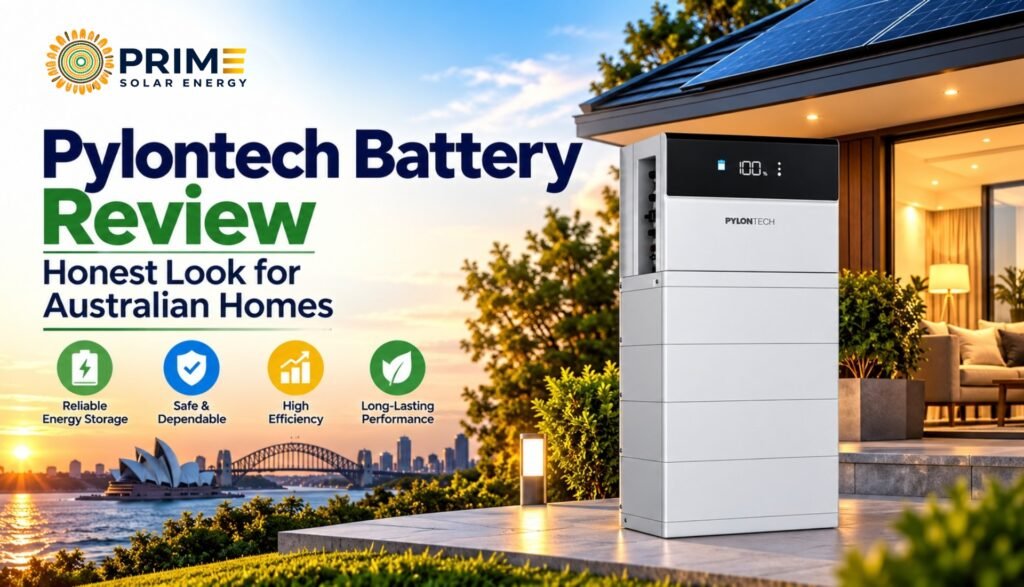
Looking for an honest Pylontech battery review before you pick a home battery? This guide covers the whole range, from the older US-series modules to the all-in-one Force H3X.
We go through specifications, installation, charging, and how Pylontech compares with Fox ESS. Every figure was checked against manufacturer documents and Australian sources.
If you live in Canberra or NSW, we also point out the local rebates and rules that matter.
Pylontech Company Overview
Pylontech (Pylon Technologies Co., Ltd.) is a Shanghai-based maker of lithium iron phosphate (LFP) storage systems. The company has been selling into Australia since 2013, and in late 2025 it opened a local subsidiary, Pylon Technologies Australia Pty Ltd, in Alexandria, Sydney. That office handles operations and customer support for Australia and New Zealand, which is a real plus when a battery needs service.
At Prime Solar Energy, we help Canberra and NSW households work out which battery suits their roof, their usage, and their switchboard. Pylontech comes up a lot, so here’s the straight version.
Pylontech Battery Review: How the Range Stacks Up
Pylontech sells four families that matter to Australian homeowners. The older US-series (like the US3000C) is a low-voltage 48 V module that pairs with compatible low-voltage inverters. Force H2 was the company’s first high-voltage stack for homes. Force H3 is the newer high-voltage battery, and Force H3X wraps a hybrid inverter around those same H3 modules in one tower.
The Force H3 and H3X models are listed on the Clean Energy Council (CEC) approved battery list at the time of writing, though always confirm the exact model number before you buy. Approval is per model, not per brand.
Pylontech Battery Specifications
Here’s every model side by side in one table.
| Specification | US3000C | Force H2 | Force H3 | Force H3X (single-phase) |
| Chemistry | LFP | LFP | LFP | LFP |
| System type | Low voltage (48 V) | High voltage | High voltage | High voltage, all-in-one |
| Module capacity | 3.552 kWh | 3.552 kWh | 5.12 kWh | 5.12 kWh |
| Module voltage | 48 V | 96 V | 102.4 V | 102.4 V |
| Usable capacity/depth of discharge | 3.374 kWh per module | 90% | 95% | 95% |
| Stack options | Up to 16 per string | 2 to 4 modules (7.10 to 14.20 kWh) | 2 to 7 modules (10.24 to 35.84 kWh) | 1 to 4 modules (5.12 to 20.48 kWh) |
| Module weight | 32 kg | 35 kg | 39 kg | 39 kg (whole system 77 to 194 kg) |
| Cycle life | Over 6,000 | Over 5,000 | Over 8,000 | Over 8,000 |
| Operating temperature | Charge 0 to 50°C, discharge -10 to 50°C. | 0 to 50°C | -10 to 55°C | -10 to 55°C (power reduces above 45°C) |
| Protection rating | IP20 (indoor only) | IP55 | IP55 | IP55, C5M salt spray |
| Communication | RS485, CAN | Modbus RTU, CAN | Modbus RTU, CAN | WiFi, LAN, Bluetooth |
| Inverter included | No | No | No | Yes (3.6, 5, 6 or 8 kW, up to 98% efficient) |
| Parallel systems | Via string | Not listed | Up to 6 | Up to 6 |
| Warranty | 10 years | 10 years | 10 years | 10 years |
View the US3000C, Force H2, Force H3, and Force H3X battery datasheets for more information.
Which Pylontech Battery Fits Which Home?
| Model | Best for | Needs a separate inverter? | Where it can go |
| US3000C | Existing low-voltage setups and small upgrades | Yes (low voltage) | Indoors |
| Force H2 | Homes with a compatible high-voltage inverter | Yes (high voltage) | Indoor or outdoor |
| Force H3 | Larger storage with your own high-voltage inverter | Yes (high voltage) | Indoor or outdoor |
| Force H3X | New solar-plus-battery installs wanting one tidy tower | No | Indoor or outdoor |
Pylontech Battery Installation: What to Know First
Good Pylontech battery installation matters as much as the hardware. The Force H3X manual is clear that only licensed, qualified technicians should wire it. Each module weighs 39 kg, so you need two people to lift one. The floor or wall must support at least 300 kg, and the system should sit at least 2 meters from heat sources. Mounting the base about 300 mm off the ground helps keep water away. If floor mounting isn’t ideal, anti-toppling brackets can secure the tower to a wall instead.
Safety gear is part of the job. The manual calls for a fire extinguisher and a sound alarm in the install area, and an optional emergency power-off (EPO) switch is built in.
Australia has its own wiring rules here. On H3X, the grid and backup neutrals must be connected, or the backup function won’t work. The inverter also supports DRM0 for AS/NZS 4777 demand response.
In NSW, the government’s battery installation information includes a checklist for getting a compliant install, and its guide to owning a battery recommends using an installer accredited by Solar Accreditation Australia. Not sure what your site needs? Contact us, and we’ll walk through it.
How to Charge Pylontech Battery Systems?
How to charge Pylontech battery setups depends on the model. The US-series and Force H3 don’t charge themselves. Your compatible inverter controls charging and talks to the battery over CAN or RS485.
On the H3X, you control it through the PyHome app. In the default self-consumption mode, solar feeds your home first, then the battery, then the grid. You can also set a charge limit between 50% and 100%, a backup reserve between 5% and 50%, and up to four timed charge or discharge periods. There’s even a heat pump relay, so you can switch a compatible heat pump from the app.
One practical tip from the manual: recharge the battery within 12 hours after a full discharge. If you’ll be away for a long stretch, leave it above 90% charge, and cycle it at least every six months.
Extra Things Worth Knowing about the Pylontech battery
- Three-phase options: If your home is on three-phase power, H3X also comes in three-phase versions. Several of these (10 kW and 12 kW, with 10.24 to 35.84 kWh) are on the CEC list.
- Room to grow: Single-phase H3X inverter power can be upgraded later through a paid service from Pylontech, for example, moving from 5 kW up to 8 kW. That helps if your usage grows.
- Coastal and hot-climate use: H3X carries a C5M salt spray rating, and the system keeps running up to 55°C, though output tapers off once ambient temperature passes 45°C.
- Stay online: The H3X must be connected through PyHome. Without a network connection, the warranty drops from 10 years to 5.
- Only one battery power limit to watch: With a single H3X module, charge and discharge power is limited to 2.5 kW. Two or more modules unlock the full inverter output.
Pylontech Battery vs Fox ESS
The Pylontech battery vs Fox ESS question comes up often. Both use LFP cells, and both offer 10-year warranties in Australia, but the designs differ.
| Feature | Pylontech Force H3 / H3X | Fox ESS EQ4800 |
| Module size | 5.12 kWh | 4.66 kWh |
| Depth of discharge | 95% | 100% |
| Warranty basis | 10 years | 10 years, 70% retention, throughput-based |
| Protection | IP55 | IP65 |
| All-in-one option | Yes (H3X) | Separate inverter or stackable AIO |
| Local base | Sydney | Melbourne |
Fox ESS entered Australia in 2021 and added batteries in 2022. Pylontech’s edge is the single-tower H3X design and its longer rated cycle life. Fox ESS counters with a higher IP rating and full depth of discharge. Neither is wrong, so the best pick depends on your inverter, roof, and usage.
Rebates and Rules for Canberra and NSW Homes
The federal Cheaper Home Batteries program runs through the Small-scale Renewable Energy Scheme. According to the Clean Energy Regulator, eligible batteries must be between 5 kWh and 100 kWh nominal capacity, and batteries installed without solar PV aren’t eligible. The program only covers CEC-approved products fitted by an accredited installer. The rules changed from 1 May 2026, so check that page for current settings.
Canberra households can also look at the ACT’s Sustainable Household Scheme, a low-interest loan that covers household battery storage. It can be used alongside the federal program.
Pros and Cons of Pylontech Battery
Pros
- Safe LFP chemistry across the range
- Long rated cycle life (8,000+ on Force H3)
- Modular stacking with no cables between modules
- 10-year warranty
- Local support in Sydney
- H3X offers a fast backup switchover and all-in-one design
Cons
- US3000C is IP20, so it’s indoor only
- US-series and Force H3 need a compatible inverter
- H3X’s 10-year warranty needs the system online
- A single H3X module limits battery power to 2.5 kW
- H3X is built as one matched system, so you can’t mix inverter brands
Final Verdict
This Pylontech Battery Review comes down to one thing: Pylontech is a solid, proven brand with strong specs and growing local support. The Force H3X suits most Canberra and NSW homes that want a tidy all-in-one tower. Force H3 suits homes that already have a compatible high-voltage inverter. The US-series is better for existing low-voltage setups.
Ready to compare options for your home? Get a quote from the Prime Solar Energy team today, or contact us with your questions.
Frequently Asked Questions
Is Pylontech a good battery brand in Australia?
Yes. Pylontech has operated here since 2013, uses LFP chemistry, and now has a Sydney office for local support.
Are Pylontech batteries CEC approved?
Force H3 and H3X models appear on the CEC-approved list, but check your exact model number, since approval is per model.
Can I use a Pylontech battery without solar?
It’ll work, but the federal battery program doesn’t cover batteries installed without solar PV.
How long is the Pylontech warranty?
The manufacturer documents list 10 years. On H3X, the system must stay online to keep the full term.
Where can Canberra buyers find an independent battery guide?
The ACT Government’s household battery storage buyers guide is a good starting point.