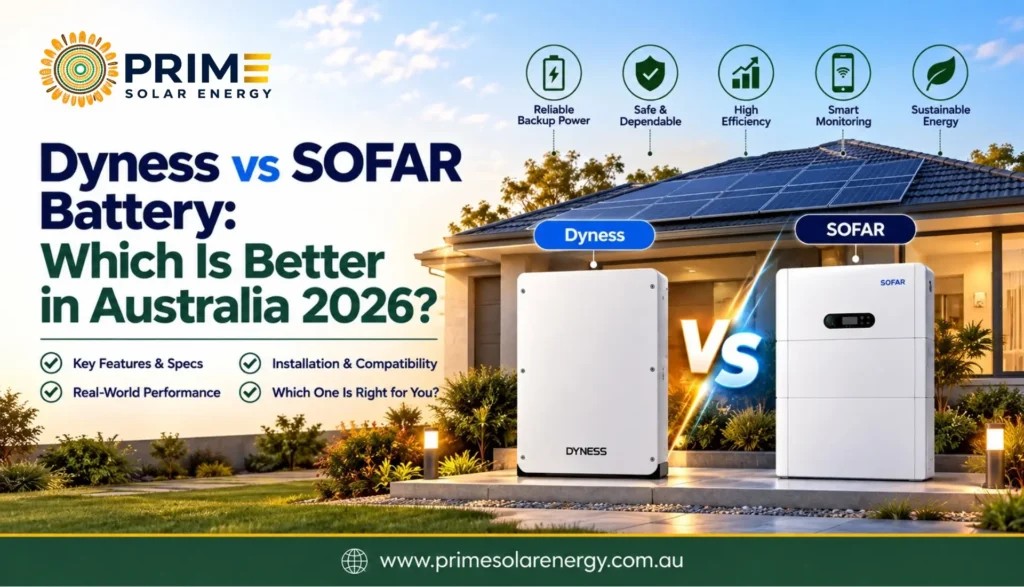
Dyness and SOFAR both offer flexible home battery solutions for Australian households, but they take different approaches to energy storage.
In this Dyness vs SOFAR comparison, we look at the Dyness PowerBox G2 and SOFAR PowerAll across capacity, performance, safety, inverter compatibility, backup and warranty to help you choose the right battery system for your home.
Dyness vs SOFAR Battery Comparison
| Feature | Dyness PowerBox G2 | SOFAR PowerAll |
|---|---|---|
| System Type | Modular low-voltage battery | Integrated hybrid storage system |
| Battery Chemistry | LiFePO₄ | LFP |
| Battery Size | 10.24 kWh per unit | 5 kWh-class modular storage |
| Capacity | From 10.24 kWh, expandable in parallel | 5–30 kWh |
| Maximum Battery Output | Up to 10.24 kW per unit | Depends on inverter configuration |
| Inverter | Compatible inverter required | Matched SOFAR hybrid inverter |
| Protection Rating | IP66 | Up to IP66 |
| Monitoring | Dyness Smart App | SOFAR monitoring ecosystem |
| Backup | Depends on inverter and system design | Integrated backup capability |
| Warranty | 10 years | Check current warranty for selected configuration |
| Australian Approval | Approved PowerBox G2 models available | Approved BTS battery components available |
Battery Capacity and Expandability
The Dyness PowerBox G2 provides 10.24 kWh per battery unit and supports multiple batteries connected in parallel. This makes it suitable for homes that may need greater storage capacity over time.
The SOFAR PowerAll offers 5, 10, 15, 20, 25 and 30 kWh configurations, giving homeowners smaller capacity steps and a straightforward residential storage range.
For large-scale expansion, Dyness provides greater flexibility. For simpler residential sizing, SOFAR offers more gradual capacity options.
Power and Backup Performance
Dyness PowerBox G2 supports a 1C discharge rate with up to 10.24 kW output per unit. Actual household output still depends on the compatible inverter and overall system design.
SOFAR PowerAll combines battery storage with compatible 3–6 kW single-phase hybrid inverter options. Backup capability is built around the SOFAR ecosystem, making system matching simpler for new installations.
If high battery-side output is important, Dyness has an advantage. If you prefer an integrated battery and inverter package, SOFAR may be easier to configure.
Inverter Compatibility
Dyness PowerBox G2 can work with a range of compatible low-voltage hybrid and off-grid inverters. This gives homeowners more flexibility when choosing an inverter.
SOFAR PowerAll is designed around SOFAR’s own inverter and battery ecosystem. It offers less brand-mixing flexibility but provides a more unified installation and monitoring experience.
Safety and Outdoor Protection
Both systems use LFP battery chemistry.
Dyness PowerBox G2 includes an IP66 enclosure, automatic pressure relief and a smart fire-suppression system designed to respond within five seconds.
SOFAR PowerAll also provides multi-level protection, electrical isolation features, AFCI protection and up to IP66 protection on current configurations.
For clearly specified active fire protection, Dyness PowerBox G2 has the stronger feature set.
Smart Monitoring
Dyness PowerBox G2 supports the Dyness Smart App for battery monitoring, smart control and OTA software updates.
SOFAR PowerAll uses SOFAR’s monitoring and energy-management ecosystem, allowing the battery and inverter to operate within one platform.
Both provide smart monitoring, but SOFAR offers a more integrated experience when the complete system uses SOFAR equipment.
Warranty and Australian Availability
Dyness PowerBox G2 comes with a 10-year warranty in Australia. Dyness also lists long-cycle-life performance for the battery, subject to its warranty conditions.
The SOFAR BTS 5K battery modules used in PowerAll come with a 10-year limited product warranty in Australia, subject to the manufacturer’s warranty terms and performance conditions.
Both brands offer battery products for the Australian market. Exact battery and inverter configurations should be confirmed before installation.
Dyness vs SOFAR: Which Is Better?
Choose Dyness PowerBox G2 if you want:
- High battery output
- Large expansion potential
- Flexible inverter compatibility
- IP66 protection
- Active fire-suppression features
Choose SOFAR PowerAll if you want:
- An integrated battery and hybrid inverter system
- Smaller 5 kWh capacity steps
- Built-in backup capability
- Unified monitoring
- A lower listed price around 30 kWh
Final Verdict
Both Dyness PowerBox G2 and SOFAR PowerAll offer strong home battery solutions, but they suit different needs. Dyness PowerBox G2 is a better fit for homeowners who prioritise higher power output, scalability, inverter flexibility and advanced safety features.
SOFAR PowerAll is better suited to homeowners who want a simpler integrated solar-and-battery system with flexible capacity options and reliable backup capability. The best choice will depend on your storage needs, existing inverter setup, backup requirements and overall system design.
Not sure which battery is right for your home? Get a free quote from Prime Solar Energy and speak with our team about the best option for your energy needs.
Frequently Asked Questions
Is Dyness better than SOFAR?
It depends on the system. Dyness offers greater inverter flexibility, strong battery output and large expansion potential, while SOFAR provides a simpler integrated battery and inverter solution.
How much storage does Dyness PowerBox G2 provide?
Each PowerBox G2 provides 10.24 kWh of storage and multiple units can be connected in parallel for larger systems.
How much storage does SOFAR PowerAll provide?
SOFAR PowerAll is available in 5, 10, 15, 20, 25 and 30 kWh configurations.