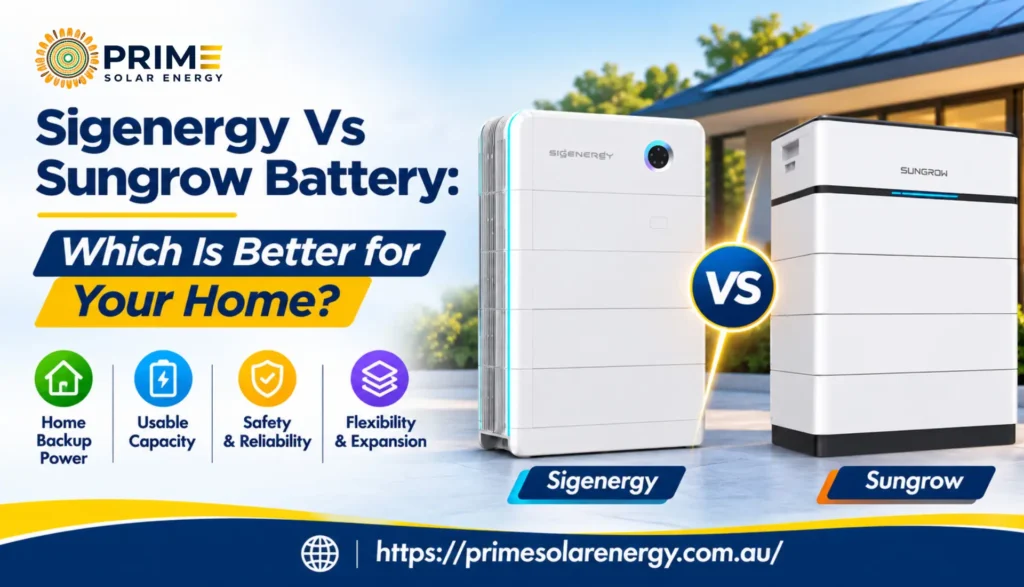
The Sigenergy Vs Sungrow Battery decision is one of the most common questions Canberra homeowners ask when adding storage to a solar system.
Sigenergy offers an integrated platform that combines the inverter, battery, and EV charging interface. Sungrow offers a well-established stackable battery that pairs with its own hybrid inverters.
Both come with a 10-year warranty and Clean Energy Council approval, so the choice comes down to system design, track record, and how you plan to use your battery.
Quick answer: Choose Sigenergy if you want one integrated system with a high capacity ceiling and plan to add an EV charger. Choose Sungrow if you prefer a longer-established brand and a modular battery that sits beside a separate hybrid inverter. Both are sound options, and your usage, roof, and backup needs should drive the final decision.
Sigenergy Vs Sungrow Battery: Company Overview
Sigenergy
Sigenergy is the newer brand. It was founded in 2022 by Tony Xu, a former president of Huawei’s solar division, and launched the SigenStor in Australia at All-Energy Australia in October 2023. Its Australian arm is based in Sydney and handles local warranty claims.
Sungrow
Sungrow has operated since 1997, when Professor Cao Renxian founded it in Hefei, China. It opened its first Australian office in Sydney in 2012 and is best known for solar inverters.
Prime Solar Energy helps Canberra households weigh both brands against their roof, usage, and backup needs.
Sigenergy Battery and Sungrow Battery Specifications
The SigenStor combines a hybrid inverter, battery, power conversion system, EV charging interface, and energy management in one platform. The Sigenergy battery is built from LiFePO₄. modules in two sizes: the BAT 5.0 (5.2 kWh usable) and the BAT 8.0 (7.8 kWh usable). You can connect one to six modules to a single energy controller, which gives 46.8 kWh of usable storage with six BAT 8.0 modules. Controllers come in single-phase (3.0 to 12.0 kW) and three-phase (5.0 to 30.0 kW) versions; the system is rated IP66, and monitoring runs through the mySigen app.
The Sungrow battery range covers two high-voltage LFP lines. The SBR series uses 3.2 kWh modules and runs from the SBR096 (9.6 kWh usable) to the SBR256 (25.6 kWh). The newer SBH series uses 5 kWh modules, which Sungrow describes as plug-and-play with no cables between modules, and runs from 10 kWh (SBH100) to 40 kWh (SBH400) per stack. Both lines are rated IP55, and monitoring runs through Sungrow’s iSolarCloud platform.
Sigenergy Vs Sungrow Battery Comparison
This Sigenergy Vs Sungrow Battery Comparison draws on the published Australian datasheets and warranty documents.
| Feature | Sigenergy SigenStor | Sungrow SBR / SBH |
| Company founded | 2022 | 1997 |
| In Australia since | 2023 | 2012 |
| Battery chemistry | LiFePO₄ | LiFePO₄ (prismatic cells) |
| Module size | 5.2 or 7.8 kWh usable | SBR 3.2 kWh, SBH 5 kWh |
| Capacity per unit | Up to 46.8 kWh usable | SBR 9.6–25.6 kWh, SBH 10–40 kWh |
| Design | Five-in-one: hybrid inverter, battery, power conversion, EV charging, energy management | Stackable battery paired with a Sungrow hybrid inverter |
| Ingress protection | IP66 | IP55 |
| Warranty | 10 years, 70% usable energy guarantee | 10 years, 70% capacity guarantee |
| Monitoring | mySigen app | iSolarCloud |
In a Sigenergy Vs Sungrow Battery Storage System decision, the trade-off is integration against track record. Sigenergy consolidates more functions into one unit and reaches a higher capacity from a single controller. Sungrow keeps the battery as a separate stack, backed by a longer history in Australia.
Sigenergy Vs Sungrow Battery Warranty & Lifespan
Both brands offer a 10-year warranty backed by a performance guarantee.
Sigenergy’s current Australian warranty, dated 31 December 2025, states that the battery retains at least 70% of its usable energy for ten years, or until it reaches a minimum throughput, whichever comes first. That limit is 15.84 MWh for the BAT 5.0 and 23.77 MWh for the BAT 8.0.
Sungrow’s warranty for batteries installed on or after 1 October 2024 also guarantees at least 70% of initial capacity over ten years. Its throughput caps are 26.88 MWh for the SBR096 and 35.84 MWh for the SBR128. The terms apply to the original purchaser, so check the transfer conditions if you may sell the property.
Throughput is a more useful guide to lifespan than the calendar. Dividing throughput by capacity gives roughly 3,000 full cycles for Sigenergy and 2,800 for the Sungrow SBR models. A battery cycled fully every day would use around 3,650 cycles in ten years, so heavy use could reach the cap before the ten years are up.
Warranty length also affects rebates. Under the Cheaper Home Batteries program, an eligible battery must stay at the property until the end of its warranty period or the end of 2030, whichever is later.
Safety, Recalls, and Approvals
Sungrow lists Clean Energy Council certification on its SBR and SBH datasheets, and the SigenStor range has CEC approval for Australia. Confirm that your exact battery and inverter combination appears on the approved list before you sign.
The Sigenergy battery has one safety notice worth knowing about. On 19 November 2025, the ACCC published a voluntary recall of Sigenergy single-phase 8, 10, and 12 kW energy controllers with quick-connect AC plugs. The plugs may overheat and become damaged, which poses a fire risk. Affected owners receive a replacement controller with an updated plug and an extra two years of warranty. Sigenergy has said the problem stems from installation practices rather than a product defect.
The recall covers the energy controller, not the battery modules. If you are quoted a single-phase SigenStor, ask your installer which controller version they will supply.
Sigenergy Vs Sungrow Battery Australia: Rebates and Support in Canberra
The federal Cheaper Home Batteries program requires a battery with 5 to 100 kWh of nominal capacity that appears on the Clean Energy Council approved list. A Solar Accreditation Australia installer with a battery endorsement must fit it.
Canberra households can also use the ACT Government’s Sustainable Household Scheme, which offers low-interest loans for energy-efficient upgrades, including household battery storage systems. Brighte is the loan provider, and applicants attend a free one-hour workshop. The ACT Government has said eligible Canberrans can combine a scheme loan with the Commonwealth program. Program rules change, so check each one before you sign.
Sigenergy Vs Sungrow Battery: Which One Should You Choose?
Choose Sigenergy if you want one integrated system, plan to add an EV charger, or want the highest capacity from a single controller. Choose Sungrow if you value a longer track record, prefer the iSolarCloud app, or want a stackable battery alongside a separate hybrid inverter.
The best solar battery for Australian homes is the one matched to your household. Three checks help: compare the usable capacity with your evening consumption, confirm the battery suits your phase and inverter setup, and ask how much experience your installer has with the brand.
If your property is on the NSW side of the border, such as Queanbeyan, the NSW Government’s guide to owning a battery covers what to consider when buying, safe use, and virtual power plants. Whichever way you lean, ask for the exact model numbers, the warranty document, and proof of CEC approval in writing. Then get a quote for both options and compare them line by line.
Frequently Asked Questions
Is Sigenergy better than Sungrow?
Neither wins every category. Sigenergy leads on integration and single-controller capacity, while Sungrow leads on company history and time in Australia. Your roof, usage, and backup needs decide which suits you.
Do both batteries offer a 10-year warranty?
Yes. Both provide a 10-year warranty with a performance guarantee of at least 70% capacity, subject to throughput limits and installation conditions. Read the current warranty document for your exact model.
Can I claim a rebate on either battery?
Both can qualify if the exact model is on the Clean Energy Council approved list and a battery-endorsed accredited installer fits it. See the Cheaper Home Batteries program page for current details.
Is the Sigenergy recall a reason to avoid the brand?
The recall covers specific single-phase 8, 10, and 12 kW energy controllers with quick-connect AC plugs, and the remedy is a free replacement. Ask your installer which controller version they will supply.
How much storage can I install?
A SigenStor controller takes up to six modules, and a Sungrow SBH stack ranges from 10 to 40 kWh. The right size depends on how much electricity you use after sunset.
Compare Both Batteries for Your Canberra Home
Still weighing up Sigenergy and Sungrow? At Prime Solar Energy, we help you choose the best one. Contact us and our team will compare both systems against your usage and roof.