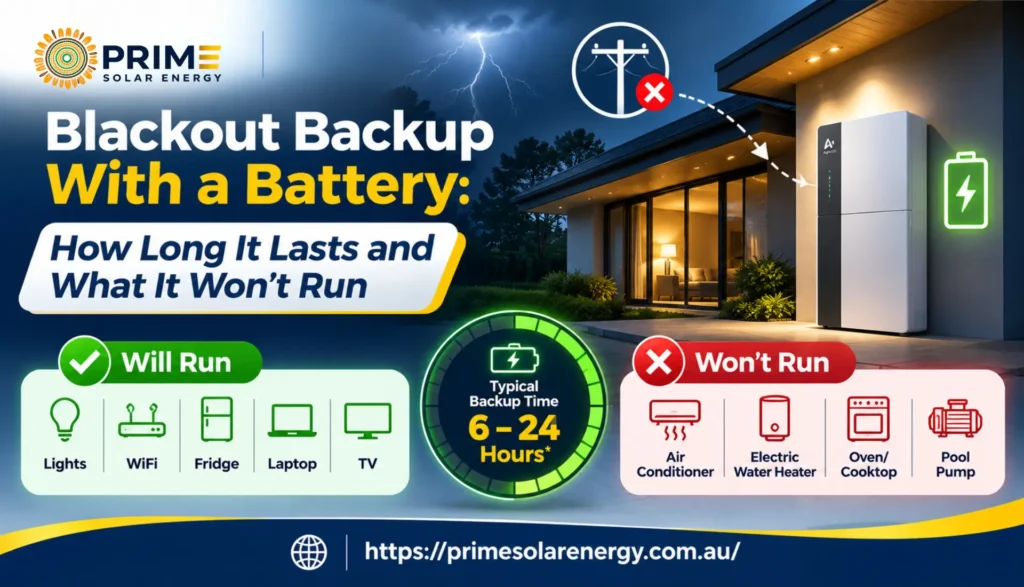
A battery-powered blackout backup with a battery can keep essential appliances running when the grid goes down. But how long it lasts depends on your battery’s usable capacity, remaining charge, and the appliances drawing power.
A 10 kWh battery might support essential loads overnight, while running heating, air conditioning, or other high-power appliances could drain it within hours.
Importantly, not every solar battery provides blackout protection. Your system must be specifically designed and configured for backup operation.
How Does a Solar Battery Work During a Blackout?
A regular, grid-connected solar system automatically shuts off during a blackout, so it can’t feed electricity into the power lines.
Unlike a backup-capable battery system, it is a single battery in a single terminal block. It safely unplugs your home from the electrical network and provides stored power to specific circuits in your home.
This requires:
- A compatible battery and backup-capable inverter.
- Suitable backup switching or gateway equipment.
- Correctly configured switchboard circuits.
- Sufficient stored energy and inverter power capacity.
According to the Australian Government’s Solar Consumer Guide, not all battery systems can provide backup electricity during a power outage.
How Long Will a Solar Battery Last During a Blackout?
Most batteries can run selected essential appliances for several hours or longer, depending on the load and available charge. There is no fixed backup duration.
Two specifications matter:
- Battery capacity (kWh): How much energy the battery can store and deliver.
- Backup power output (kW): How much power the inverter can supply at once.
A battery may hold enough energy for several hours but still be unable to start an appliance that exceeds its backup power rating.
Estimated Battery Backup Runtime
The table below illustrates backup duration at different average household loads.
| Usable Battery Capacity | 0.5 kW Average Load | 1 kW Average Load |
| 5 kWh | 9 hours | 4.5 hours |
| 10 kWh | 18 hours | 9 hours |
| 13.5 kWh | 24.3 hours | 12.2 hours |
Estimates assume a fully charged battery, the stated usable capacity, 90% DC-to-AC energy conversion efficiency, and no additional backup reserve. Actual results vary.
For example, a fully charged 10 kWh usable battery could theoretically supply a steady 500 W load for approximately 18 hours under these assumptions.
However, the available charge when the blackout begins, battery operating limits, and changing appliance demand affect the actual duration.
What Appliances Can and Can’t a Solar Battery Run?
A solar battery can generally support low-power household essentials, provided those appliances are connected to backed-up circuits.
High-power appliances may require a larger inverter, greater battery capacity, or a dedicated whole-home backup arrangement.
| Appliance | Typical Backup Suitability |
| LED lighting | Usually suitable |
| Fridge and freezer | Usually suitable |
| Wi-Fi router | Usually suitable |
| TV and laptop | Usually suitable |
| Phone charging | Usually suitable |
| Microwave | Depends on inverter output |
| Washing machine | Depends on starting and operating load |
| Reverse-cycle air conditioner | Depends on system capacity |
| Electric oven or cooktop | Often excluded |
| Electric hot water system | Often excluded |
| EV charger | Usually excluded from essential backup circuits |
These are general examples, not guarantees. Appliance power ratings, startup demand, and backup circuit configuration determine what can operate.
Why High-Power Appliances May Not Run
Several kilowatts of electricity can be used by an electric oven, a ducted air conditioner, or an EV charger. If there is enough energy stored in the battery, the energy load may be too heavy for the inverter.
Other appliances powered by moving mechanisms, such as some pumps and air conditioners, may also need extra power for their starter.
Multiple large appliances simultaneously may overload the inverter and result in a failure of the backup supply or disconnecting the load.
Essential Circuits vs Whole-Home Backup
Australian homeowners generally have two backup options.
Essential Circuits Backup
Only selected circuits remain powered during an outage.
Common priorities include:
- Refrigeration
- Lighting
- Internet equipment
- Selected power points
This approach reduces electricity demand and usually extends the available backup time.
Whole-Home Backup
If the whole-house system is properly designed and configured, it can provide a much wider variety of house circuits.
But whole-home backup isn’t an unlimited supply of power. The combined demand still needs to be taken care of by the battery and inverter.
More batteries and/or equipment or load-management controls can be required.
For three-phase homes: A single-phase backup system generally supplies only circuits connected to its backed-up phase. Supporting all three phases requires an appropriately designed system.
Can Solar Panels Recharge a Battery During a Blackout?
But only if the solar and battery system can operate disconnected from the grid.
Some systems that are backed up can still produce power when the electricity is down, even if the solar panels also fail to create any electricity. Household loads can be operated using solar energy, and battery recharging can be done when there is adequate solar energy.
Other systems, however, would isolate the solar inverter during a blackout and only provide power from the battery.
The result depends on:
- Solar and battery inverter compatibility.
- Backup system configuration.
- Available sunlight and solar generation.
- Battery charge and operating limits.
For Canberra and NSW homeowners, this matters during extended outages. A compatible system may provide backup across multiple days with adequate sunlight and controlled electricity consumption.
However, cloudy weather, overnight demand, and limited battery capacity can still interrupt supply.
How to Make Your Battery Backup Last Longer
Reducing electricity consumption is the simplest way to extend battery backup time.
- Prioritise essential appliances
Keep refrigeration, necessary lighting, and communication devices running before other equipment.
- Avoid unnecessary high-power loads.
Limit electric heating, ovens, clothes dryers,s and other energy-intensive appliances during outages.
- Set an appropriate backup reserve. ve
Some batteries allow you to reserve a percentage of stored energy for outages. This can help retain charge before a blackout, although it may reduce the energy available for everyday savings.
- Monitor battery charge
Use your battery monitoring app to track remaining energy and household demand.
- Use available daytime solar.
Where supported, take advantage of solar generation to reduce battery discharge and replenish stored energy.
What to Check Before Installing Battery Backup
Before choosing a battery, ask your installer:
- Does the proposed system include blackout backup functionality?
- Which appliances and circuits will remain powered?
- What are the inverter’s continuous and peak backup power ratings?
- Can the solar panels recharge the battery during an outage?
- Will backup cover one phase or all three phases?
- What is the total installed cost, including switching equipment and switchboard modifications?
These questions help distinguish a battery designed mainly for electricity bill savings from one configured to provide reliable emergency backup.
For more information about battery selection and capacity, read Prime Solar Energy’s Solar Battery Guide for Canberra & NSW Homes.
Final Thoughts
A blackout backup with a battery can keep essential household appliances running, but backup duration depends on available energy, appliance demand, and system configuration.
Choosing the right battery capacity, inverter, and backed-up circuits is more important than battery size alone.
For homeowners in Canberra and NSW, get a quote from Prime Solar Energy to explore suitable battery options, backup requirements, and installation costs.
Frequently Asked Questions
Does solar battery backup switch on instantly during a blackout?
Not always. Changeover time varies with the inverter and backup equipment. There are systems that can switch rapidly, and there are systems that can only cause a slight interruption. In some instances, sensitive electronics may need a separate uninterruptible power supply (UPS) to help them continue to function.
Can a home solar battery safely power life-support medical equipment?
The home battery is not a suitable battery to be used as a primary source of power for life-support equipment. Contact a specialist for advice, have an electricity power plan in place and register with your electricity supplier if required.
Will my internet work during a blackout if the router has battery power?
Possibly. Powering your router is only part of the requirement. Your NBN connection equipment and the external telecommunications network must also remain operational.
Can I add blackout backup to an existing solar battery?
Sometimes, if your battery and inverter already support backup mode. Otherwise, you may need extra switching equipment or an inverter upgrade, so ask an installer to check your system first.
Is a solar battery better than a generator for blackout backup?
A battery is quiet, fume-free, and switches on automatically, and solar can recharge it if your system supports that. A generator can run as long as you have fuel, but it needs fuel and maintenance, and it must be connected to your home safely.
How many batteries do I need to run my whole home during a blackout?
It depends on your energy use, your peak power demand, and how long you want to stay powered. Essential circuits often need just one battery, while whole-home backup may need more capacity and a larger inverter.