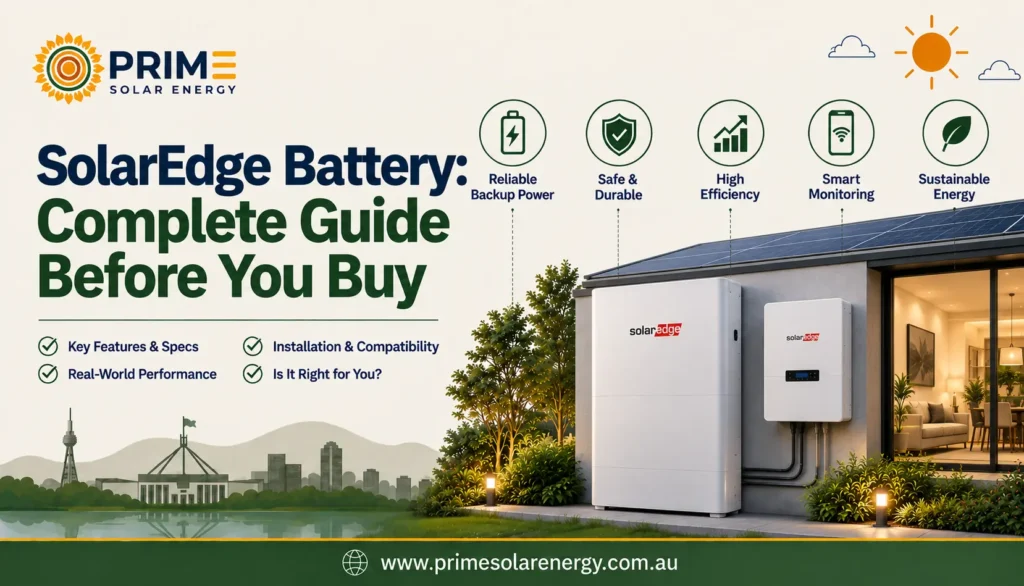
Choosing the right home battery is a big step toward energy independence, and this SolarEdge Battery Review covers the real details: capacity, backup performance, and how it compares with Tesla Powerwall and BYD.
SolarEdge is well known in Australia for its DC-optimized inverters, and its battery range offers tighter integration between panels, the inverter, and the battery. Homeowners can also access the federal Cheaper Home Batteries Program for a discount on eligible systems.
Whether you already have a SolarEdge inverter or are starting a new solar-plus-storage setup, this guide will help you decide with confidence.
Company Overview: Who Is SolarEdge?
SolarEdge is a global energy technology company known for pioneering DC power optimization in residential and commercial solar systems. Originally focused on inverters and power optimizers, the company expanded into home battery storage to offer a more complete, closed-loop solar ecosystem. In Australia, SolarEdge batteries are supported through the company’s local office and an accredited installer network, giving homeowners access to trained technicians familiar with local grid and safety requirements. Full eligibility details for the current battery incentive are also listed on business.gov.au, which is worth checking before finalizing a purchase.
What Is the SolarEdge Home Battery?
The SolarEdge home battery is a DC-coupled residential storage unit that stores excess solar energy generated during the day for use at night or during a blackout. Because it connects on the DC side of the system rather than through a separate AC inverter, it avoids some of the conversion losses seen in AC-coupled retrofits, which SolarEdge says can recover extra usable energy over a year compared with less efficient architectures.
For the Australian market, SolarEdge currently offers two distinct battery models depending on your home’s electrical setup:
- SolarEdge Home Battery (High Voltage, BAT-10K1P): for single-phase homes, paired with SolarEdge single-phase Home/Energy Hub inverters.
- SolarEdge Home Battery 48V (Low Voltage, BAT-05K48): for three-phase homes, paired with SolarEdge Home Hub or Wave three-phase inverters.
Both use sealed, weather-rated enclosures suitable for indoor or sheltered outdoor mounting, and a 10-year manufacturer warranty backs both.
SolarEdge Home Battery — High Voltage (BAT-10K1P) Specifications
| Specification | Details |
| Usable Energy (100% DoD) | 9.7 kWh |
| Continuous Output Power | 5 kW |
| Peak Backup Power (10 sec) | 7.5 kW |
| Round-Trip Efficiency | Over 94.5% |
| Voltage Range | 350–450 Vdc |
| Warranty | 10 years |
| Operating Temperature | -10°C to 50°C |
| Dimensions (W x H x D) | 790 x 1179 x 250 mm |
| Weight | Approximately 119–121 kg |
| Mounting | Floor or wall mount |
| Compatible Inverters | SolarEdge single-phase Home/Energy Hub inverters |
| Batteries Per Inverter | Up to 3 |
| Round-trip Efficiency | IP 55, indoor and outdoor (water and dust protection) |
View the official SolarEdge High Voltage Battery Datasheet
SolarEdge Home Battery—Low Voltage 48V (BAT-05K48) Specifications
| Specification | Details |
| Usable Energy per Module (100% DoD) | 4.85 kWh |
| Modular Capacity Range | 4.85 kWh up to 23 kWh (5 modules) |
| Continuous Output (Multiple Modules) | 5000 / 5000 W (charge/discharge) |
| Peak Round-Trip Efficiency | Over 95.4% |
| Voltage Range | 44.8–56.5 Vdc |
| Warranty | 10 years |
| Battery Chemistry | LFP (Lithium Iron Phosphate) |
| Communication | RS-485 between modules, CAN bus to inverter |
| Modules Per Inverter | Up to 5, connected in parallel |
| Compatible Inverters | SolarEdge Home Hub / Wave three-phase inverters |
| Round-trip Efficiency | IP 65, indoor and outdoor (water and dust protection) |
View the official SolarEdge Three-Phase Battery Datasheet
SolarEdge Battery Backup and Performance
In terms of SolarEdge battery backup, the system uses an optional Blackout Box (backup interface) that switches the home to battery power within a few seconds of a grid outage. In backup mode, the high-voltage unit can supply continuous power comparable to normal on-grid operation, generally enough to keep essential circuits—lighting, fridge, internet, and a few appliances—running during a blackout. Multiple batteries can be stacked on a single inverter for households wanting more backup runtime or higher solar self-consumption.
SolarEdge Battery Dimensions and Installation
Regarding SolarEdge battery dimensions, the High Voltage unit measures roughly 790 mm wide, 1179 mm tall, and 250 mm deep, while the Low Voltage 48V modules are more compact and stack vertically as capacity needs grow.
For SolarEdge battery installation, Australian regulations require specific clearances—typically 60 cm to the sides and 90 cm above the unit—and the battery cannot be installed inside habitable areas of the home.
Installation must be carried out by a CEC– or SAA-accredited installer, and Canberra homeowners can further offset costs through the ACT Government’s Sustainable Household Scheme, which offers low-interest loans for battery storage and other energy-efficient upgrades.
How to Reset a SolarEdge Battery?
How to reset SolarEdge battery? The answer typically involves the mySolarEdge monitoring app or the SetApp installer tool rather than a manual physical reset. Most fault codes can be cleared by power-cycling the Blackout Box and battery in the correct sequence or by triggering a soft restart through the app. Because incorrect resets can affect warranty status, it’s best to contact your installer or SolarEdge support rather than attempting an undocumented reset procedure yourself.
SolarEdge Battery vs. Tesla Powerwall vs. BYD Battery
A common question homeowners ask is how the SolarEdge Battery vs. Tesla Powerwall vs. BYD Battery comparison actually plays out in real-world use. Each battery targets a slightly different buyer, and recent figures show battery systems now make up the majority of new loan applications under the ACT scheme, as detailed in this ACT Government update—a sign of how quickly demand is growing across all these brands.
| Feature | SolarEdge Home Battery | Tesla Powerwall 3 | BYD Battery-Box Premium HVS |
| Usable Capacity | 9.7 kWh (HV) / up to 23 kWh (LV) | 13.5 kWh | 5.1–12.8 kWh (modular) |
| Chemistry | NMC | LFP | LFP |
| Continuous Output | 5 kW | Up to 11.04 kW | 25A max output current |
| Round-Trip Efficiency | Over 94.5% | Up to 97.5% | Around 96% |
| Built-in Inverter | No (needs SolarEdge inverter) | Yes, integrated | No (needs compatible inverter) |
| Warranty | 10 years | 10 years | 10 years |
| Stackable | Up to 3 units (HV) / 5 modules (LV) | Up to 3 expansion units (54 kWh) | Up to 38.4 kWh via parallel stacks |
| Round-trip Efficiency | Differ by models | IP 65 | IP 55 |
View the official Tesla Powerwall 3 Datasheet · View the official BYD Battery-Box Premium HVS Datasheet
The Tesla Powerwall 3 offers higher continuous output thanks to its integrated inverter, making it attractive for larger homes wanting strong whole-home backup. BYD’s modular LFP design appeals to buyers who want flexible capacity sizing and typically longer cycle life due to the LFP chemistry. SolarEdge’s advantage lies in deep integration for households already running a SolarEdge inverter, along with a compact footprint and strong monitoring software—though its High Voltage model’s NMC chemistry is something to weigh against the LFP alternatives now common across most competitors, including SolarEdge’s own Low Voltage 48V range.
Pros and Cons
Pros
- Seamless integration with SolarEdge inverters and the mySolarEdge monitoring app
- Two model options (high voltage and low voltage) covering both single-phase and three-phase homes
- Compact footprint relative to usable capacity
- 10-year warranty with unlimited cycles
- Strong local support through SolarEdge’s Australian office
Cons
- Locked into the SolarEdge inverter ecosystem—not a universal battery
- The high-voltage model uses NMC chemistry rather than the LFP chemistry most competitors have shifted to
- Less overall scalability than BYD’s fully stackable design
- Backup power output is lower than Tesla Powerwall 3’s integrated inverter
NSW residents comparing incentives across brands should also check the NSW Peak Demand Reduction Scheme, which requires the battery to be connected to a participating Virtual Power Plant and can apply regardless of which brand you choose.
Final Thoughts
The SolarEdge Home Battery range is well-engineered and tightly integrated, best suited to households already invested in the SolarEdge ecosystem or planning a new SolarEdge-based solar system. It holds its own on efficiency and build quality across both the high-voltage and low-voltage models, though buyers who compare purely on capacity, backup power, or chemistry may find Tesla Powerwall 3 or BYD’s modular battery box worth considering side by side. Getting a tailored recommendation based on your home’s energy use, roof setup, and budget is the best way to decide—reach out to Prime Solar Energy for a personalized assessment and get a quote, or simply contact us to talk through your options before making a final call.
Frequently Asked Questions
Is the SolarEdge Home Battery good for Australian homes?
Yes, for households already using a SolarEdge inverter, it offers tight system integration, solid efficiency, and a compact design. Buyers without an existing SolarEdge system should weigh it against LFP-based alternatives before deciding.
What is the SolarEdge Battery Australia capacity?
The high-voltage model offers 9.7 kWh of usable energy and can stack up to three units, while the low-voltage 48V model scales from 4.85 kWh up to 23 kWh across five modules.
Can SolarEdge batteries work during a blackout?
Yes, when paired with the optional Blackout Box, the system automatically switches to battery power within seconds of a grid outage.
Is the SolarEdge battery compatible with other brands of inverter?
No, both models are designed exclusively for use with SolarEdge single-phase or three-phase inverters, so it is not a universal storage solution.
How long does the SolarEdge battery warranty last?
Both models carry a 10-year warranty, subject to correct installation and operation within the specified temperature range.
Is the SolarEdge Home Battery suitable for Canberra homes?
Yes, especially for Canberra households already using a SolarEdge inverter, as it stores sunny-day solar to cover high evening energy use during cold winters. Just make sure a licensed local installer sets it up within the specified temperature range.