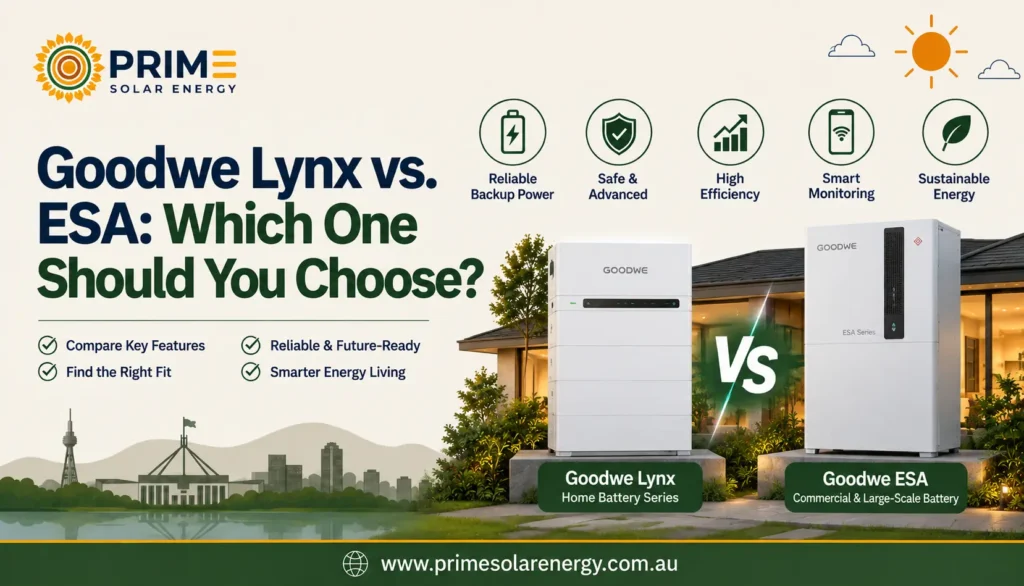
If you’ve been researching solar batteries for a while, the comparison between GoodWe Lynx vs. ESA has probably caught your attention. Both come from the same Australian-approved manufacturer, use the same safe LiFePO₄ chemistry, and appear frequently in installer recommendations across Canberra and NSW.
Despite these similarities, the two batteries aren’t interchangeable. The real difference lies in their design philosophy, not their quality. Lynx is a modular system built from stackable units, letting you expand capacity over time. ESA, by contrast, is an all-in-one solution—inverter, battery, and backup management sealed into a single unit.
This guide breaks down both options in detail, covering specs, safety, backup speed, and real-world performance, so you can make an informed decision rather than a guess.
A Quick Look at GoodWe as a Company
Before we get into the actual GoodWe Lynx vs. ESA comparison, it’s worth knowing a little about the company standing behind both products, because that context matters more than most buyers realize. GoodWe was founded back in 2010 and has since become one of the larger global names in solar inverters and battery storage, listed on the Shanghai Stock Exchange since 2020. It has a proper local footprint in Australia too, with technical support on the ground rather than just a website and a hotline. Both product lines sit comfortably on the Clean Energy Council’s approved list, which, as you probably already know, is the non-negotiable box that has to be ticked before any rebate applies. Broadly speaking, GoodWe’s home storage range splits into two camps: Lynx Home, the older and more modular family, and ESA, the newer all-in-one system built to go head-to-head with products like the Tesla Powerwall. Once that split makes sense, the rest of this GoodWe Lynx vs. ESA specification comparison gets a lot easier to follow.
What Is the GoodWe Lynx Battery?
Think of Lynx as the Lego version of home battery storage. It’s GoodWe’s modular residential range, split into low-voltage (the U Series) and high-voltage (F Series and D Series) builds, and instead of buying one fixed-size box, you’re stacking individual modules together until you reach the capacity your home actually needs. Want more storage down the track? Add another module rather than ripping the whole system out. It also plays nicely with a fairly wide spread of separate GoodWe hybrid and battery inverters—ET, EH, BT, BH, ES, EM, and SBP—so if there’s already a GoodWe inverter on your wall, bolting on a Lynx battery tends to be a fairly painless upgrade.
Goodwe Lynx Home F Series – Technical Specifications
| Specification | Details |
| Battery chemistry | LiFePO₄ (LFP) |
| Module capacity | 3.27 kWh per module |
| Stackable capacity | 6.6 kWh – 16.4 kWh (up to 5 modules) |
| Compatible inverters | ET, EH, BT, BH series |
| Protection rating | IP65 |
| Product & performance warranty | 10 years |
| Remote monitoring | GoodWe SEMS / PV Master App |
Goodwe Lynx Home U Series – Technical Specifications
| Specification | Details |
| Battery chemistry | LiFePO₄ (LFP) |
| Capacity range | 5.4 kWh – 32.4 kWh (scalable) |
| Rated voltage | 51.2V |
| Round-trip efficiency | Around 93% |
| Installation | Wall-mounted or ground-mounted, indoor/outdoor |
| Compatible inverters | ES, EM, SBP series |
| Integrated BMS | Yes, per module (no separate PCU needed). |
GoodWe Lynx Battery Review: Pros and Cons
What we like:
- You can start small and keep adding modules as your household’s usage grows
- Plays well with several existing GoodWe inverter families, which is great for retrofits
- Backed by a solid 10-year product warranty
- Plug-and-play modules with auto-recognition, so installers aren’t fighting the wiring all day
Where it falls short:
- You’ll need a separate, compatible inverter—this isn’t a grab-and-go all-in-one box
- Backup performance leans heavily on whatever inverter it’s paired with, so results vary
- Really only makes sense if you already have, or plan to add, a matching GoodWe inverter
What Is the GoodWe ESA Battery?
ESA takes the opposite approach entirely. It’s GoodWe’s all-in-one home storage system—inverter, LFP battery modules, and full energy management, all living inside a single unit. If you’ve looked at a Tesla Powerwall and liked the “one box does everything” idea, ESA is GoodWe’s answer to that. And this is really the crux of the GoodWe Lynx vs. ESA pros and cons debate: with ESA, there’s no separate inverter to shop for or size correctly, because it’s already built in.
It comes in single-phase and three-phase versions, with inverter sizes from 3 kW right up to 10 kW, and it’s built around 5 kWh or 8 kWh battery modules that can be mixed within the one stack. Backup was clearly a design priority here too—during a blackout, it switches over in well under 10 milliseconds, fast enough that most people won’t even notice the lights flicker.
Goodwe ESA Series – Technical Specifications
| Specification | Details |
| Battery chemistry | LiFePO₄ (LFP) |
| Module capacity | 5 kWh or 8 kWh (mixable) |
| Maximum stack capacity | Up to 48 kWh per stack (6 stacks in parallel) |
| Inverter options | 3 kW, 5 kW, 6 kW, 8 kW, 10 kW |
| Backup switching time | Under 4–10 milliseconds |
| Protection rating | IP66, fanless cooling, under 30 dB noise |
| Product & performance warranty | 10 years (single-phase) |
| PV oversizing | Up to 200% |
| CEC approval | Yes (single-phase and three-phase) |
ESA Battery Performance and Efficiency: Pros and Cons
What we like:
- Genuine all-in-one build—inverter and battery share one enclosure, one install
- Backup switching is near-instant, which matters a lot during storm season
- Scales up impressively, with mixed module sizes reaching 48 kWh per stack
- Fanless and quiet, and rated IP66 for tougher outdoor conditions
- CEC-approved, so current rebates generally apply
Where it falls short:
- Being a sealed, integrated unit, you can’t reuse an inverter you already own
- It’s a bigger, heavier box than a single Lynx module
- Labor warranty terms can differ between installers, so it pays to ask upfront rather than assume
Goodwe Lynx vs. ESA: Specification Comparison
If you just want the short version, here’s the Goodwe Lynx vs. ESA specification comparison laid out side by side:
| Feature | Goodwe Lynx | Goodwe ESA |
| System type | Modular battery only | All-in-one battery + inverter |
| Chemistry | LiFePO₄ | LiFePO₄ |
| Capacity range | 5.4 kWh – 32.4 kWh | 5 kWh – 48 kWh per stack |
| Inverter required | Separate GoodWe inverter | Built-in |
| Backup switching | Depends on the paired inverter | Under 4–10 ms |
| Ideal for | Retrofits with an existing GoodWe inverter | New installs wanting full-home backup |
| Installation complexity | Moderate (two components) | Lower (single unit) |
| Noise level | Standard | Under 30 dB, fanless |
Which Inverter Battery Is Best for Your Home?
Here’s where the GoodWe Lynx vs. ESA decision actually gets personal, because “which inverter battery is best for home” really depends on where you’re starting from. Already running a compatible GoodWe inverter, or keen on the idea of growing your storage module by module as the budget allows? Lynx suits that pattern well, and it’s a genuinely smart pick if you’re chasing the best lithium battery for solar system upgrades without committing everything upfront. Starting from a blank slate instead, and want the simplest possible install with strong full-home backup baked in? That’s ESA’s home turf. We’ve also noticed larger households and homes in the storm-prone or bushfire-affected pockets of NSW where outages hit harder tend to gravitate toward ESA specifically for its quick backup switching and higher ceiling on total stack capacity.
One more thing worth saying: don’t look at the battery in isolation. It only performs as well as the system around it, so if you’re not sure how either option fits your existing solar array, get someone to actually look at your setup before you commit either way.
Government Support for Home Batteries in Canberra and NSW
There’s another good reason to move on a battery now rather than later—the level of government backing currently on offer across the ACT and NSW. In Canberra, the ACT Government’s Sustainable Household Scheme offers low-interest loans Canberrans can put straight toward battery storage, and recent ACT Government reporting shows batteries now make up more than half of all loan applications under the scheme. A separate ACT Government media release puts a number on the impact too, confirming the scheme has already delivered well over $100 million in household bill savings since it launched.
Over the border, the NSW Government’s household battery incentive program provides an upfront discount on eligible installs, and further NSW Government reporting on the Peak Demand Reduction Scheme shows battery uptake still climbing as more households hook into Virtual Power Plants for extra value. Both Lynx and ESA are CEC-approved, so either battery can generally slot into these programs—though eligibility and funding levels do shift from time to time, so it’s worth double-checking current terms rather than relying on last year’s numbers.
Given how often these schemes move, the safest first step is really just to get a quote so you know exactly what applies to your home before you go anywhere near a rebate application.
Final Verdict: Goodwe Lynx vs. ESA
If you’ve read this far hoping for a clean, one-line winner—sorry, there isn’t one, and honestly, that’s a good thing. Both systems are genuinely well-built, CEC-approved, LFP-based, and backed by a 10-year warranty, so you’re not choosing between “good” and “bad” here. You’re choosing between two different philosophies. Our honest take: go with Lynx if you already have a compatible GoodWe inverter, or you’d rather ease into battery storage gradually and expand it as life (and budgets) allow. Go with ESA if you’re starting fresh, you want the least fuss possible during installation, and fast, whole-home backup is non-negotiable for you. Neither choice is wrong—it just depends on which problem you’re actually trying to solve. When in doubt, weigh up your current inverter, your household’s typical energy use, and how much a blackout would actually cost you in inconvenience, and the right answer in the Goodwe Lynx vs. ESA debate tends to become obvious pretty quickly.
Still torn between the two? That’s exactly what we’re here for. Our team at Prime Solar Energy looks at this exact comparison with customers every week, so we’re not guessing from a spec sheet—we know how both systems actually behave once they’re on a roof. Contact us for a straightforward, no-pressure chat about your home, or jump straight to our get a quote page to see what a Lynx or ESA setup would realistically look like for you. Either way, Prime Solar Energy would rather talk you through the trade-offs honestly than sell you whichever box is easiest to move.
Frequently Asked Questions
Is the GoodWe Lynx or ESA better for backup power during blackouts?
ESA generally has the edge here, with sub-10-millisecond switching and an integrated design built specifically for full-home backup. Lynx can back up your home too, but how well it does that depends a lot on which inverter it’s paired with.
Can I upgrade my existing GoodWe inverter system with a Lynx battery?
In most cases, yes. Lynx batteries are built to work with a range of existing GoodWe hybrid and battery inverters, which makes them a practical retrofit rather than a full system replacement.
Do I need a separate inverter for the GoodWe ESA?
Nope—that’s the whole point of ESA. Inverter and battery modules come combined in one enclosure, which makes installation noticeably simpler.
Are both batteries eligible for government battery rebates in NSW and the ACT?
Both Lynx and ESA are CEC-approved, which is usually the baseline requirement for state and federal battery incentives. Program terms and funding do change, though, so it’s worth confirming current eligibility before you install.
Which battery has a longer warranty, Lynx or ESA?
Both are generally backed by a 10-year product and performance warranty, though the fine print can vary a little by model and installer—worth a quick check of the actual documentation for your chosen system.
How do I know which system actually suits my home?
Honestly, the most reliable way is to have your roof, existing inverter (if you have one), and household energy habits properly assessed. Contact us at Prime Solar Energy to get a quote, and we’ll walk you through what makes sense for your place.