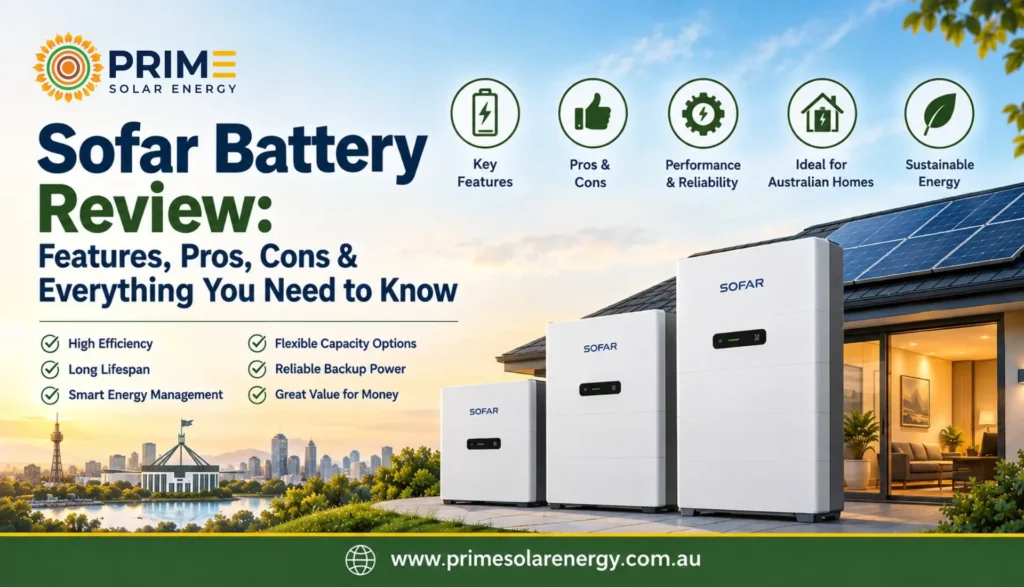
At Prime Solar Energy, we help Australian homeowners move from grid dependence toward genuine energy independence, and one question we hear constantly is whether Sofar deserves a place on that shortlist. This Sofar Battery Review shares what we’ve learned from installing and servicing Sofar systems across dozens of homes, without the manufacturer marketing gloss.
We’ll walk through the BTS and PowerAll ranges, look honestly at where Sofar battery technology shines and where it falls short, and compare it against a direct rival, Fox ESS, so you can judge the fit for your own roof.
You’ll also find specification tables for each model, a rebate overview for Canberra and NSW households, and an FAQ covering the questions we get asked most—so if you’re wondering whether a Sofar solar battery earns its reputation, this guide gives you a clear, practical answer.
Who Is Sofar Solar?
Sofar Solar is a solar technology manufacturer that has grown into one of the more visible battery and inverter brands across the Australian residential market. The company builds hybrid inverters, battery storage modules, and monitoring software as an integrated ecosystem rather than selling isolated components, which is part of why many installers pair a Sofar inverter with a matching Sofar battery rather than mixing brands. Current Sofar battery models sit on the Clean Energy Council’s approved product list, a requirement for any battery that wants to qualify for Australian government rebates, and that approval status matters more than most marketing copy when deciding what goes on your wall.
Sofar Battery Review: Is Sofar Battery Good?
This is the question every homeowner researching a Sofar solar battery actually wants answered, so let’s be direct. Yes, on the fundamentals, a Sofar solar battery is a genuinely competent piece of equipment. It uses Lithium Iron Phosphate (LFP) chemistry, the same stable, thermally forgiving cell technology used in most premium batteries today, rather than older nickel-based lithium-ion chemistry that carries a higher fire risk. The battery pairs with Sofar’s own HYD and ME series hybrid inverters as a single coordinated system, with the Battery Management System actively monitoring voltage, temperature, and cell balance around the clock.
Where the answer gets more nuanced is in the extras. Sofar batteries don’t include built-in fire suppression, unlike a small number of premium competitors, and the companion monitoring app, while functional, is fairly basic compared with some rivals. Neither issue is a dealbreaker for most households, but both are worth knowing before you commit.
Sofar Battery Range: BTS Series and PowerAll Explained
Sofar currently sells two main battery product lines in Australia, and understanding the difference is the first step in any serious Sofar Battery Review.
BTS Series – a modular, DC-coupled battery that requires a compatible Sofar hybrid inverter. It’s built for homeowners who want to start small and expand later, since additional modules simply stack on top of the existing tower without extra communication cabling.
PowerAll – an all-in-one unit that houses the battery, hybrid inverter, and BMS inside a single enclosure. It suits homeowners who want a tidier, single-cabinet installation rather than a separate inverter and battery stack.
Sofar Battery Specifications: BTS 5K Module
| Specification | Detail |
| Battery chemistry | Lithium Iron Phosphate (LFP) |
| Nominal capacity per module | 5.12 kWh |
| Usable capacity per module | 4.75 kWh |
| Stackable configurations | Up to 4 modules (20.48 kWh nominal) |
| Operating temperature | -20°C to +50°C |
| IP rating | IP65 (outdoor-capable) |
| Cooling | Natural convection |
| Communication | CAN bus |
| Product warranty | 10 years, 70% capacity retention guaranteed |
| Installation | Wall or floor-mounted |
Sofar Battery Specifications: PowerAll Modules
| Specification | Detail |
| Battery chemistry | Lithium Iron Phosphate (LFP) |
| Usable capacity per module | Approx. 4.75 kWh |
| Stackable configurations | 1–6 modules per stack (4.75–28.5 kWh usable) |
| Output per module | Approximately 2.5 kW |
| Multi-stack support | Yes, stacks can be paralleled for larger systems. |
| Form factor | Integrated battery, hybrid inverter, and BMS |
| Inverter warranty | 10-year standard, extendable to 15–20 years |
Sofar Battery Lifespan and Everyday Performance
Sofar battery lifespan is generally tied to its 10-year product and performance warranty, with the manufacturer guaranteeing at least 70% capacity retention by the end of that period, backed by a throughput allowance of roughly 3.84 MWh per usable kWh on the BTS 5K. A well-installed, correctly ventilated Sofar battery should still be doing useful daily work well past the decade mark.
Round-trip efficiency sits in the 94–96% range depending on the model, and depth of discharge runs at roughly 90–95%, so very little stored energy is wasted before you draw it back out in the evening. Continuous output for a typical single or dual-module setup lands around 3–5 kW, enough to run a fridge, lighting, a TV, and general household loads simultaneously, while larger PowerAll configurations can push peak output toward 8–10 kW.
Features Worth Knowing About
- One-button start-up – the BTS series is designed for straightforward commissioning, with automatic configuration rather than complex manual settings.
- VPP-ready hardware – the Sofar Cloud platform supports Virtual Power Plant participation, which is directly relevant to eligibility for state-based demand-response incentives.
- App-based monitoring – the Sofar app tracks battery charge, solar generation, and household consumption in real time, though it’s simpler than some premium competitor apps.
- Blackout backup capability—when configured with emergency power supply (EPS) functionality on a compatible HYD inverter, a Sofar battery can keep essential circuits running during a grid outage.
- Modular scalability – both the BTS and PowerAll ranges let you add capacity later rather than forcing you to size for maximum future need on day one.
Pros and Cons of Sofar Battery
Pros
- LFP chemistry that’s stable, heat-resistant, and long-lasting
- Modular design lets you expand capacity as your needs grow
- Sits on the Clean Energy Council’s approved product list for rebate eligibility
- Solid 10-year warranty with a clear capacity-retention guarantee
- VPP-ready for participation in state demand-response schemes
- Strong depth of discharge and round-trip efficiency for the category
Cons
- No built-in fire suppression system
- The BTS series requires a compatible Sofar hybrid inverter, limiting mix-and-match flexibility
- The monitoring app is functional but fairly basic
- Performance can suffer if installed incorrectly or by an unaccredited installer
Sofar Battery vs. Fox ESS: How Do They Compare?
Fox ESS is one of the most common names homeowners weigh up against Sofar, so no Sofar Battery Review would be complete without a direct look at how the two stack up.
| Feature | Sofar Battery (BTS/PowerAll) | Fox ESS Battery |
| Battery chemistry | LFP | LFP |
| Design | Modular, DC-coupled, or all-in-one | Modular, DC-coupled |
| Inverter compatibility | Requires Sofar HYD/ME inverter (BTS) | Requires Fox ESS hybrid inverter |
| VPP compatibility | Yes, via Sofar Cloud | Yes, model-dependent |
| CEC approved | Yes. | Yes. |
| Warranty | 10 years, 70% capacity retention | Typically 10 years; terms vary by model |
| Local Australian support | Growing installer and warehouse network | Established installer network |
| Fire suppression | Not built-in | Not built-in on most models |
In practice, the two brands are closer in capability than the marketing on either side suggests. The decision usually comes down to which hybrid inverter ecosystem your installer already works with and which brand they can service quickly if something needs attention. If you’re unsure which fits your roof better, it’s worth asking your installer to get a quote for both configurations before you commit.
Sofar Battery Rebates: What’s Available in Canberra and NSW
Government support is a major reason so many households are seriously considering a Sofar solar battery right now, and if your search began with “Sofar Battery Review Australia,” this is likely the section you were looking for. Homeowners across Canberra and the broader NSW region have more layers of support available than most people realise.
At the federal level, the Cheaper Home Batteries Program provides an ongoing discount on eligible small-scale battery installations, and full eligibility details are published by DCCEEW for anyone wanting the fine print.
New South Wales runs its own incentive on top of that federal discount. You can check current battery incentive details on the NSW Government’s energy site, and the government has confirmed eligible households can combine the NSW incentive with the Commonwealth’s battery discount for a larger combined saving.
Canberra households also have the ACT Government’s Sustainable Household Scheme, a low-interest loan usable toward battery storage alongside other efficiency upgrades. The ACT Government has reported the scheme has delivered more than $100 million in cumulative household bill savings since launch, with battery systems now making up the majority of new loan applications.
Because eligibility rules and CEC-approved model lists change fairly often, it’s worth confirming your specific entitlement before finalizing a system.
Final Thoughts
Taken as a whole, this Sofar Battery Review lands on a fairly confident conclusion: Sofar has built a technically sound battery range, backed by a genuine 10-year warranty, and increasingly well supported by local installers across NSW and the ACT. It isn’t the flashiest option on the market, and the app and fire-suppression gaps are worth weighing against premium alternatives, but as a rebate-eligible, modular LFP battery for Australian homes, it holds up well.
If you’re comparing a Sofar solar battery against other CEC-approved options for your own roof, the team at Prime Solar Energy can walk you through the specifics for your household. Contact us to discuss which configuration suits your energy use, or get a quote directly if you already know Sofar is the direction you want to go.
Frequently Asked Questions
Is Sofar battery good for Australian conditions?
Yes. Sofar batteries use LFP chemistry rated for a wide operating temperature range and carry an IP65 rating on the BTS series, suiting outdoor installation in most Australian climates, including Canberra’s cold winters.
What is the typical Sofar battery lifespan?
Sofar backs its range with a 10-year product and performance warranty, guaranteeing at least 70% capacity retention at the end of that period under normal use.
Is Sofar eligible for the NSW and federal battery rebates?
Current Sofar battery models sit on the Clean Energy Council’s approved product list, the baseline requirement for both the federal Cheaper Home Batteries Program and NSW’s state-based incentive.
Sofar battery vs. Fox ESS—which should I choose?
Both are LFP, modular, CEC-approved options with comparable warranties. The better fit usually depends on which inverter ecosystem suits your installation and which brand your local installer supports.
Can I expand my Sofar battery later if my energy needs grow?
Yes. Both the BTS and PowerAll ranges are modular, so you can generally add additional modules to an existing stack.
Does a Sofar battery keep the power on during a blackout?
With an EPS-enabled configuration on a compatible inverter, yes—a Sofar battery can supply backup power to selected circuits during a grid outage.