With power bills climbing every quarter and grid blackouts becoming more common across Australia, home battery storage has gone from a “nice-to-have” to a genuine household essential. If you’ve already got solar panels — or you’re planning to install them — the trick to saving real money is capturing that free daytime energy and using it after dark. That’s where the Hinen home battery comes in.
Over the past couple of years, Hinen has become one of the fastest-growing names in the Australian residential storage market — a budget-friendly, highly modular alternative to household names like Tesla and Sonnen. But is it actually worth your money? In this Hinen battery review, we break down real Australian pricing, round-trip efficiency, blackout backup speed, CEC approval status, and what the Hinen battery warranty actually covers — so you can decide with confidence before you book an installer.
Is Hinen CEC Approved, and Where Are Hinen Batteries Made?
Whenever a newer brand gains traction, the first question most homeowners ask is: “Where are Hinen batteries made, and are they even approved for use here?”
Hinen New Energy is a subsidiary of the Hinen Group, a publicly listed Chinese electronics manufacturer founded in 2004. Hinen’s battery and inverter engineering is carried out across production centres in Dongguan and Ji’an (China) and Hai Duong and Bac Giang (Vietnam), under international manufacturing standards, with a specific focus on Lithium Iron Phosphate (LiFePO₄/LFP) cells, smart battery management software, and hybrid inverters.
Hinen established a dedicated Australian entity — Hinen Australia Pty Ltd — with a support office in North Sydney in late 2023, giving local customers a genuine in-country contact point for support and warranty claims. Before release, Hinen batteries go through thermal and electrical stress testing intended to handle everything from salty coastal air to scorching inland heat, and the company works with CEC-accredited installers to deliver compliant, grid-ready systems.
Yes — Hinen’s core residential models (including the B5000 series) are Clean Energy Council (CEC) listed, which matters because CEC approval is a requirement to access most state and federal battery rebates, including the Cheaper Home Batteries Program.
Is Hinen Battery good for the Canberra climate?
If you just want the short answer to Is Hinen battery good? —yes, absolutely. It delivers top-tier performance, rock-solid reliability, and impressive specs without the eye-watering price tag of some legacy brands.
Here are a few practical reasons why the Hinen solar battery is getting such positive feedback from both solar installers and everyday homeowners:
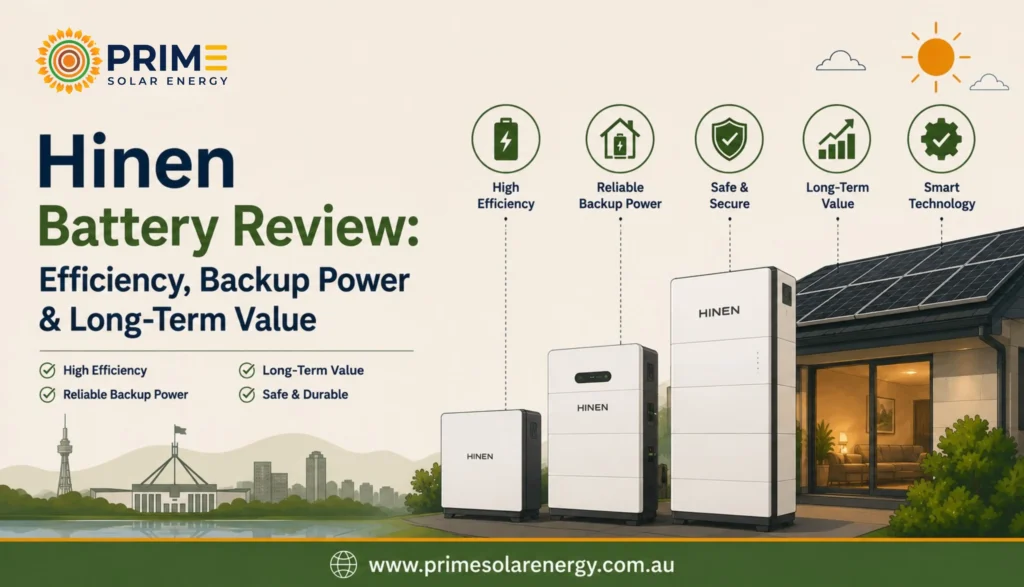
- Top-Notch Efficiency: Hinen’s high-voltage stackable units deliver a round-trip efficiency between 95% and 98%. That simply means almost none of your solar energy is wasted during the charging and discharging process.
- Start Small and Add Later: You don’t have to buy a massive system on day one. You can start with a modest 5 kWh setup and stack extra modules all the way up to 50 kWh as your family grows or your power needs increase.
- Seamless Blackout Protection: When the main power grid drops out, Hinen’s automatic transfer kicks in within 10 milliseconds (≤ 10 ms). It is so fast that your desktop computers, Wi-Fi, and fridge won’t even register the flicker.
- Built-in Safety Features: The battery packs include 5-layer physical and electrical safety systems, including automated thermal sensors and active aerosol fire suppression materials.
- Weather-Resistant Build: Thanks to an IP65 outdoor rating, you can safely mount these units on outside brick walls or inside garages without worrying about dust, rain, or heat.
If you are curious whether your current roof setup can handle a battery retrofit, feel free to drop your details into our free portal to get a quote tailored specifically to your home’s power consumption.
Hinen Battery Range & Technical Specifications
Hinen offers two primary paths depending on how your home is wired: low-voltage modular stackable batteries (like the B5000 series) and high-voltage all-in-one setups (A Series & B8900M clusters).
General Hinen Battery Lineup at a Glance
| Feature / Specification | B5000 / B5000-W Series | B8900M-HA High-Voltage Series | A Series All-in-One Systems |
| Battery Chemistry | LiFePO₄ (Lithium Iron Phosphate) | LiFePO₄ (Lithium Iron Phosphate) | LiFePO₄ (Lithium Iron Phosphate) |
| Capacity Range | 5 kWh to 50 kWh (Up to 10 stacked) | 8.9 kWh to 26.7 kWh per tower | 8.9 kWh to 53.4 kWh complete system |
| Round-Trip Efficiency | ~95% | 95.5% – 96.5% | Up to 97.5% – 98% |
| Emergency Switch Time | ≤10 ms (UPS Class) | ≤10 ms (UPS Class) | ≤10 ms (UPS Class) |
| Weather Protection | IP65 (Indoor & Outdoor) | IP65 (Indoor & Outdoor) | IP65 (Indoor & Outdoor) |
| Working Temperature | -20°C to 55°C | -20°C to 55°C | -20°C to 55°C |
| Factory Warranty | 10 Years | 10 Years | 10 Years |
Popular Hinen Models & How They Compare
| Model Name & Type | Architecture & Capacity | Best Suited For |
| Hinen B5000-W (Low-Voltage Stackable) | 5.12 kWh base block; scalable up to 50 kWh. Works with most 3rd-party hybrid inverters. | Budget-conscious homeowners who want a solid starting point and the freedom to expand later. |
| Hinen A Series H10S (Single-Phase) | 10 kW single-phase hybrid inverter with 35.6 kWh to 53.4 kWh storage capacity. | Medium-to-large single-phase homes with heavy evening appliance usage and EV chargers. |
| Hinen A Series H15T / H20T (Three-Phase) | 15 kW to 20 kW three-phase hybrid inverter with up to 53.4 kWh battery storage. | Larger multi-story homes, rural properties, or commercial buildings running heavy three-phase HVAC loads. |
Working out the right size for your home comes down to when you use power and what appliances you run during peak hours. You can get in touch with an expert through our contact us page to get a clear, custom recommendation.
Which Hinen Model Suits Your Home?
| Household type | Recommended Hinen model | Why |
|---|---|---|
| Small home, single-phase, budget-first | B5000 (1–2 modules) | Lowest entry cost, expandable later |
| Growing family with EV plans | B5000 (3+ modules, stackable) | Add capacity in 5.12 kWh steps as needs grow |
| Large single-phase home, heavy evening use | A Series H10S | 10 kW inverter, up to 53.4 kWh storage |
| Large multi-storey or rural three-phase property | A Series H15T/H20T | 15–20 kW three-phase inverter, handles big HVAC loads |
Hinen Battery Warranty & Real-World Lifespan
A battery is a long-term investment, so you want to know the manufacturer stands behind their product. The standard Hinen battery warranty gives you a full 10-year warranty covering the battery modules, the built-in management software, and core hardware components.
Because Hinen manufactures its packs using high-grade LFP cell chemistry, these units are rated to endure more than 6,000 full charge-and-discharge cycles. To put that into perspective, if you cycle the battery completely once every single day, it will still hold around 70% or more of its original factory capacity after an entire decade of use.
Government Rebates & Incentives (ACT & NSW)
If you live in Canberra or NSW, government programs can help take a bite out of the upfront cost of adding battery storage to your property.
- NSW Peak Demand Reduction Scheme (PDRS): Property owners in New South Wales can unlock financial incentives when installing battery systems linked to a smart energy management setup. You can read up on the latest state rebate details on the official NSW Energy Incentive Programs page.
- ACT Sustainable Household Scheme: If you are based in Canberra, the ACT Government offers zero-interest loans to help cover the cost of energy-efficient home upgrades, including battery storage. Check your eligibility directly on the ACT Government Everyday Climate Choices portal.
- Federal Small-scale Renewable Energy Scheme (SRES): While the federal STC program mostly applies to solar panels, pairing a battery with a new or upgraded rooftop solar array maximizes your overall financial returns. Learn more on the Clean Energy Regulator (CER) platform.
Sorting through all these government guidelines can feel overwhelming, but working with a seasoned installer like Prime Solar Energy makes it simple to claim every dollar you are entitled to.
Hinen batteries are eligible for the Federal Cheaper Home Batteries Program plus applicable state incentives (see below), which can bring the effective cost down substantially. For an exact, no-obligation quote based on your roof, usage pattern, and phase type, get a free custom quote from Prime Solar Energy.
Hinen vs. Tesla Powerwall
It is impossible to talk about home batteries without mentioning Tesla. But when you compare Hinen vs. Tesla Powerwall, a few key practical differences stand out:
| Feature Comparison | Hinen Home Battery System | Tesla Powerwall (Powerwall 2 / 3) |
| Cell Chemistry | LiFePO₄ (Lithium Iron Phosphate) – Exceptionally stable and safe. | NMC / LFP (Varies by generation/model). |
| Expansion Options | Highly flexible (Add extra 5 kWh blocks anytime). | Fixed block size (13.5 kWh per battery). |
| Inverter Compatibility | Wide support for standalone low-voltage or built-in single/three-phase inverters. | Built-in single-phase inverter (Powerwall 3). |
| Switchover Speed | Ultra-fast ≤10 ms (UPS grade). | Around 50 ms to 100 ms. |
| Mobile App | Hinen app with real-time monitoring and smart scheduling. | Tesla app ecosystem. |
Tesla certainly has great brand recognition, but Hinen wins hands-down when it comes to flexibility. Instead of paying upfront for a fixed 13.5 kWh block you might not fully use, a hinen home battery lets you buy only the capacity you need today and click extra modules into place later down the road.
Pros and Cons of Hinen Batteries
To give you a balanced view, here is a quick look at where Hinen shines and where there is room for improvement:
Pros:
- Modular and Expandable: Stack extra battery blocks as your energy needs increase without replacing your existing inverter.
- Lightning-Fast Backup: Switches over in less than 10 milliseconds, keeping computers, lights, and appliances running smoothly during grid outages.
- Safer Battery Tech: LFP chemistry provides impressive heat tolerance and physical safety.
- 3-Phase Power Support: Handles unbalanced loads easily, making it great for larger homes with big ducted air-conditioning systems.
- Easy App Control: Keep tabs on your solar generation, battery storage levels, and power usage from your phone.
Cons:
- Newer Name in Australia: While growing fast globally, Hinen is still establishing itself against decades-old brands in the local market.
- Requires Trained Installers: To get the fast UPS backup wired correctly, you need an installer who knows Hinen’s system architecture inside out.
Final Verdict: Is the Hinen Battery Worth It?
Weighing its competitive entry pricing, strong technical specs, and CEC-approved status, Hinen is a genuinely strong option for Australian homeowners who want modular, future-proof storage without paying Tesla-level prices. The LFP chemistry, IP65 weatherproofing, and sub-10ms blackout switchover deliver the safety and reliability needed for Australia’s climate — and the ability to start small and scale later means your first battery purchase doesn’t have to be your last.
Ready to see what a Hinen battery would cost for your specific home? Get a free, no-obligation quote from Prime Solar Energy — our accredited installers will size a system to your actual usage, confirm current rebate eligibility, and handle the CEC-compliant installation from start to finish.
Frequently Asked Questions
Is the Hinen battery any good?
Yes — independent testing and early Australian customer feedback show strong round-trip efficiency (up to 98% on the A Series), sub-10ms blackout switchover, and a 10-year warranty that’s competitive with established brands. Its main limitation is a shorter Australian track record than legacy competitors.
Is Hinen CEC approved?
Hinen’s core B5000 series and several A Series configurations are Clean Energy Council listed, which is required for rebate eligibility — confirm the specific model’s current listing status with your installer, as approvals are added over time.
Can I add more storage capacity later?
Yes. Hinen’s stackable modular design lets an installer add extra battery modules onto your existing tower whenever your energy needs increase, in 5.12 kWh increments.
What will a Hinen battery power during a blackout?
Depending on how your electrician wires your backup circuits, a Hinen battery will keep lights, fridges, Wi-Fi, and general power outlets running. Larger three-phase A Series setups can extend backup to ducted air conditioning and pool pumps.
How long will a Hinen battery last?
Hinen batteries use LiFePO₄ cells rated for 6,000–8,000+ charge cycles. Backed by a 10-year warranty, a realistic practical lifespan under normal daily household use is 12–15+ years.