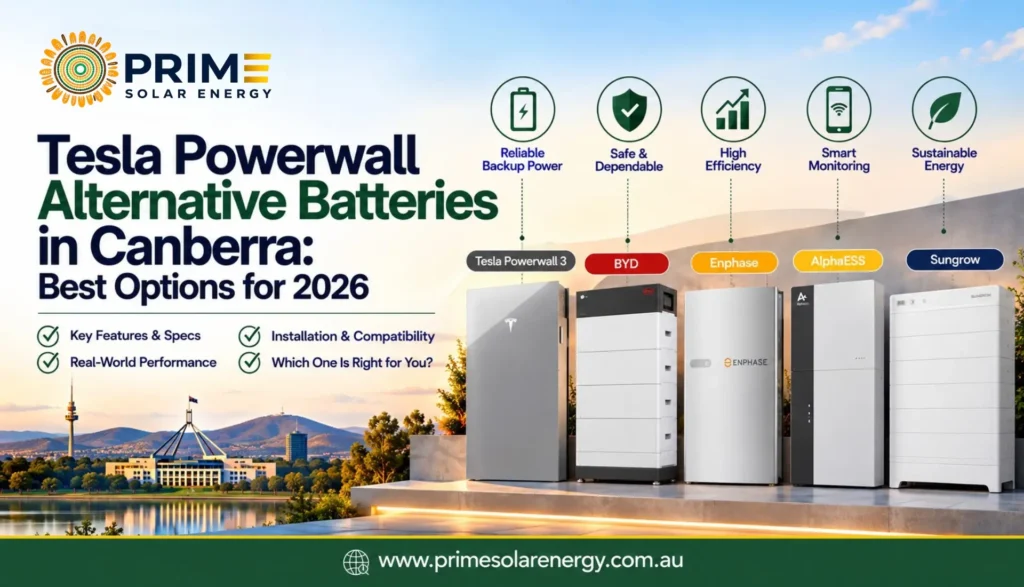
Looking for a Tesla Powerwall alternative in Canberra? There are excellent options that deliver equal or better performance, often at a lower cost.
BYD HVM, Sungrow SBR, Alpha ESS and Enphase IQ all use the same safe LFP chemistry as the Powerwall 3. They offer competitive pricing, scalable capacity and strong warranties suited to Canberra’s climate, and all qualify for the federal Cheaper Home Batteries Program rebate in 2026.
At Prime Solar Energy, we install these top-rated batteries across Canberra and the ACT, helping homeowners and businesses cut energy bills and get more from their solar.
What Is a Home Battery Storage System?
A home battery storage system stores excess electricity generated by your solar panels during the day and makes it available when the sun isn’t shining at night, on cloudy days, or during a grid outage.
In Canberra’s climate, where winter days are shorter and temperatures can plunge below zero, a reliable battery system is essential to maximise self-consumption and protect against rising energy costs from Evoenergy’s network tariffs, which have seen further evening peak increases in the 2025–26 tariff period.
The Tesla Powerwall is one of the most well-known home batteries on the market, but it’s not always the most accessible or cost-effective option for Canberra households. That’s where quality alternatives come in.
Top Tesla Powerwall Alternatives — Compared (2026 Data)
Here is a fully updated side-by-side comparison based on verified 2026 specifications and installed pricing in the Canberra / ACT market:
| Feature | Tesla Powerwall 3 | BYD HVM 11.0 | Sungrow SBR096 | Alpha ESS SMILE5 | Enphase IQ Battery 5P |
| Usable capacity | 13.5 kWh | 11.04 kWh | 9.6 kWh | 13.34 kWh per module (15.07 kWh module also available) | 5.0 kWh per unit |
| Chemistry | LFP | LFP | LFP | LFP | LFP |
| Warranty | 10 years | 10 years (60% capacity retention) | 10 years (70% capacity retention) | 10-year product warranty, 70% capacity retention at 10 years | 15 years (up to 6,000 cycles, >60% capacity) |
| Scalable | Yes, up to 54 kWh | Yes, 8.3-22.1 kWh per stack | Yes, 9.6-25.6 kWh per stack, up to 4 stacks (100 kWh) | Yes, up to 80 kWh | Yes, up to 4 units (20 kWh) |
| Inverter included | Yes (built-in hybrid inverter) | No (requires a compatible hybrid inverter) | No (requires a Sungrow hybrid inverter) | Yes (built-in 5 kW hybrid inverter) | Yes (built-in micro inverters, AC-coupled) |
| Installed price (AUD) | Get a quote | Get a quote | Get a quote | Get a quote | Get a quote |
| VPP | Yes | Depends on inverter and retailer program | Depends on inverter and retailer program | VPP Ready | Depends on retailer and VPP program |
| Federal rebate | Eligible if on the CEC-approved list and VPP-capable | Eligible if on the CEC-approved list and VPP-capable | Eligible if on the CEC-approved list and VPP-capable | Eligible if on the CEC-approved list and VPP-capable | Eligible if on the CEC-approved list and VPP-capable |
Rebate note: To qualify for the Federal Cheaper Home Batteries Program, the battery must be on the Clean Energy Council (CEC) approved product list and be VPP-capable, though you don’t have to join a VPP. Since 1 May 2026, the STC factor is 6.8 (May-Dec 2026), dropping to 5.7 on 1 January 2027. The first 14 kWh gets the full factor, 14-28 kWh gets 60%, and 28-50 kWh gets 15%. Rebate amounts depend on installation date and battery size. To find out what you’d get, talk to Prime Solar Energy or get a quote today.
Best Tesla Powerwall Alternatives for Canberra Homes
1. BYD HVM Battery — Best All-Round Alternative
BYD (Build Your Dream) is one of the world’s largest lithium battery manufacturers, and their HVM (High Voltage Module) series is a favourite among Canberra solar installers for good reason.
- LFP chemistry — the same safe, cold-weather-friendly technology as Powerwall 3
- Highly scalable: stack multiple modules to match your home’s energy needs
- Compatible with most major hybrid inverters (Fronius, SMA, GoodWe, Huawei)
- Excellent thermal performance — handles Canberra’s sub-zero winters reliably
- Strong 10-year warranty with proven degradation rates
- Qualifies for the federal Cheaper Home Batteries Program rebate
For Canberra families running 20–30 kWh per day, BYD HVM offers a genuinely cost-effective path to energy independence without compromising on quality.
2. Sungrow SBR Series — Best Value for Money
Sungrow is one of the world’s top inverter and battery manufacturers, and the SBR series continues to lead the ACT solar market for value in 2026.
- Stackable LFP modules from 9.6 kWh up to 100 kWh for commercial applications
- Integrated battery management system (BMS) for smart energy dispatch
- Pairs seamlessly with Sungrow hybrid inverters for a single-brand ecosystem
- Suitable for both new solar installs and retrofit onto existing systems
- AC and DC coupling options available
- VPP-compatible, qualifying for maximum federal rebate benefits
Homeowners in Gungahlin, Belconnen, and Tuggeranong have found the Sungrow SBR to be a reliable and affordable choice with strong local installer support through Prime Solar Energy.
3. Alpha ESS Smile5 — Best Flexible Modular Battery
Alpha ESS has carved out a strong niche in the Australian market with its modular Smile series, which can grow with your energy needs over time.
- Start small and expand capacity as your budget allows
- Smart energy management app with real-time monitoring
- Warranty: 5-year product warranty plus 10-year performance warranty (confirm with installer at time of purchase as documentation varies)
- Excellent compatibility with most solar inverter brands
- Eligible for both the federal Cheaper Home Batteries Program and the ACT Sustainable Household Scheme
4. Enphase IQ Battery — Best for Microinverter Systems
If your Canberra home already runs Enphase microinverters, the Enphase IQ Battery is a natural and highly efficient pairing.
- Industry-leading 15-year warranty — the longest in the market
- AC-coupled design works with most existing solar systems
- Modular and scalable from 3.5 kWh to 10.5 kWh+
- Exceptional safety record; no thermal runaway incidents reported
- Ensemble technology for reliable blackout protection
- VPP-compatible and eligible for federal rebate
Why Canberra Homeowners Are Choosing Alternatives to Tesla Powerwall
The Tesla Powerwall has strong brand recognition, but several practical factors have led Canberra residents to look beyond it:
- Higher upfront cost: At $13,000–$19,000 installed, the Powerwall sits at the top of the price range
- Limited installer network: Fewer Canberra installers are Tesla-certified compared to multi-brand installers like Prime Solar Energy
- Inverter dependency: Powerwall 3 includes an integrated inverter — if you already have a quality inverter, you’re paying for duplication.
- Brand alternatives have caught up: BYD, Sungrow, and Alpha ESS now match Powerwall 3 on chemistry (all LFP), warranty, and performance.e
That said, the Powerwall 3 is a premium, well-engineered product and is now stackable up to 54 kWh (four units), making it viable for larger homes or those planning future expansion.
Government Rebates 2026: What Canberra Homeowners Need to Know
Two programmes can work together to reduce your out-of-pocket cost for a home battery.
Federal Cheaper Home Batteries Program
The Cheaper Home Batteries Program launched on 1 July 2025 and gives an upfront discount on eligible batteries through Small-scale Technology Certificates (STCs). Since 1 May 20,26 the STC factor is 6.8 (May-Dec 2026), dropping to 5.7 on 1 January 2027. That works out to roughly $250-$270 per kWh on the first 14 kWh of usable capacity, with a reduced rate above that.
- 13.5 kWh Powerwall 3: approximately $3,400-$3,700 rebate
- 10-11 kWh BYD/Sungrow: approximately $2,600-$3,000 rebate
- Maximum rebate: approximately $6,500-$7,000 (for very large systems, as only the first 50 kWh is supported and larger capacity is tiered down)
- To be eligible, the battery must be on the Clean Energy Council (CEC) approved product list and be VPP-capable. You do not have to join a VPP.
- The rebate depends on your installation date and battery size, so confirm the exact figure and CEC listing for your chosen model with your installer.
ACT Sustainable Household Scheme
The ACT Government’s Sustainable Household Scheme offers low-interest loans (not a grant) to eligible Canberra homeowners. Loans start at $2,000 and are available at 3% interest over up to 10 years, with no upfront fees. New applicants from 1 July 2026 can borrow up to $20,000 (up to $15,000 if you applied before that date). Applicants must pass a credit assessment and complete a free energy-efficiency workshop.
- The loan can finance the remaining cost of a battery after the federal rebate.
- Check eligibility at climatechoices.act.gov.au
Combined effect: A 10 kWh-class battery at approximately $7,500-$10,000 installed (indicative price) could cost around $4,800-$7,500 after the federal rebate, with the remainder potentially financed through an ACT loan at 3% interest. Ask Prime Solar Energy about using both programmes for your specific situation.
How Much Do Tesla Powerwall Alternatives Cost in Canberra in 2026?
The following pricing reflects current installed costs in the Canberra / ACT market, updated for 2026 and factoring in Evoenergy’s rising evening peak tariffs that increase the value of stored energy:
| Battery System | Usable Capacity | Est. Federal Rebate (from 1 May 2026) |
|---|---|---|
| Enphase IQ Battery 5P | 5.0 kWh | ~$1,250-$1,350 |
| Sungrow SBR096 | 9.6 kWh | ~$2,400-$2,600 |
| BYD HVM 11.0 | 11.04 kWh | ~$2,800-$3,000 |
| Alpha ESS SMILE5 | 13.34 kWh | ~$3,350-$3,650 |
| Tesla Powerwall 3 | 13.5 kWh | ~$3,400-$3,700 |
Rebate = usable kWh × STC factor 6.8 × STC value (~$37-$40). Actual amount depends on installation date and STC market price. The factor drops to 5.7 on 1 January 2027, so the rebate will be lower after that.
Why Canberra’s Climate Demands a Quality Battery
Canberra is one of Australia’s sunniest capitals — but it’s also the coldest. This creates a unique energy storage challenge.
Winter Energy Profile
- Shorter daylight hours mean less solar generation from June–August
- Heating demand spikes — reverse-cycle systems and gas heaters run longer
- Grid electricity costs peak in evenings when solar isn’t generating
- Sub-zero temperatures — all five batteries in our comparison use LFP chemistry, which handles cold far better than older NMC lithium
Summer Energy Profile
- Long sunny days produce surplus solar energy that needs storage
- Cooling loads increase — air conditioners run mid-afternoon and evening
- Time-of-use tariffs from Evoenergy reward overnight battery discharge
The good news: by 2026, all the leading batteries, including the Powerwall 3, have moved to LFP chemistry. This means every battery on our comparison list is well-suited to Canberra’s climate.
Solar Battery Installations Across Canberra and the ACT
Prime Solar Energy services all suburbs across Canberra and surrounding regions. We install Tesla Powerwall alternatives throughout:
- Gungahlin — one of Canberra’s fastest-growing areas with strong demand for new solar + battery systems
- Belconnen — established suburb base with many retrofit battery opportunities
- Tuggeranong — high energy-use households benefit greatly from battery storage in the valley’s cold climate
- Woden & Weston Creek — popular for upgrading older solar systems with new battery storage
- Molonglo Valley (Wright, Coombs, Denman Prospect) — new builds with ideal setups for whole-home battery integration
- Queanbeyan & Jerrabomberra (NSW) — just across the border, we service ACT-adjacent NSW communities
- Palerang region (Bungendore, Braidwood) — ideal for off-grid battery solutions in rural properties
No matter where you are in the greater Canberra region, Prime Solar Energy’s local team can assess your property, recommend the right battery, and handle end-to-end installation and commissioning.
How to Choose the Right Battery Alternative in Canberra
Follow this step-by-step process to find the right battery for your home:
- Analyse your energy bills: Look at your daily kWh consumption across seasons. Canberra winters are 30–50% higher in energy demand.
- Assess your solar system: Is your current inverter compatible with your preferred battery? Retrofit vs. new install matters.
- Determine your goals: Are you focused on bill reduction, blackout protection, VPP participation, or going off-grid?
- Check rebate eligibility first: Confirm your eligibility for the federal Cheaper Home Batteries Program and the ACT Sustainable Household Scheme before committing to a brand.
- Confirm VPP requirements: Until at least April 2026, VPP enrolment is required for the full federal rebate — ask your installer which VPPs are available in Canberra.
- Get multiple quotes: Compare at least 2–3 battery systems from a local, accredited Canberra installer.
- Review warranties carefully: For Alpha ESS, note the split 5-year product / 10-year performance warranty structure. For the longest coverage, Enphase offers 15 years.
- Choose a CEC-accredited installer: Only Clean Energy Council-accredited installers should design and commission battery systems in Canberra.
Common Mistakes When Choosing a Battery
- Assuming all batteries are the same chemistry: As of 2026, the major brands all use LFP — but always confirm, as product lines evolve.
- Undersizing the battery: A 5–6 kWh battery won’t cover a Canberra winter evening — aim for at least 8–10 kWh for meaningful bill reduction.
- Ignoring inverter compatibility: Not all batteries work with all inverters — always confirm before purchasing.
- Overlooking backup capability: Some batteries don’t include blackout protection as standard — confirm with your installer.
- Missing the VPP rebate window: Until the VPP requirement changes in May 2026, not enrolling in a VPP costs you the maximum federal rebate.
- Confusing the ACT loan with a grant: The Sustainable Household Scheme is an interest-free loan, not a cash rebate — you will repay it, but at 0% interest.
- Choosing a non-local installer: Local Canberra installers understand ACT grid regulations, Evoenergy requirements, and network connection rules.
When to Call a Professional Battery Installer?
Battery storage is a sophisticated electrical system. You should engage a licensed, CEC-accredited Canberra installer if:
- Your solar system is 5+ years old, and you want to add battery storage
- You’re building a new home or undertaking a major renovation
- You want blackout protection integrated into your system
- You’re considering joining an ACT virtual power plant (VPP)
- You want to move towards partial or full off-grid operation
- Your current battery system is underperforming or showing errors
Safety Note: Battery storage systems involve high-voltage DC electricity. Never attempt DIY installation. Improper installation can void warranties, breach building codes, and pose serious fire hazards. Always use a licensed electrician and CEC-accredited installer.
Why Choose Prime Solar Energy?
Prime Solar Energy is Canberra’s trusted local solar retailer and battery installer. Here’s why hundreds of ACT homeowners choose us:
- Locally based in Canberra — we know ACT grid rules, Evoenergy requirements, and local rebate schemes inside out
- CEC-accredited design and installation team with positive, verified customer reviews
- We supply and install all major battery brands: BYD, Sungrow, Alpha ESS, Enphase, Tesla Powerwall, and more
- Up-to-date on 2026 federal and ACT rebate programmes — we help you claim every dollar you’re entitled to
- No-pressure, expert advice — we recommend what suits your home, not what earns the highest margin
- End-to-end service: site assessment, system design, installation, grid connection, VPP enrolment, monitoring setup
- Aftercare support: we’re local, so we’re here for warranty claims and ongoing servicing
We’ve helped homeowners from Gungahlin to Tuggeranong, Molonglo Valley to Queanbeyan, take control of their energy costs with smart battery storage solutions.
Ready to explore your options? Visit Prime Solar Energy or contact us today for a FREE, no-obligation battery storage consultation. Our Canberra-based experts will design the right system for your home and budget and make sure you capture every available rebate.
Conclusion
Canberra homeowners in 2026 have access to the best battery storage market conditions ever seen, with strong competing brands, all using safe LFP chemistry, combined with a generous federal rebate programme and ACT interest-free loans that together dramatically reduce the real cost of storage.
Whether you choose BYD, Sungrow, Alpha ESS, Enphase, or even the Powerwall 3 itself, the right battery depends on your home’s energy profile, existing solar system, and goals. Prime Solar Energy’s local Canberra team is here to guide you through every step from initial consultation to VPP enrolment and post-installation support.
Frequently Asked Questions (FAQs)
What is the best Tesla Powerwall alternative in Canberra in 2026?
The BYD HVM, Sungrow SBR, and Alpha ESS Smile series are the top-rated alternatives in Canberra. All use LFP chemistry like the Powerwall 3, with lower installed costs and strong warranty coverage.
Does the Tesla Powerwall 3 use LFP chemistry?
Yes. As of 2026, the Powerwall 3 uses LFP (Lithium Iron Phosphate) — the same safe, cold-weather-friendly chemistry as BYD, Sungrow, Alpha ESS, and Enphase. This is an improvement over older NMC-based models.
Is the Tesla Powerwall 3 scalable?
Yes. The Powerwall 3 can be stacked up to four units, providing up to 54 kWh of total storage, making it a viable option for larger Canberra homes or those planning future expansion.
What is the federal Cheaper Home Batteries Program rebate in Canberra?
The programme offers approximately $336 per kWh of usable battery capacity. For a 13.5 kWh system, that’s around $4,500 in rebates; for a 10 kWh system, around $3,360. VPP enrolment is currently required (until at least April 2026) to access the full rebate amount.
Is the ACT Sustainable Household Scheme a grant or a loan?
It is an interest-free loan, not a grant. Eligible ACT homeowners can borrow up to $15,000 at 0% interest to cover battery installation costs after federal rebates. You repay it over time, but pay no interest.