Average Electricity Bills in Canberra: What You Need to Know
If you’re living in Canberra and wondering about the average electricity bills, it’s important to know that they can vary depending on several factors, including the size of your home, the number of appliances you use, and your lifestyle. As of 2026, the average electricity bill in Canberra for a typical household is between $150 to $300 per month, though this can be higher for larger homes or families with high energy usage. By switching to solar power, however, many households in Canberra are reducing their electricity bills and their carbon footprint. Keep reading to learn more about average electricity costs and how going solar can help. Understanding Average Electricity Bills in Canberra Electricity bills are a significant part of household expenses, and understanding how these charges are calculated can help you manage your energy consumption better. In Canberra, like many other Australian cities, electricity pricing is influenced by various factors such as market trends, weather conditions, and government policies. What Makes Up Your Electricity Bill? Energy Consumption: This is the amount of electricity you use, measured in kilowatt-hours (kWh). The higher your consumption, the higher your bill. Supply Charge: This is a fixed daily charge for connecting your home to the electricity grid, regardless of how much energy you use. Environmental Charges: These are charges for clean energy initiatives like solar energy rebates or sustainability programs. Tariffs: These are the rates you pay per kWh of electricity consumed. They can vary depending on whether you’re on a peak, off-peak, or controlled load tariff. How Do Average Electricity Bills in Canberra Compare to Other Cities? When comparing electricity bills across Australian cities, Canberra often stands out for its relatively moderate electricity costs. However, it’s important to consider specific factors such as the climate, electricity demand, and local regulations. Here’s how Canberra’s average electricity bill compares to some of the other major cities: City Average Monthly Bill Energy Type Canberra $150 – $300 Electricity (Grid) Sydney $200 – $350 Electricity (Grid) Melbourne $180 – $320 Electricity (Grid) Brisbane $160 – $300 Electricity (Grid) From this comparison, we can see that Canberra’s average electricity bill tends to be more affordable than Sydney and Melbourne, although it still varies significantly based on usage patterns and energy providers. Key Factors Influencing Electricity Bills in Canberra Several factors influence the cost of electricity in Canberra: 1. Climate Canberra’s distinct four seasons, including cold winters and hot summers, can significantly increase your energy consumption. In winter, heating systems tend to use a lot of electricity, while air conditioning in the summer leads to a spike in demand. 2. Energy Tariffs The type of tariff you’re on can significantly affect your electricity bill. In Canberra, most households use either time-of-use tariffs, which vary by time of day, or flat-rate tariffs that charge a fixed price for energy used. By switching to solar power, households can offset these costs and even potentially eliminate some of them. 3. Appliance Usage The more electrical appliances you use, the higher your bill. This is especially true for energy-hungry devices like air conditioners, water heaters, and dishwashers. By making simple energy-saving adjustments, you can lower your electricity consumption. How to Lower Your Electricity Bill in Canberra Reducing your electricity bill is not only possible, but it’s also quite straightforward. Here are some tips that can help you lower your energy costs: Switch to Solar Power: Solar energy is the most sustainable option for reducing electricity costs in Canberra. By installing solar panels, you can produce your own energy, significantly reducing your reliance on the grid. Improve Energy Efficiency: Upgrade to energy-efficient appliances, insulate your home, and use smart thermostats to reduce energy consumption. Take Advantage of Off-Peak Tariffs: If you are on a time-of-use tariff, try running high-energy appliances like washing machines during off-peak hours to reduce costs. Switch Providers: Regularly comparing electricity providers and tariffs in Canberra can help you find the most competitive rate. Why Choose Prime Solar Energy for Solar Installation in Canberra? Switching to solar energy in Canberra has never been easier. With Prime Solar Energy, you can expect: Tailored Solar Solutions: We customize solar panel installations to match your energy needs and budget. Expert Installations: Our team of certified professionals ensures that your solar system is installed correctly and efficiently. Long-Term Savings: Solar panels can drastically reduce your electricity bills, with many customers saving up to 50% on their energy costs. Reliable Service: We offer top-quality solar systems and excellent after-sales service, ensuring long-term efficiency and performance. Interested in reducing your electricity bills? Contact Prime Solar Energy for a free consultation on solar panel installations in Canberra today! Local Services in Canberra and Nearby Areas Prime Solar Energy proudly serves not just Canberra, but also surrounding suburbs like Tuggeranong, Belconnen, Gungahlin, and Queanbeyan. We provide high-quality solar panel installation, maintenance, and repair services, ensuring that every home and business in the region can benefit from sustainable, low-cost energy. FAQ: Frequently Asked Questions About Electricity Bills in Canberra H4: 1. How can I reduce my electricity bills in Canberra? Start by upgrading to energy-efficient appliances and consider installing solar panels to offset grid consumption. H4: 2. Why are electricity bills high in Canberra? High electricity bills in Canberra are usually due to increased energy consumption during extreme weather conditions or the type of tariff you’re on. H4: 3. What is the average solar panel installation cost in Canberra? The average cost for solar panel installation in Canberra is typically between $5,000 and $7,000, depending on system size and installation requirements. H4: 4. How do solar panels reduce electricity bills? Solar panels allow you to generate your own electricity, which reduces reliance on the grid and lowers your monthly bill. H4: 5. What are the benefits of solar energy in Canberra? Solar energy helps reduce electricity costs, lower carbon footprints, and increase energy independence, especially in Canberra’s sunny climate. Conclusion In conclusion, understanding the factors that contribute to your electricity bill in Canberra can help you manage your
Tesla Powerwall Alternative Batteries in Canberra: Best Options for 2026
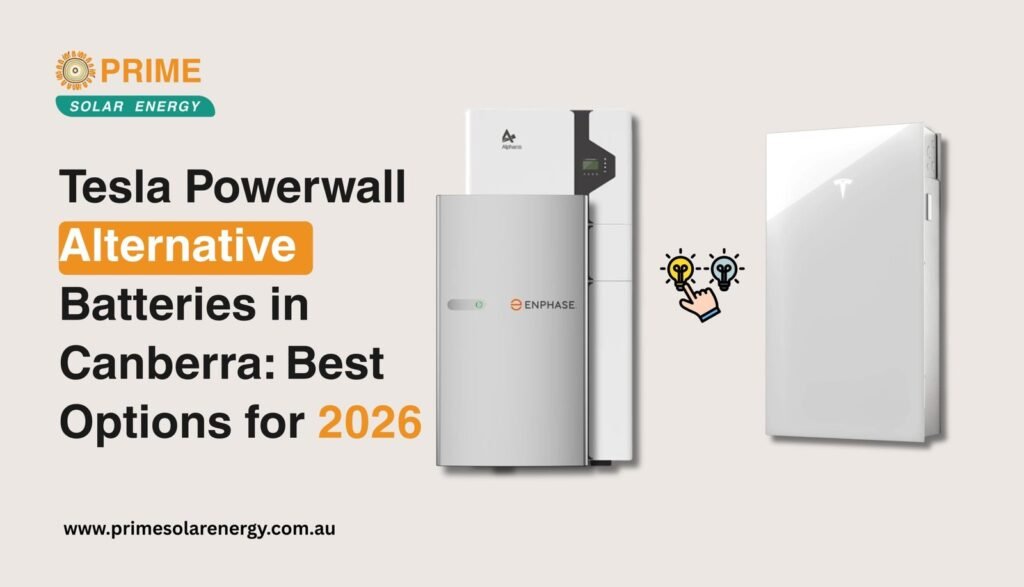
Yes there are excellent Tesla Powerwall alternatives available in Canberra that deliver equal or better performance, often at lower cost. BYD, Sungrow, Alpha ESS, and Enphase are among the top-rated options installed by Prime Solar Energy across Canberra and the ACT and all qualify for the federal Cheaper Home Batteries Program rebate in 2026. If you’re searching for Tesla Powerwall alternative batteries in Canberra, you have several high-quality, cost-effective options that match or outperform the Powerwall in real-world conditions. The best alternatives — including BYD HVM, Sungrow SBR, Alpha ESS, and Enphase IQ — all use the same safe LFP chemistry as the Powerwall 3, with competitive pricing, scalable capacity, and strong warranties suited to Canberra’s unique climate. At Prime Solar Energy, we help Canberra homeowners and businesses find the right battery storage solution to maximise their solar investment and reduce energy bills year-round. What Is a Home Battery Storage System? A home battery storage system stores excess electricity generated by your solar panels during the day and makes it available when the sun isn’t shining at night, on cloudy days, or during a grid outage. In Canberra’s climate, where winter days are shorter and temperatures can plunge below zero, a reliable battery system is essential to maximise self-consumption and protect against rising energy costs from Evoenergy’s network tariffs which have seen further evening peak increases in the 2025–26 tariff period. The Tesla Powerwall is one of the most well-known home batteries on the market, but it’s not always the most accessible or cost-effective option for Canberra households. That’s where quality alternatives come in. Top Tesla Powerwall Alternatives in Canberra — Compared (2026 Data) Here is a fully updated side-by-side comparison based on verified 2026 specifications and installed pricing in the Canberra / ACT market: Feature Tesla Powerwall 3 BYD HVM 11.0 Sungrow SBR096 Alpha ESS Smile5 Enphase IQ Capacity 13.5 kWh 11.0 kWh 9.6 kWh 5.7–17.5 kWh 3.5–10.5 kWh Chemistry LFP Lithium LFP Lithium LFP Lithium LFP Lithium LFP Lithium Warranty 10 years 10 years 10 years 5yr product + 10yr performance 15 years Scalable Yes (up to 54 kWh) Yes Yes Yes Yes Approx. Price (AUD, installed) $13,000–$19,000 $9,500–$12,000 $7,500–$10,000 $8,000–$13,000 $6,000–$10,000 VPP Compatible Yes Yes Yes Yes Yes Inverter Included Yes (Powerwall 3) No No No No Federal Rebate Eligible Yes Yes Yes Yes Yes Note: All five batteries use LFP (Lithium Iron Phosphate) chemistry as of 2026 — safer, more stable in cold weather, and longer-lasting than older NMC lithium. Prices reflect installed costs post-rebate estimates in the ACT market. Contact Prime Solar Energy for a precise quote. Best Tesla Powerwall Alternatives for Canberra Homes 1. BYD HVM Battery — Best All-Round Alternative BYD (Build Your Dream) is one of the world’s largest lithium battery manufacturers, and their HVM (High Voltage Module) series is a favourite among Canberra solar installers for good reason. LFP chemistry — the same safe, cold-weather-friendly technology as Powerwall 3 Highly scalable: stack multiple modules to match your home’s energy needs Compatible with most major hybrid inverters (Fronius, SMA, Goodwe, Huawei) Excellent thermal performance — handles Canberra’s sub-zero winters reliably Strong 10-year warranty with proven degradation rates Qualifies for the federal Cheaper Home Batteries Program rebate For Canberra families running 20–30 kWh per day, BYD HVM offers a genuinely cost-effective path to energy independence without compromising on quality. 2. Sungrow SBR Series — Best Value for Money Sungrow is one of the world’s top inverter and battery manufacturers, and the SBR series continues to lead the ACT solar market for value in 2026. Stackable LFP modules from 9.6 kWh up to 100 kWh for commercial applications Integrated battery management system (BMS) for smart energy dispatch Pairs seamlessly with Sungrow hybrid inverters for a single-brand ecosystem Suitable for both new solar installs and retrofit onto existing systems AC and DC coupling options available VPP-compatible, qualifying for maximum federal rebate benefits Homeowners in Gungahlin, Belconnen, and Tuggeranong have found the Sungrow SBR to be a reliable and affordable choice with strong local installer support through Prime Solar Energy. 3. Alpha ESS Smile5 — Best Flexible Modular Battery Alpha ESS has carved out a strong niche in the Australian market with its modular Smile series, which can grow with your energy needs over time. Start small and expand capacity as your budget allows Smart energy management app with real-time monitoring Warranty: 5-year product warranty plus 10-year performance warranty (confirm with installer at time of purchase as documentation varies) Excellent compatibility with most solar inverter brands Eligible for both the federal Cheaper Home Batteries Program and the ACT Sustainable Household Scheme 4. Enphase IQ Battery — Best for Microinverter Systems If your Canberra home already runs Enphase microinverters, the Enphase IQ Battery is a natural and highly efficient pairing. Industry-leading 15-year warranty — the longest in the market AC-coupled design works with most existing solar systems Modular and scalable from 3.5 kWh to 10.5 kWh+ Exceptional safety record no thermal runaway incidents reported Ensemble technology for reliable blackout protection VPP-compatible and eligible for federal rebate Why Canberra Homeowners Are Choosing Alternatives to Tesla Powerwall The Tesla Powerwall has strong brand recognition, but several practical factors have led Canberra residents to look beyond it: Higher upfront cost: At $13,000–$19,000 installed, the Powerwall sits at the top of the price range Limited installer network: Fewer Canberra installers are Tesla-certified compared to multi-brand installers like Prime Solar Energy Inverter dependency: Powerwall 3 includes an integrated inverter — if you already have a quality inverter, you’re paying for duplication Brand alternatives have caught up: BYD, Sungrow, and Alpha ESS now match Powerwall 3 on chemistry (all LFP), warranty, and performance That said, the Powerwall 3 is a premium, well-engineered product and is now stackable up to 54 kWh (four units), making it viable for larger homes or those planning future expansion. 2026 Government Rebates: What Canberra Homeowners Need to Know This is where the 2026 market becomes very exciting for Canberra battery buyers. Two programmes stack together to
Micro Inverter vs String Inverter: Which Is Best for Your Solar System in Canberra 2026?
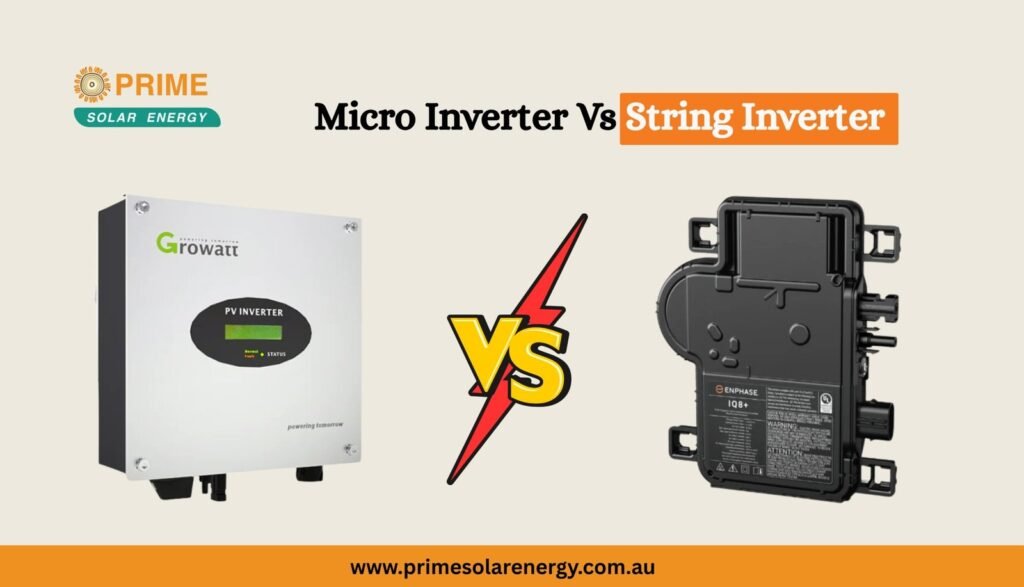
When choosing a solar power system, selecting the right inverter is crucial for optimal energy production. Micro inverters and string inverters are the two most common types, each with its advantages and drawbacks. But what’s the best choice for your home or business in Canberra? Let’s explore both to help you make an informed decision. If you’re in Canberra, especially areas like Queanbeyan, Belconnen, or Woden, this guide will offer valuable insights into which solar inverter is best suited for your needs. Solar power is an excellent renewable energy solution, and choosing the right inverter can significantly impact the overall efficiency and performance of your solar system. What are Micro Inverters? Micro inverters are compact, high-tech devices that are attached to each individual solar panel. They work by converting DC (direct current) power produced by each panel into AC (alternating current) power. This differs from the traditional method, where multiple solar panels are connected in series to a single inverter. Advantages of Micro Inverters: Higher Energy Efficiency (in Shaded or Mismatched Panels): Each micro inverter works independently for each panel, ensuring that the performance of one panel does not affect the others. This is particularly beneficial in areas with partial shading. Better Performance in Shaded Areas: Micro inverters are less affected by shading. In real-world conditions, they can provide a 5-10% efficiency boost in situations with shading or panel mismatch. Scalability: Micro inverters allow for easy future expansion of your solar power system. You can add more panels without disrupting the entire system. Enhanced Reliability: Since each inverter operates independently, if one fails, it does not bring down the entire system. Disadvantages: Higher Initial Cost: Micro inverters are generally more expensive than string inverters. Complex Installation: Installing multiple micro inverters can be more time-consuming and intricate compared to installing a single string inverter. Maintenance Challenges: Micro inverters are often mounted on the roof, which can make them harder to access and service. What are String Inverters? String inverters are the most traditional type of solar inverter. They work by connecting multiple solar panels in a series, which then feeds the DC power to a single inverter for conversion into AC power. This means the inverter handles the combined output of the entire series of panels, making it simpler but potentially less efficient under certain conditions. Advantages of String Inverters: Lower Initial Cost: String inverters are less expensive compared to micro inverters, making them a cost-effective solution for many homeowners. Simpler Installation: With only one inverter to install, the process is faster and more straightforward. Reliability: String inverters are generally reliable and can serve well in installations where shading or panel failures are minimal. Easier to Maintain: Since string inverters are ground-mounted, they are easier to service and access for repairs or maintenance. Disadvantages: Efficiency Loss in Shaded Areas: If one panel is shaded or malfunctioning, it can reduce the efficiency of the entire system. The performance of the other panels in the string will be impacted. Limited Expansion: Adding more panels to a string inverter system can be more complicated, and the system may require more complex modifications. Micro Inverter vs String Inverter: Key Differences In order to make an informed decision, let’s dive deeper into a detailed comparison between micro inverters and string inverters, which will help you determine which is best suited for your home or business in Canberra. Feature Micro Inverters String Inverters Energy Efficiency Higher (independent per panel, 5-10% more in shaded areas) Comparable to micro inverters in ideal conditions (up to 98-99% efficiency) Cost Higher initial investment More affordable initial cost Maintenance More complex (requires servicing of each unit) Easier (one central unit, ground-level access) Shading Impact Minimal (only affected panel) Significant (affects entire string) System Expandability Easier to expand with more panels More difficult to expand Installation Complexity More complex due to multiple inverters Simpler installation Lifespan 15-25 years per unit 10-12 years (typical) Warranty 10-25 years per unit 5-12 years per inverter Monitoring Allows panel-level monitoring (via app) Provides array-level monitoring only When to Choose Micro Inverters Micro inverters are perfect for homeowners or businesses in Canberra and its nearby areas like Tuggeranong, Belconnen, and Weston Creek who want to maximize energy production, especially in environments with partial shading. They’re also ideal for those who plan to expand their solar systems in the future since each panel operates independently. Real-life Example: In Queanbeyan, where many homes have trees that cause shading in the afternoon, micro inverters are the perfect solution. They help ensure that even if one panel is shaded, the others continue to operate efficiently, maximizing energy output. When to Choose String Inverters String inverters are a great choice if you are looking for a more budget-friendly option and have a roof that is completely free from shading. If your property in Canberra enjoys full sun exposure throughout the day, a string inverter can work well for you. It also provides a reliable option for simpler installations and lower maintenance needs. Example: In suburban areas like Woden, where there are minimal trees and no significant shading issues, a string inverter would be more than sufficient, providing a reliable and cost-effective solar solution. Canberra Solar Incentives and Rebates If you are considering a solar power system in Canberra, it’s important to be aware of the available incentives and rebates. The Australian Capital Territory (ACT) offers the Cheaper Home Batteries program, which provides up to $10,000 in rebates for home battery installations. Additionally, there are feed-in tariffs in the ACT, typically ranging from 8-12¢/kWh, which can help offset your electricity costs. When selecting your solar inverter, keep in mind that micro inverters may be a better option for shaded properties, but hybrid inverters which combine string inverter efficiency with battery integration are also a popular choice due to their ability to store excess energy for later use. Cost vs Value: Which is Better for Your Solar System? When deciding between micro inverters and string inverters, the upfront cost is an important consideration. While
Solar Panel Replacement in Canberra: When Should You Upgrade an Older System?
If your solar panels are over 15 years old or your energy bills are creeping back up despite sunny Canberra days, it may be time for a solar panel replacement. Older systems lose efficiency, miss out on modern technology, and often fall short of current energy demands. At Prime Solar Energy, Canberra’s trusted local solar provider, we help homeowners and businesses across the ACT and NSW assess, upgrade, and future-proof their solar investments. Why Solar Panel Lifespan Matters in Canberra’s Climate Canberra experiences one of Australia’s most extreme climates scorching summers regularly above 35°C, frosty winters, and hailstorms that can physically stress solar panels over time. While quality solar panels are built to last, no system performs at peak capacity forever. According to Clean Energy Council Australia, most solar panels are rated for 25–30 years, but their efficiency begins to decline noticeably after the 10–15 year mark. The average degradation rate is approximately 0.5 — 0.8% per year, meaning a 15-year-old system could be operating at 88–92% of its original output at best and much lower if it was a budget system installed during the early solar boom. What Is Solar Panel Degradation? Solar panel degradation refers to the gradual reduction in a panel’s ability to convert sunlight into electricity. It happens due to UV exposure, thermal cycling (heating and cooling), moisture ingress, and micro-cracking. In Canberra, where temperature swings between seasons are dramatic, degradation can occur faster than in more temperate regions. Key Signs You Need Solar Panel Replacement in Canberra Knowing when to replace your system can save you thousands in lost energy savings. Here are the most important warning signs: 1. Significantly Higher Electricity Bills If your power bills have increased despite no major change in household usage, your panels are likely underperforming. This is one of the most common reasons Canberra residents contact Prime Solar Energy for a system assessment. 2. Your System Is More Than 15 Years Old Panels installed during Australia’s solar rush between 2010 and 2013 are now reaching critical age. Many of those early systems used lower-grade components that degraded faster than modern Tier 1 panels. 3. Physical Damage Is Visible Discolouration (yellowing), cracked glass, delamination, or hotspots visible through thermal imaging are all signs that panels need replacing. Canberra’s hailstorms are a leading cause of physical damage to solar arrays. 4. Inverter Failures Are Recurring An inverter typically lasts 10–15 years. If yours has failed once already and your panels are aging, it may be more cost-effective to upgrade the entire system rather than repair individual components. 5. Your System Lacks Battery Compatibility Older systems were not designed with battery storage in mind. Upgrading to a modern system means you can add a solar battery and store excess energy especially valuable during Canberra’s winter months or peak-rate evening hours. 6. You’re Missing Out on Government Rebates Current Australian Government solar rebates and STCs (Small-scale Technology Certificates) are only available on new installations. Upgrading your system means you can access these incentives again, significantly reducing your out-of-pocket costs. Solar Panel Performance Comparison: Old vs. New Systems The table below highlights the performance difference between a typical older system and a modern Tier 1 solar installation: Feature Older system (pre-2015) Modern system (2026) Panel efficiency 14–16% 20–23% Degradation rate (per year) 0.8–1.2% typical; early budget panels often >1% due to quality variations 0.3–0.5% Inverter technology String inverter only Hybrid / microinverter options Battery compatible Rarely Yes (standard) Monitoring app No / limited Real-time smart monitoring Warranty remaining Likely expired 25-year performance warranty Eligible for STCs No Yes — new installs qualify; full panel replacements often qualify if panels are fully swapped (confirm with installer) Avg. output (6.6 kW system) 18–22 kWh/day 26–30 kWh/day The Real Cost of Keeping an Underperforming Solar System Many Canberra homeowners assume it’s cheaper to keep their old system running. The reality is the cost of inaction can be significant. Consider a 5kW system installed in 2011 that now operates at 80% efficiency. If it was originally generating 20 kWh/day, it now produces just 16 kWh/day a loss of 4 kWh daily. At Canberra’s average electricity rate of approximately $0.30/kWh, that’s $1.20 lost every day, or around $438 per year in electricity you’re buying from the grid unnecessarily. Over five years, that’s over $2,190 in avoidable costs before accounting for further degradation, repair bills, or missed battery savings. Upgrading to a new system through Prime Solar Energy can pay for itself faster than many Canberra residents expect, especially when government rebates are applied. What the Solar Panel Replacement Process Looks Like At Prime Solar Energy, we make the upgrade process straightforward and stress-free. Here’s what to expect: Step 1: Free System Assessment Our in-house consultants visit your property in Canberra or surrounds including Queanbeyan, Belconnen, Tuggeranong, Woden, Gungahlin, and Molonglo Valley to evaluate your existing system’s performance using monitoring data and visual inspection. Step 2: Tailored Upgrade Proposal We design a system matched to your current and future energy needs, factoring in EV chargers, battery storage, and home energy usage patterns. Step 3: Removal of Old Panels and Equipment Our CEC-accredited installers safely remove your existing panels, inverter, and wiring. Old equipment is responsibly recycled where possible. Step 4: New System Installation We install CEC-approved Tier 1 solar panels and high-efficiency inverters, backed by strong manufacturer warranties and our own workmanship guarantee. Step 5: Grid Connection and Commissioning We manage all paperwork with Evoenergy (ACT) or your NSW network provider, ensuring your new system is grid-connected and operational without delays. Step 6: Handover and Monitoring Setup You receive a full system briefing and access to real-time monitoring so you can track your production, consumption, and savings from day one. Neighbourhoods in Canberra Where Solar Upgrades Are Most Common Based on the age of housing stock and early solar adoption rates, Prime Solar Energy frequently assists residents upgrading older systems across: Tuggeranong – High concentration of 2010–2013 era installations Belconnen – Many family homes now outgrowing small 1.5–3kW
What Size Solar System Is Best for Homes in Canberra, Queanbeyan, and Nearby
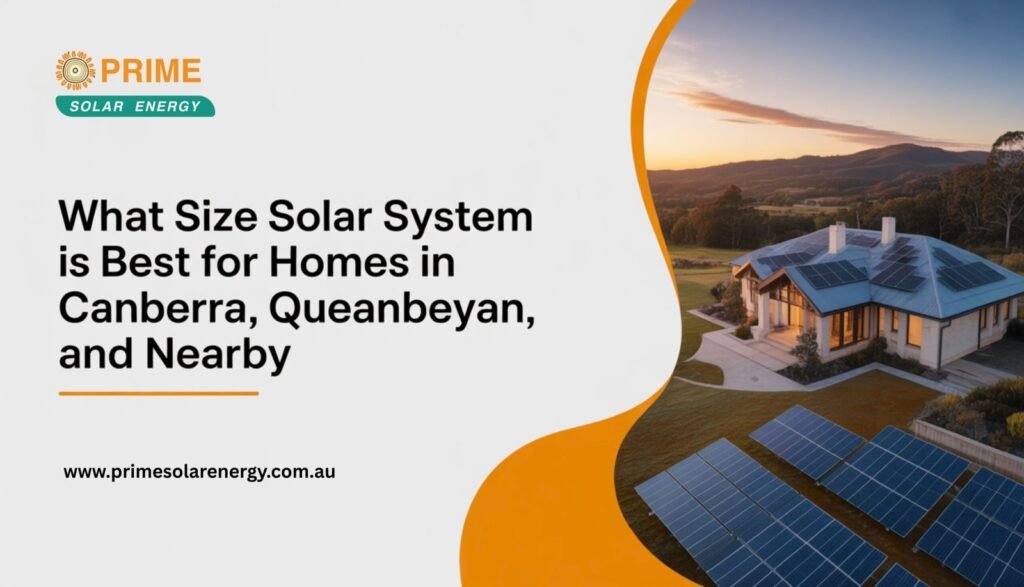
For most Canberra homes, a 6.6kW solar system is the ideal starting point. Larger homes, EV owners, or households planning battery storage should consider 10kW or above. At Prime Solar Energy, we size every system to your exact energy profile and local conditions. Choosing the wrong solar system size is one of the most costly mistakes Canberra homeowners make. Too small and you leave money on the table. Too large and you pay for capacity you never use. At Prime Solar Energy, we’ve helped hundreds of ACT and NSW families go solar this guide gives you clear, honest answers based on real local experience. What Do Solar System Size Numbers Actually Mean? kW (kilowatt) — Your panel array’s rated output capacity kWh (kilowatt-hour) — The energy your home actually consumes or produces Inverter — Converts solar DC power to usable AC power; a 6.6kW array typically pairs with a 5kW inverter Self-consumption rate — The percentage of solar energy you use directly rather than exporting to the grid Choosing the Right System Size for Your Canberra Home The average ACT household uses 18–22 kWh per day — higher than most Australian cities due to Canberra’s cold winters and hot summers. Household Profile Daily Usage Recommended System Payback Period 1–2 people / small unit 8–12 kWh 3kW – 5kW 4–5 years 3–4 people / average home 15–22 kWh 6.6kW – 8kW 4–6 years 4–5 people / larger home 22–30 kWh 8kW – 10kW 4–6 years 5+ people / EV / pool 30–45 kWh 10kW – 13.3kW 5–7 years Battery storage planned Any 10kW+ recommended 6–9 years Is 6.6kW Enough? For most 3–4 bedroom homes in Belconnen, Woden, and Tuggeranong, yes. Real example: A Tuggeranong family paying $550/quarter installed a 6.6kW Prime Solar Energy system and cut their bills to under $80/quarter saving over $1,800 per year. When to Upsize to 10kW You have 4+ bedrooms with high heating and cooling loads You own or plan to buy an electric vehicle You are adding a battery storage system You are switching from gas to all-electric appliances Your home has three-phase power Warning: Installing a 10kW+ system without checking your Evoenergy export limits can waste significant generation. Prime Solar Energy always verifies your network connection before recommending a system size. Canberra’s Unique Solar Conditions Canberra receives 2,200+ sunshine hours per year and 5.5–6.0 peak sun hours daily one of Australia’s best solar locations. However, sizing must account for seasonal variation: Summer: Peak generation, but air conditioning loads are also highest Winter: Output drops 30–40% due to shorter days; cold temperatures actually improve panel efficiency Spring/Autumn: Most consistent generation conditions year-round ACT Government Incentives STCs — Federal rebate reducing upfront cost; larger systems earn more certificates ACT Sustainable Household Scheme — Zero-interest loans for ACT residents on solar and batteries Feed-in tariff — ActewAGL pays for surplus energy exported to the Evoenergy grid Prime Solar Energy handles all STC paperwork and incentive applications as part of every installation. Solar System Costs in Canberra (2024–2025) System Size Installed Cost (After STCs) Annual Savings 3kW $3,500 – $5,500 $800 – $1,200 5kW $4,500 – $7,000 $1,200 – $1,800 6.6kW $6,000 – $9,500 $1,800 – $2,400 10kW $9,000 – $14,000 $2,400 – $3,500 10kW + Battery $17,000 – $25,000+ $3,000 – $4,500 Prime Solar Energy offers flexible finance with no upfront deposit and assists with ACT Sustainable Household Scheme zero-interest loans. Watch out for quotes significantly below market rate they almost always involve non-Tier-1 panels without proper Australian warranty support. Solar Sizing Across Canberra & Nearby Areas Gungahlin — Newer, larger homes. Excellent for 10kW+ systems. Many residents transitioning from gas benefit from upsizing now rather than upgrading later. Tuggeranong — Older homes with higher heating loads. 6.6kW with battery is the most popular combination. We always check roof condition and asbestos status before quoting. Belconnen — Smaller roofs common in townhouses. 5kW–6.6kW suits most properties. Strata approvals required for some buildings Prime Solar Energy assists with this. Queanbeyan (NSW) — STCs still apply, but the ACT Sustainable Household Scheme does not. Essential Energy network rules differ from Evoenergy. We manage all compliance for Queanbeyan customers. Murrumbateman, Yass & Bungendore — Rural properties ideal for 13.3kW+ systems with battery backup. Off-grid solutions also available through Prime Solar Energy. Maintenance Tips for Canberra Solar Owners Clean panels every 6–12 months — Canberra dust and autumn leaf litter reduce output Monitor your inverter daily via its app (Fronius, SolarEdge, etc.) Check roof mounting hardware after severe weather Inspect for bird nesting under panels — very common in ACT suburbs Watch for new tree shading growth each year Review bills quarterly to confirm feed-in credits are correct Book a professional inspection every 2–3 years Never attempt DIY electrical repairs on your solar system. All work must be done by a licensed ACT electrician tampering voids your warranty and risks serious injury. When to Call a Professional in Canberra Call Prime Solar Energy immediately if: Your roof’s age or condition is uncertain (especially pre-1990 homes in Tuggeranong or Belconnen) Your inverter is showing fault codes or daily generation has dropped unexpectedly You want to add a battery to an existing system You are buying or selling a property with solar installed You want to upgrade an old 2kW–3kW system to a modern, larger one Why Choose Prime Solar Energy in Canberra? CEC-Accredited — Fully approved retailer and installer meeting all ACT and federal standards Tier 1 Products Only — We never compromise on panel or inverter quality Full In-House Team — No subcontracting; our own consultants and installers handle everything Incentive Management — We handle STCs and ACT Sustainable Household Scheme applications for you Transparent Pricing — Detailed written quotes, no hidden fees, no pressure Flexible Finance — No upfront deposit, simple payment plans available Ongoing Support — Operation & Maintenance packages for long-term peace of mind We have built a strong reputation across Canberra, Queanbeyan, Gungahlin, Tuggeranong, Belconnen, Woden, Murrumbateman, Yass, and Bungendore for solar that genuinely performs
Solar Installation in Canberra: Common Mistakes to Avoid

The most common solar installation mistakes in Canberra are choosing the wrong system size, ignoring roof shade and winter sun angle, chasing the cheapest quote, overlooking switchboard or grid-connection issues, and failing to plan for long-term maintenance and after-sales support. In a city with strong solar uptake, cold winters, hot summers, and suburb-to-suburb roof differences, the best way to avoid these problems is to get a site-specific design, clear performance estimates, and installation advice from a qualified local professional. At Prime Solar Energy, we help homeowners and businesses across Canberra and nearby NSW make the switch to clean energy with confidence. As a local solar provider, we know that a solar system is not just about panels on a roof. It is about designing the right setup for your property, your energy habits, your budget, and Canberra’s unique climate. That is why this guide focuses on the mistakes we see most often, how to prevent them, and when to bring in a professional before a small issue becomes an expensive one. Canberra is already one of Australia’s strongest solar markets. The Australian PV Institute reports 62,482 solar installations in Canberra, including 59,328 residential systems, with average annual generation of 1,340 kWh per kW installed. It also estimates a typical new 8.6 kW system can save around AU$1,300 per year. Those numbers show solar works here, but they also show why good design matters: in a mature market, homeowners should expect more than a generic quote. Why Solar Mistakes Happen in Canberra Solar installation looks simple from the outside. You compare a few quotes, choose a system, and wait for installation day. In reality, many problems begin much earlier, during quoting and design. Canberra has a local climate that rewards smart system design. Bureau of Meteorology data for Canberra Airport shows an annual mean maximum temperature of 21.1°C, an annual mean minimum of 6.8°C, and annual rainfall of 635.5 mm. That means homes need systems designed for cold winter mornings, warm summer afternoons, and all-weather durability. In practical terms, that affects: panel positioning inverter placement shade analysis cable runs long-term maintenance planning battery and EV readiness A solar system that looks fine on paper can underperform if the design ignores how Canberra homes actually use power. What “Solar Installation” Really Means Definition: Solar installation is the full process of assessing your property, designing the system, selecting components, installing the panels and inverter, arranging electrical work, and connecting the system to the grid. A good installation is not just “putting panels on the roof.” It should include: a site-specific design the right system size quality panels and inverter clear warranty terms switchboard and meter checks monitoring setup after-sales support The Australian Government advises homeowners to look for site-specific designs, clear output estimates, warranty information, and details of any extra work such as switchboard or mains upgrades before signing. Common Solar Installation Mistakes to Avoid in Canberra 1. Choosing the Wrong System Size This is one of the most common client mistakes we see. Many homeowners size a solar system based only on their current bill. That sounds reasonable, but it often leads to regret later. A system that fits today’s usage may not suit your home after you add an EV charger, switch to electric hot water, install air conditioning, or move more heating to electricity. Professional advice A better approach is to look at: 12 months of electricity bills daytime vs night-time usage future appliances family growth or work-from-home changes battery plans At Prime Solar Energy, we always recommend designing for the next 5 to 10 years, not just the next 5 months. Real example A family in Gungahlin might choose a smaller system because their bills seem manageable. Six months later, they install reverse-cycle heating and an EV charger. Suddenly, the system that seemed affordable now feels undersized. 2. Ignoring Shade, Roof Layout, and Seasonal Sun Conditions Canberra roofs vary more than many people expect. In Belconnen, Woden, Weston Creek, and older Inner North suburbs, mature trees, split rooflines, chimneys, and surrounding buildings can all reduce performance if not properly assessed. A quote should never rely on assumptions alone. The government’s solar buying guidance says quotes should show a site-specific design including where panels and the inverter will be installed, plus expected output and assumptions. Warning signs Be cautious if a quote: is produced without a proper site review does not mention shade at all uses generic output estimates avoids discussing roof orientation Comparison: generic quote vs site-specific design Generic quote faster to send cheaper upfront appearance higher risk of surprises Site-specific design more accurate better long-term output fewer installation-day issues 3. Choosing the Cheapest Quote Instead of the Best Value Cheap solar can become expensive solar. The Australian Government specifically warns consumers to look beyond price when comparing quotes. It recommends checking product models, output assumptions, possible network export limits, warranty details, and any extra electrical work. It also notes that quality matters, especially for inverters, because the inverter is the most common point of failure. What to compare instead of just price panel brand and warranty inverter quality workmanship warranty local support monitoring access battery compatibility excluded costs installer experience At Prime Solar Energy, we believe transparency matters. We explain performance expectations, pricing, and product quality clearly so customers understand exactly what they are paying for. 4. Overlooking Inverter Placement The inverter is the working brain of your system. If it is placed badly, performance and lifespan can suffer. Government guidance says the inverter should ideally be located close to the switchboard and in a shaded position, with a cover if it is not shaded. Why this matters in Canberra Canberra summers can bring hot afternoon conditions, while winter mornings can be very cold. A poorly placed inverter on a west-facing wall in direct afternoon sun may not be the best long-term choice, even if it seems convenient during installation. Good inverter placement should consider shade airflow accessibility weather exposure future battery connection 5. Forgetting the Switchboard,
Step-by-Step Solar Installation Checklist for Canberra and NSW Homes

As energy costs continue to rise across Australia, solar power has become a smart investment for homeowners in the ACT and NSW regions. The Step-by-Step Solar Installation Checklist for Canberra and NSW Homes gives you everything you need to move from planning to powering up with confidence. Whether you are a first-time solar buyer or upgrading an existing system, this guide covers every critical stage from government rebates to grid connection ensuring a smooth, compliant, and cost-effective solar journey. 1. Understanding Solar Incentives and Rebates in Canberra and NSW Before investing in solar, understanding the financial incentives available in your state or territory is essential. Both the ACT (Canberra) and New South Wales offer generous programs that can significantly reduce the upfront cost of a solar installation. Federal Small-scale Technology Certificates (STCs) Under the Australian Government’s Small-scale Renewable Energy Scheme (SRES), homeowners receive STCs based on the size of their solar system and location. In Canberra and NSW, a typical 6.6 kW system can generate between 80–100 STCs, worth hundreds to thousands of dollars in point-of-sale discounts. ACT-Specific Programs Canberra residents can access the Sustainable Household Scheme, a zero-interest loan of up to $15,000 for solar panels, batteries, and other energy upgrades. The ACT Government has committed to 100% renewable electricity, making Canberra one of the most progressive regions for solar investment in Australia. NSW Solar Programs NSW residents benefit from the NSW Empowering Homes Program, which offers interest-free loans for solar-battery systems. The NSW Government also provides feed-in tariffs through electricity retailers, though rates vary. Table 1: Solar Incentives Available in Canberra and NSW Incentive Who Qualifies Benefit Region Small-scale Technology Certificates (STCs) All homeowners Point-of-sale discount National (ACT + NSW) Sustainable Household Scheme ACT homeowners 0% loan up to $15,000 ACT (Canberra) Empowering Homes Program NSW homeowners Interest-free solar battery loan NSW Feed-in Tariff Grid-connected solar owners Credits for exported energy ACT + NSW Energy Saver Program Low-income households Subsidised solar systems NSW 2. Conducting a Site Assessment A thorough site assessment is the foundation of any successful solar installation. This step determines how much solar energy your home can generate and identifies any barriers to installation. Roof Orientation and Tilt Angle In the Southern Hemisphere, north-facing roofs receive the most direct sunlight throughout the year. For Canberra and NSW homes, a roof pitch between 20–30 degrees generally optimises solar energy production. East and west-facing installations are also viable, especially when combined with battery storage. Shading Analysis Shadows from trees, chimneys, nearby buildings, and aerials can dramatically reduce solar panel output. Use shading analysis tools or request that your installer conduct a shade assessment using software such as SolarEdge or OpenSolar. Even partial shading can reduce system output by up to 25%. Roof Structural Integrity Your roof must be structurally sound enough to hold the weight of solar panels (typically 10–15 kg per panel). If your roof is older than 15 years or made of asbestos-containing materials, a structural engineer or roofing inspection may be required before installation proceeds. Energy Consumption Analysis Review your last 12 months of electricity bills to understand your average daily consumption (measured in kWh). This data helps your installer recommend the right system size. The average Canberra home uses approximately 18–20 kWh per day, while NSW households average around 17 kWh daily. 3. Choosing the Right Solar System Size Selecting the correct solar system size is critical to maximising your return on investment without overspending on capacity you cannot use. Matching System Size to Consumption A common rule of thumb is that 1 kW of solar panels generates approximately 4 kWh per day in Canberra and NSW under average conditions. For a household consuming 20 kWh/day, a 5–6.6 kW system is typically sufficient. However, if you plan to add an EV charger or battery storage, sizing up to 8–10 kW may be more economical. Table 2: Solar System Size Guide for Canberra and NSW Homes System Size Est. Daily Output (ACT/NSW) Avg. Annual Savings Best For 3 kW 10–12 kWh/day $800–$1,000/yr Small homes, 1–2 people 5 kW 17–20 kWh/day $1,300–$1,600/yr Average family home 6.6 kW 23–27 kWh/day $1,700–$2,100/yr Large family, high usage 10 kW 35–40 kWh/day $2,500–$3,200/yr EV charging + battery combo 13.3 kW 45–55 kWh/day $3,500–$4,500/yr Large home, business use Inverter Types Your inverter converts DC electricity from solar panels into usable AC electricity. The three main types are string inverters (most affordable), microinverters (best for shaded roofs), and hybrid inverters (compatible with battery storage). For Canberra homes planning future battery installations, a hybrid inverter is strongly recommended. 4. Selecting a CEC-Accredited Solar Installer Only use an installer accredited by the Clean Energy Council (CEC). CEC-accredited installers are required to follow the Australian Standards for solar PV installation (AS/NZS 5033) and are eligible to process STC rebates on your behalf. Search for accredited installers near you: Always obtain at least three quotes, check reviews, verify their CEC accreditation number, and ask for references from previous Canberra or NSW installations. What to Ask Your Installer What brands of panels and inverters do you recommend, and why? What warranties include product, performance, and workmanship? How do you handle the STC rebate process? Will you manage the grid connection application with my electricity network? Do you provide post-installation monitoring and support? 5. Approvals, Permits, and Grid Connection Solar installation in Canberra and NSW involves several regulatory steps that your installer typically manages on your behalf. Understanding the process helps you avoid delays. Development Approval (DA) Most residential solar installations in the ACT and NSW are exempt from development approval under complying development provisions. However, heritage-listed properties or those in certain zones may require a DA. Check with your local council or the ACT Planning Authority before proceeding. Electrical Work Approval All electrical work associated with solar installation must be completed by a licensed electrician. In NSW, a Certificate of Compliance for Electrical Work (CCEW) must be issued. In the ACT, compliance is governed by the Electrical Safety Act. Network Connection Application (NCA) To
How Do Solar Panels Work at Night in Australia?

If you’ve ever wondered how solar panels work at night in Australia, you’re not alone. Millions of Australians have now installed rooftop solar, yet one of the most common questions remains: what happens when the sun goes down? The short answer is that solar panels do not generate electricity at night. But that doesn’t mean your home goes dark. With battery storage, smart grid connections, and government incentives reaching record levels, Australian households have more options than ever to stay powered around the clock. Why Solar Panels Don’t Generate Electricity at Night Solar panels, also called photovoltaic (PV) panels, work by converting sunlight into electricity through the photovoltaic effect. When photons from the sun strike the silicon cells inside a panel, they knock electrons loose, creating a flow of direct current (DC) electricity. An inverter then converts this to alternating current (AC) for use in your home. At night, there are no photons so there is no electricity generation. This is a fundamental characteristic of current solar technology, not a fault with any particular brand or installation. How Much Do Australian Solar Panels Generate During the Day? Australia is one of the sunniest continents on Earth. Depending on your location, panels typically receive between 4.5 and 7 peak sun hours per day. This means a well-sized system produces a significant surplus during daylight hours and that surplus is exactly what powers your home after dark through the solutions described below. What About Cloudy Days and Early Morning? Solar panels do produce some electricity during overcast conditions, at dawn, and at dusk just at reduced levels. High-quality monocrystalline panels handle low-light conditions better than older polycrystalline models. Lighting Condition Approximate Output (% of Rated Capacity) Full sun (midday) 90 – 100% Partial cloud 40 – 60% Heavy overcast 10 – 25% Twilight (dawn/dusk) 5 – 15% Complete darkness (night) 0% How Australian Homes Stay Powered After Sunset Even though solar panels go dormant at night, there are several reliable pathways to keep your home running on clean energy. 1. Home Battery Storage Systems The most effective solution is pairing your solar system with a home battery. During the day, excess solar electricity charges the battery. At night, the battery powers your home with no grid needed. Australia has surpassed 4.2 million rooftop solar installations, and home battery uptake is surging rapidly thanks to the federal government’s Cheaper Home Batteries Program. Popular battery systems available in Australia include the Tesla Powerwall 3, BYD Battery-Box, Sonnen ECO, and the Enphase IQ Battery range. According to the Clean Energy Council, Australia is one of the world’s fastest-growing residential battery markets. 2. Grid Connection and Net Metering Most Australian solar homes remain connected to the electricity grid. During the day, surplus solar power is exported to the grid. At night, the home imports electricity from the grid. Your bi-directional electricity meter tracks both flows, and your retailer adjusts your bill accordingly effectively using the grid as a large shared energy bank. 3. Solar Feed-In Tariffs (FiTs) When you export excess solar to the grid during daylight hours, your electricity retailer credits your account at the solar feed-in tariff (FiT) rate. These credits then offset the cost of the power you draw from the grid at night. Solar Feed-In Tariff Rates Across Australian States (Latest) Feed-in tariffs have fallen significantly over recent years as solar exports have flooded the grid during midday hours. Standard FiT rates currently range from 3 to 10 cents per kWh nationally far below the retail electricity rate of 25–48 cents per kWh you pay when importing from the grid. This gap makes self-consumption via battery storage the most financially rewarding strategy for most homeowners. State / Territory Typical FiT Range (c/kWh) Grid Import Rate (c/kWh) Key Note New South Wales 5.5 – 10 28 – 38 Engie, Alinta & GloBird offer highest rates; export charge applies 10am–3pm Victoria ~0 – 6.57 (time-varying) 26 – 35 Near-zero flat daytime rate due to high solar penetration Queensland 6 – 12 24 – 32 Regional QLD (Ergon) often better rates South Australia 2 – 8 35 – 48 Export charge applies 10am–4pm; ENGIE offers ~7c average Western Australia 2.25 – 7 29 – 34 Limited retailer competition ACT 4 – 6 22 – 28 Stable regulated market Tasmania 6 – 9 27 – 33 Aurora Energy main retailer The Federal Battery Rebate: Australia’s Game-Changing Incentive The single biggest development for Australian solar homeowners right now is the Cheaper Home Batteries Program, the federal government’s $7.2 billion initiative to slash the upfront cost of home battery storage. How the Rebate Works The program delivers a discount of approximately 30% off the installed cost of eligible home battery systems (5 kWh to 50 kWh usable capacity) through Small-scale Technology Certificates (STCs) the same mechanism used for the solar panel rebate. Homeowners don’t apply to the government directly; accredited installers deduct the rebate at the point of sale. The rebate is valued at approximately $300 per kWh of usable capacity after administration. Battery Rebate Tiered Structure Due to overwhelming demand installations surging from ~200 to over 1,500 per day the government expanded funding to $7.2 billion and introduced a tiered structure: Battery Capacity Band STC Support Level First 14 kWh 100% of STC factor (6.8 STCs/kWh) 14 – 28 kWh 60% of STC factor 28 – 50 kWh 15% of STC factor The rebate steps down every six months through to 2030. Acting sooner means a larger discount. State-Level Incentives Supporting Solar and Battery Beyond the federal rebate, Australian states offer additional support: Victoria Solar Homes Program – Rebates up to $1,400 for solar panels plus interest-free battery loans Home Battery Scheme (SA) – Subsidies up to $2,000 for eligible battery installations Queensland Battery Booster – Rebates for eligible Queensland households adding batteries ACT Sustainable Household Scheme – Zero-interest loans for battery storage up to $15,000 Off-Grid Solar in Australia: Full Night-time For rural and remote Australians, off-grid solar systems provide complete energy independence
Why Are High Electricity Bills in Canberra Increasing? Causes & Smart Solutions

Canberra residents are experiencing unprecedented increases in their electricity bills, leaving many households struggling to manage rising energy costs. Understanding why high electricity bills in Canberra are increasing has become essential for homeowners seeking financial relief. Multiple factors contribute to this troubling trend, including wholesale energy price volatility, network infrastructure upgrades, environmental policies, and changing consumption patterns. This comprehensive guide examines the root causes behind soaring electricity costs in the ACT and provides actionable solutions to help Canberra households reduce their energy expenses through smart technology, behavioral changes, and strategic investments in renewable energy systems. The Current State of High Electricity Prices in Canberra Recent Price Trends Canberra’s electricity prices have climbed significantly over recent years, with the Australian Capital Territory consistently ranking among the nation’s most expensive energy markets. In 2026, average household electricity bills in Canberra range between $1,800-$2,500 annually, representing a substantial increase from previous years. Some households with high consumption or inefficient appliances face bills exceeding $3,000 per year. ActewAGL, the primary electricity retailer in the ACT, has implemented multiple price increases responding to wholesale market pressures and regulatory requirements. The average cost per kilowatt-hour has risen from approximately 25 cents in 2020 to over 35 cents in 2026, marking a 40% increase in just six years. Comparison with Other Australian Cities While electricity costs have risen nationwide, Canberra experiences particularly acute increases due to its unique market structure and climate conditions. The table below illustrates how Canberra’s electricity costs compare with other major Australian cities: City Average Annual Bill Cost per kWh Year-on-Year Increase Canberra $2,200 35-38 cents 8-12% Sydney $2,100 33-36 cents 7-10% Melbourne $1,900 30-33 cents 6-9% Brisbane $1,850 29-32 cents 5-8% Adelaide $2,050 32-35 cents 7-11% Perth $1,750 28-31 cents 5-7% These figures demonstrate that Canberra residents pay premium prices for electricity, making cost-reduction strategies particularly valuable for ACT households. Major Causes of Rising High Electricity Bills in Canberra Wholesale Energy Market Volatility The National Electricity Market (NEM) experiences significant price fluctuations driven by supply-demand dynamics, fuel costs, and generation availability. Coal and gas-fired power stations providing baseload electricity face increasing operational costs due to aging infrastructure, fuel price volatility, and carbon pricing mechanisms. Extreme weather events both heatwaves and cold snaps create demand spikes that strain generation capacity, causing wholesale prices to surge during peak periods. Canberra’s climate extremes, with hot summers requiring air conditioning and freezing winters demanding heating, contribute to particularly volatile consumption patterns that retailers pass through to consumers via higher bills. Network Infrastructure Costs A substantial portion of your electricity bill typically 40-50% covers network charges for poles, wires, substations, and transmission infrastructure. The ACT’s electricity network requires ongoing investment to maintain reliability, accommodate population growth, and integrate renewable energy sources. Evoenergy, operating the ACT distribution network, implements regular upgrades addressing aging infrastructure, bushfire resilience, and capacity expansion. These capital investments, while necessary for long-term reliability, increase network charges that directly impact consumer bills. Regulatory frameworks allow network operators to recover these costs through usage charges, ensuring maintenance continues regardless of consumption trends. Environmental and Renewable Energy Policies The ACT government’s ambitious renewable energy targets aiming for 100% renewable electricity require substantial investment in wind and solar generation contracts. While these policies deliver environmental benefits and long-term price stability, the transition period involves costs passed to consumers through renewable energy premiums and network modifications. Feed-in tariff schemes supporting early solar adopters create cross-subsidies where non-solar households partially fund payments to solar owners. Large-scale renewable energy certificates and other environmental programs add layers of charges to electricity bills, contributing to overall price increases despite their role in building sustainable energy systems. Increasing Household Energy Consumption Modern households consume more electricity than ever before. The proliferation of electronic devices, home entertainment systems, smart home technology, and electric vehicle charging substantially increases baseline consumption. Many Canberra homes use electric heating, which becomes extremely costly during the ACT’s harsh winters when temperatures regularly drop below freezing. Work-from-home arrangements following the pandemic have increased daytime electricity usage when many households traditionally consumed minimal power. This shift elevates overall consumption and increases exposure to peak pricing periods when electricity costs significantly more than off-peak rates. Inefficient Appliances and Poor Home Insulation Older appliances, particularly refrigerators, air conditioners, and electric hot water systems, consume considerably more electricity than modern energy-efficient alternatives. A 15-year-old refrigerator might use three times the electricity of a contemporary model, adding hundreds of dollars annually to energy costs. Poor home insulation is particularly problematic in Canberra’s climate extremes. Inadequate ceiling insulation, drafty windows and doors, and insufficient wall insulation force heating and cooling systems to work harder, consuming excessive electricity to maintain comfortable indoor temperatures. Many older Canberra homes lack proper insulation, directly contributing to elevated energy bills. Smart Solutions to Reduce Electricity Bills Invest in Solar Power Systems Installing rooftop solar represents one of the most effective strategies for reducing Canberra electricity bills. The ACT receives excellent solar radiation, making solar panel systems highly productive. A typical 6.6kW solar system generates 25-30kWh daily, offsetting significant grid consumption and reducing bills by 50-70% for households with good daytime usage alignment. Federal Small-scale Technology Certificates (STCs) provide upfront rebates reducing installation costs by $3,000-$4,000, while various ACT government programs offer additional support. With electricity prices continuing to rise, solar systems typically achieve payback within 3-5 years, then provide decades of virtually free electricity. Adding battery storage further enhances solar benefits by storing excess daytime generation for evening use when grid electricity peaks in cost. While batteries represent additional investment, they maximize solar self-consumption and provide energy security during outages. Optimize Your Electricity Tariff Many Canberra households remain on default standing offer tariffs that charge premium rates. Switching to competitive market offers can save $200-$400 annually without any lifestyle changes. Comparison websites like Energy Made Easy and Canstar Blue help identify the best deals for your consumption profile. Consider time-of-use tariffs if your consumption flexibility allows shifting major usage to off-peak periods. These tariffs charge significantly less for electricity used overnight
GoodWe Battery vs Tesla Powerwall: Which Is Better for Australian Homes 2026?

As solar energy adoption continues to surge across Australia, choosing the right home battery storage system has never been more important. GoodWe Battery vs Tesla Powerwall is one of the most hotly debated comparisons among Australian homeowners in 2026. Both systems promise reliable backup power, seamless solar integration, and long-term energy savings but they differ significantly in price, capacity, scalability, and compatibility. This guide breaks down everything you need to know to make the right decision for your home and energy goals. Overview: GoodWe Battery and Tesla Powerwall at a Glance What Is the GoodWe LYNX Home Battery? GoodWe is a globally recognised solar inverter and battery manufacturer headquartered in Suzhou, China, with a strong and growing presence in the Australian market. The GoodWe LYNX Home series particularly the LYNX Home U and LYNX Home F product lines are modular lithium iron phosphate (LiFePO4) battery storage systems designed to pair with both GoodWe and third-party solar inverters. The modular architecture means homeowners can start with a smaller capacity and expand over time as their energy needs grow, making it an exceptionally flexible and future-proof choice. GoodWe batteries are available through a wide network of Clean Energy Council (CEC)-accredited installers across Australia, and they are listed on the Clean Energy Regulator’s approved battery product list. The LYNX range supports single-phase and three-phase installations and is compatible with GoodWe’s EH, ET, and ES series hybrid inverters as well as a growing number of third-party inverters. What Is the Tesla Powerwall 3? The Tesla Powerwall 3, launched in 2024, represents Tesla’s third generation of its iconic home battery product. Unlike the GoodWe system, the Powerwall 3 is an all-in-one unit that integrates both the battery storage and a solar inverter into a single, compact enclosure. As of 2026, Tesla Powerwall 3 units supplied to Australia use lithium iron phosphate (LFP) chemistry, having transitioned away from the nickel manganese cobalt (NMC) cells used in earlier Powerwall generations. This shift to LFP improves thermal safety, longevity, and cost-effectiveness making it an even more compelling choice for Australian conditions. The Powerwall 3 is designed to be a premium, plug-and-play home energy solution with a strong focus on user experience, smart energy management, and whole-home backup capability. In Australia, the Tesla Powerwall 3 is available exclusively through Tesla’s Certified Installers network. It is listed on the CEC’s approved product list and supports both single-phase and three-phase electrical systems. The Powerwall 3 is also compatible with Tesla’s Virtual Power Plant (VPP) programme, which allows homeowners to earn credits by exporting stored energy back to the grid during peak demand periods. For more information about approved battery products in Australia, visit the Clean Energy Council’s Battery Storage Portal. GoodWe Battery vs Tesla Powerwall: Full Comparison Table The table below summarises the key technical and commercial differences between the two systems to help you evaluate them side by side: Feature GoodWe LYNX Home Tesla Powerwall 3 Usable Capacity 5 kWh – 100 kWh+ 13.5 kWh Peak Power Output Up to 10 kW+ 11.5 kW Round-Trip Efficiency Up to 97% Up to 97.5% Warranty 10 years 10 years Approx. AUD Price $5,000 – $8,500 (5 kWh) $14,000 – $16,500 Scalability Highly scalable (modular) Limited (1–4 units) Compatible Inverters GoodWe & others (multi-brand) Tesla only (built-in) Battery Chemistry LiFePO4 (LFP) LiFePO4 (LFP) Dimensions (approx.) Compact wall-mount modules 710mm x 755mm x 147mm Backup Power Yes (with GoodWe inverter) Yes (whole home capable) Smart App Control SolarGo App Tesla App VPP Ready Yes (AEMO compliant) Yes (Tesla VPP Australia) Country of Origin China USA Sources: GoodWe product datasheets (goodwe.com), Tesla Powerwall 3 specifications (tesla.com/en_AU/powerwall), Clean Energy Council approved products list. Performance and Technical Specifications Compared Battery Chemistry and Safety Both the GoodWe LYNX Home and the Tesla Powerwall 3 (2026 Australian models) now use Lithium Iron Phosphate (LiFePO4 or LFP) chemistry, which is widely regarded as the safest lithium battery technology available for residential use. LFP cells are thermally stable, non-toxic, and significantly less prone to thermal runaway the dangerous chain reaction that can cause lithium batteries to catch fire. This makes both battery systems excellent choices for indoor installations, garages, and hot climate environments common across Australia. Tesla’s transition to LFP chemistry for the Powerwall 3 in 2026 (moving away from the NMC chemistry used in earlier Powerwall generations) represents a significant improvement in safety, cost-effectiveness, and battery longevity. LFP batteries typically offer longer cycle life and better performance in high-temperature environments, which is particularly relevant for Australian conditions where ambient temperatures regularly exceed 35-40°C in summer. Both systems incorporate sophisticated battery management systems (BMS) to ensure safe operation and optimal performance over their lifetime. Learn more about battery chemistry safety standards from the Australian/New Zealand Standard AS/NZS 5139, which governs battery installations for solar energy systems. Capacity and Scalability The GoodWe LYNX Home series offers an enormous range of usable storage capacities, starting from 5 kWh per module and scaling all the way to 100 kWh or beyond through modular stacking. This makes GoodWe an outstanding option for large households, small businesses, or any property that generates and consumes significant amounts of solar energy. Homeowners can start with a single 5 kWh module and add more as their budget or energy demands grow a significant advantage in terms of financial planning. The Tesla Powerwall 3 offers a fixed 13.5 kWh of usable storage per unit. While up to four units can be stacked (providing up to 54 kWh), each additional Powerwall represents a substantial upfront investment. For many Australian households that have a single-phase connection and moderate daily energy consumption of 20–30 kWh, a single Powerwall 3 may be sufficient, but larger families or those with electric vehicles (EVs), pool pumps, and air conditioning will often find scalability to be a deciding factor. Power Output and Backup Capability The Tesla Powerwall 3 delivers an impressive 11.5 kW of continuous power output, making it capable of running almost any standard Australian home entirely on battery power during