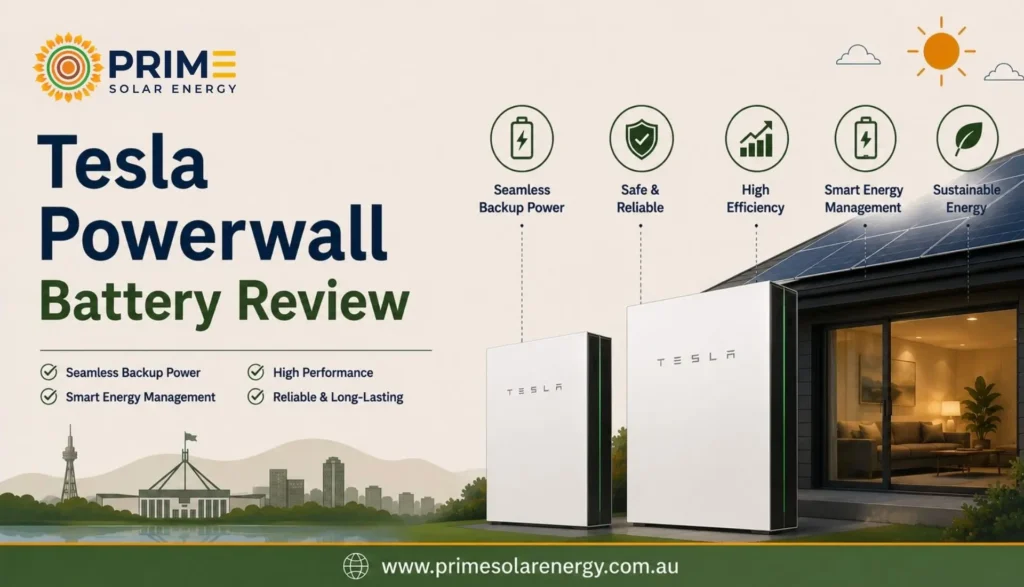
If you are considering a home battery for your solar system, the Tesla Powerwall review is worth a look for more than just the brand. Tesla has been developing residential battery storage since the original Powerwall was introduced in 2015, and the product has evolved considerably since then. Powerwall 1 was designed around a much smaller storage capacity; Powerwall 2 increased usable storage and introduced an integrated AC battery approach, while Powerwall 3 moved to a completely different system architecture with an integrated solar inverter. Tesla has also introduced the Powerwall 3 Expansion for homeowners who want more stored energy and longer backup duration without adding another complete Powerwall 3 system. For Australian homeowners, especially in Canberra and NSW, the important question is not simply which Tesla battery has the biggest specification. It is about how the system works with solar, how much usable energy it can store, how much power it can deliver, how efficiently it moves energy through the system, and what happens when the electricity grid goes down. In this guide, we look at the four main Powerwall products across Tesla’s product history and current support ecosystem and explain the differences between them, examine the latest Powerwall 3 technology, and look at warranty, backup capability, and long-term practicality for Australian homes.
Tesla Powerwall Battery Review: Understanding the Four Powerwall Products
Before comparing specifications, it is important to clear up one point.
There are four Powerwall products worth discussing in the context of this review:
- Powerwall 1
- Powerwall 2
- Powerwall 3
- Powerwall 3 Expansion
However, these should not be described as four current generations. Powerwall 1 is a legacy first-generation product. Powerwall 2 is an older generation that remains relevant for existing installations and is still supported by Tesla. Powerwall 3 is the current-generation main Powerwall product for new systems, while Powerwall 3 Expansion is an additional storage unit designed specifically to work with Powerwall 3. Tesla’s current Australian support documentation lists Powerwall 1 and Powerwall 2 documentation alongside Powerwall 3, while its current consumer information focuses on Powerwall 3 and Powerwall 3 Expansion. That distinction matters when researching Tesla Powerwall Battery Review Australia because an older Powerwall model appearing in Tesla documentation does not necessarily mean it is a current, new installation product.
Tesla Powerwall 1 Specifications
Powerwall 1 was Tesla’s original residential battery. It was introduced in the early days of Tesla Energy and had a significantly smaller storage capacity than today’s Powerwall products. Tesla’s original Powerwall documentation lists 6.4 kWh of energy, 3.3 kW peak and continuous charge/discharge power, and 92.5% beginning-of-life DC round-trip efficiency under the stated test conditions.
Powerwall 1 Specification Table
| Specification | Powerwall 1 |
| Product generation | First generation |
| Energy capacity | 6.4 kWh |
| Charge/discharge power | 3.3 kW |
| Round-trip DC efficiency | 92.5% |
| DC voltage | 350–450 V |
| Maximum continuous DC | 9.5 A |
| Operating temperature | -20°C to 50°C |
| Weight | 97 kg |
| Dimensions | 1,302 × 862 × 183 mm |
| System role today | Legacy/older installation |
Powerwall 1 is important historically because it established Tesla’s approach to residential energy storage, but it should not be confused with the current Powerwall 3 platform. Its storage capacity and system architecture are substantially different from what Tesla offers today. For someone researching a new installation in Australia, Powerwall 1 is mainly useful as a reference point for how Tesla’s technology has developed rather than as the primary product to consider.
Tesla Powerwall 2 Specifications
Powerwall 2 represented a major step forward. Tesla increased usable energy to 13.5 kWh, while the Australian and New Zealand datasheet lists 5 kW maximum continuous real power and 90% AC-to-battery-to-AC round-trip efficiency at the beginning of life under the specified test conditions.
Powerwall 2 Specification Table
| Specification | Powerwall 2 |
| Product generation | Second generation |
| Total energy | 14 kWh |
| Usable energy | 13.5 kWh |
| Maximum continuous power | 5 kW |
| Peak backup power | 7 kW |
| Round-trip efficiency | 90% |
| Battery type | Rechargeable lithium-ion |
| Operating temperature | -20°C to 50°C |
| Weight | 114 kg |
| Dimensions | 1,150 × 753 × 147 mm |
| Mounting | Floor or wall |
| Warranty | 10 years |
Tesla describes Powerwall 2 as a fully integrated AC battery system for residential or light commercial use. Its design allows it to work with existing solar systems and different inverter brands, which is one reason the model became widely used in retrofit battery installations.
Powerwall 2 is therefore still relevant when discussing existing Australian installations. It also remains important when comparing Tesla Powerwall 2 vs. Powerwall 3, because many homeowners already have Powerwall 2 and may want to understand whether the newer generation offers a meaningful improvement.
Tesla Powerwall 3 Specifications
Powerwall 3 is the most important model in this Tesla Powerwall battery review because it is Tesla’s current-generation main home battery. The biggest architectural difference is the integrated solar inverter and system controller. Tesla’s current Australian page lists Powerwall 3 with 13.5 kWh of energy capacity, up to 10 kW on-grid power, up to 10 kW backup power depending on local conditions, three solar inputs with Maximum Power Point Trackers, and 97.5% solar-to-grid efficiency.
Powerwall 3 Specification Table
| Specification | Powerwall 3 |
| Product generation | Current generation |
| Usable energy | 13.5 kWh |
| On-grid power | Up to 10 kW, depending on local conditions |
| Backup power | Up to 10 kW, depending on local conditions |
| Solar-to-grid efficiency | 97.5% |
| Solar inputs | 3 MPPT inputs |
| Integrated inverter | Yes |
| System controller | Integrated |
| Operating temperature | -20°C to 50°C |
| Dimensions | 1,105 × 609 × 193 mm |
| Weight | 130 kg |
| Warranty | 10 years |
| Expansion | Powerwall 3 Expansion compatible |
Tesla’s detailed technical documentation also specifies a configurable Powerwall 3 output range and lists 89% solar-to-battery-to-home/grid round-trip efficiency under its stated test conditions, while the separate solar-to-home/grid efficiency is 97.5%. This is why the two percentages should not be treated as competing or contradictory figures. They measure different parts of the energy pathway.
Tesla Powerwall 3 Expansion Specifications
The fourth product in this review is the Powerwall 3 Expansion.
It is important to understand that the expansion is not a standalone Powerwall with its own inverter. Tesla designed it specifically to add storage capacity to a Powerwall 3 system. Tesla states that each Powerwall 3 expansion adds 13.5 kWh of energy capacity and is designed to extend backup duration.
Powerwall 3 Expansion Specification Table
| Specification | Powerwall 3 Expansion |
| Product role | Storage expansion unit |
| Nominal battery energy | 13.5 kWh |
| Standalone inverter | No |
| Compatibility | Powerwall 3 only |
| Operating temperature | -20°C to 50°C |
| Enclosure rating | IP67 |
| Dimensions | 1,105 × 609 × 168 mm |
| Expansion weight | 110 kg |
| Floor/wall mounting | Yes |
| Stacking | Up to 3 Expansion units behind a Powerwall 3 |
| Warranty | Covered under Tesla’s applicable Powerwall warranty |
Tesla’s technical documentation confirms that Powerwall 3 Expansion is only compatible with Powerwall 3 and can be configured with up to three Expansion units. This makes the expansion particularly useful when the main limitation is energy capacity rather than power output. For example, a household may already have sufficient inverter power but want more stored energy to get through a longer overnight period or extended grid outage.
Tesla Powerwall Models Comparison
Here is a simpler overview of the four products discussed in this review:
| Feature | Powerwall 1 | Powerwall 2 | Powerwall 3 | Powerwall 3 Expansion |
| Role | Legacy | Older generation | Current main model | Expansion unit |
| Energy | 6.4 kWh | 13.5 kWh usable | 13.5 kWh usable | 13.5 kWh |
| Integrated solar inverter | No | No | Yes | No |
| Continuous/output capability | 3.3 kW | 5 kW continuous | Up to 10 kW in Australia; conditions apply | Works through Powerwall 3 |
| Backup | System-dependent | Yes | Yes | Extends duration |
| Solar integration | Older architecture | AC-coupled | Integrated | Powerwall 3 dependent |
| Current new-system relevance | Low | Mainly existing systems | High | For Powerwall 3 systems |
This comparison highlights the biggest change across Tesla’s product history: capacity increased significantly from Powerwall 1 to Powerwall 2, while Powerwall 3 focused heavily on system integration and higher power capability.
What Type of Battery Is Tesla Powerwall?
A common search query is What type of battery is Tesla Powerwall?
Tesla’s Powerwall 2 documentation identifies the product as a rechargeable lithium-ion battery system. The current Powerwall platform is designed as a residential energy storage system that can work with solar or, depending on the configuration, without solar. The practical difference is more important than the chemistry label alone. Powerwall stores electricity and makes it available when the home needs it. With solar, excess electricity generated during the day can charge the battery. Later, that stored energy can be used when solar production falls, such as during the evening. Tesla also provides monitoring, metering, and smart controls through its app, with over-the-air software updates available for supported systems.
Tesla Powerwall Battery Capacity and Daily Performance
The Tesla Powerwall battery capacity most relevant today is 13.5 kWh usable for the Powerwall 3. That does not mean every household will get the same number of hours from the battery. One household might use relatively little electricity overnight. Another might run air conditioning, electric hot water, cooking appliances, refrigeration,n and other high-demand equipment. Both homes could have the same Powerwall, but their backup duration would be very different. That is why battery sizing should start with actual electricity consumption rather than simply choosing a battery based on capacity. For Canberra homeowners, seasonal demand also matters. Heating requirements in colder months can significantly change household electricity use. In NSW, cooling demand can have a similar effect during hot periods.
Tesla Powerwall Round-Trip Efficiency
The Tesla Powerwall round-trip efficiency depends on the model and on how efficiency is measured. Powerwall 1’s original documentation listed 92.5% beginning-of-life DC round-trip efficiency. Powerwall 2’s Australian datasheet lists 90% AC-to-battery-to-AC round-trip efficiency under the specified test conditions. For Powerwall 3, Tesla’s technical documentation lists 89% solar-to-battery-to-home/grid round-trip efficiency and separately lists 97.5% solar-to-home/grid efficiency. The important point is that these are not all identical measurements. When comparing batteries, homeowners should compare equivalent efficiency metrics rather than simply looking for the largest percentage.
Tesla Powerwall Whole-Home Backup
Tesla Powerwall whole-home backup is one of the strongest reasons homeowners consider the system. Powerwall 3 is designed to detect a grid outage and transition to backup operation. Tesla’s Australian information lists up to 10 kW of backup power depending on local conditions, along with quick backup transition and motor-start capability.
But whole-home backup does not mean unlimited energy. The battery still has a finite amount of stored energy. If a home uses electricity rapidly, the available backup duration becomes shorter. High-demand appliances such as heating, cooling, electric hot water systems, and EV chargers can have a major effect on battery duration. The system design also matters. A qualified installer should determine which circuits are backed up and whether the home’s electrical infrastructure is suitable for the intended configuration.
Tesla Powerwall Warranty and Lifespan
The Tesla Powerwall warranty and lifespan are important when thinking about long-term value. Tesla’s current Australia and New Zealand warranty documentation covers Powerwall 2 AC, Powerwall 3, and Powerwall 3 Expansion with a 10-year warranty framework. For applicable Powerwall use cases, Tesla specifies 70% energy retention at 10 years, subject to the conditions and limitations in the warranty.
This does not mean the battery stops operating after the tenth year. Battery capacity naturally changes over time. What matters is the level of performance covered by the manufacturer’s warranty and how the battery is used. This is also why Solar Victoria recommends that homeowners examine warranty conditions, expected usable capacity near the end of the warranty period, and the manufacturer’s stated operating requirements when comparing battery systems.
Powerwall 3 Compatibility with Powerwall 2
One of the more useful recent Tesla updates is that eligible existing Powerwall 2 systems can now be expanded with Powerwall 3. Tesla’s Australian support documentation states that Powerwall 3 can be added to eligible Powerwall 2 systems, allowing Powerwall 2, Powerwall 3, and Powerwall 3 Expansion units to operate together in supported configurations. Installation needs to be completed by a Tesla-certified installer.
That is significant for homeowners who already own Powerwall 2. Instead of automatically replacing the older battery, some systems may be able to incorporate newer Powerwall technology while increasing storage and backup capability. The exact compatibility depends on the existing system and installation configuration.
Pros and Cons of Tesla Powerwall
Pros
Strong backup capability: Powerwall 3 provides substantially more power capability than Powerwall 2 and is designed for rapid backup operation.
Integrated inverter: The integrated inverter and system controller make Powerwall 3 particularly attractive for new solar-and-battery installations.
13.5 kWh usable capacity: The storage capacity is suitable for many residential applications.
Smart monitoring: The Tesla app gives homeowners visibility and control over their energy system.
Expandable storage: Powerwall 3 can be combined with expansion units when additional stored energy is required.
Powerwall 2 compatibility: Eligible existing Powerwall 2 systems can now be expanded with Powerwall 3 under Tesla’s supported configurations.
Cons
Powerwall 1 is no longer a practical new-system choice: It is a legacy product with much lower storage capacity than current systems.
Powerwall 2 has lower power output: Its 5 kW continuous output is significantly below the capability of Powerwall 3.
Powerwall 3 is physically substantial: the current Australian specification lists the unit at 130 kg.
Backup duration depends on usage: Even a high-capacity battery can discharge quickly when several large appliances operate simultaneously.
Installation requirements matter: The final system needs to comply with Australian electrical requirements and the relevant network rules.
Government Battery Support in Canberra, NSW and Victoria
For Australian homeowners considering a Tesla battery, government programs are worth checking before installation because eligibility and program rules can change. At the federal level, the Australian Government’s Cheaper Home Batteries Program currently supports eligible small-scale battery systems connected to new or existing solar PV systems, with the program operating through the Small-scale Renewable Energy Scheme. The program was amended from 1 May 2026, so homeowners should check the current requirements on the Australian Government’s Cheaper Home Batteries Program page before proceeding.
For Canberra households, the ACT Government’s Sustainable Household Scheme includes household battery storage among its eligible energy-efficiency products, subject to the scheme’s eligibility and lending requirements. The ACT Government also provides specific information about home batteries, including guidance on battery storage and available government support. In NSW, the previous general battery installation discount should not be confused with the current programs. The NSW government confirms that installations using the Australian government’s cheaper home batteries program can also participate in the current NSW Virtual Power Plant incentive, provided the system and homeowner meet the relevant requirements. From 1 July 2026, batteries up to 50 kWh are eligible for the NSW VPP incentive, subject to the program rules. For Victorian homeowners, the Solar Victoria Solar Battery Buyers Guide explains how battery systems work and what consumers should consider before installation. Solar Victoria also confirms that its Solar Homes Program solar battery loan is no longer accepting applications, while the federal Cheaper Home Batteries Program operates separately.
These programs should always be checked immediately before signing an installation agreement because eligibility, technical requirements, and program rules can change.
Is Tesla Powerwall Worth Considering in Australia?
There is no single answer for every household. Powerwall 3 makes the most sense when a homeowner wants a combination of solar storage, smart energy management, and backup capability in one integrated system. Powerwall 2 can still be relevant for existing installations, particularly because Tesla now supports certain Powerwall 2 and Powerwall 3 combinations.
Powerwall 1 is primarily a historical or legacy product, while Powerwall 3 Expansion is useful when a Powerwall 3 owner needs additional storage rather than another complete inverter system. For homeowners in Canberra and NSW, the right choice should be based on actual electricity consumption, solar generation, backup expectations, and future energy plans.
If you are comparing Tesla with other battery options, Prime Solar Energy can help you look at the system as a whole rather than focusing on one specification. You can get a quote and discuss your household’s energy requirements before choosing the right configuration.
Final Verdict
This Tesla Powerwall battery review shows how significantly Tesla’s home energy technology has evolved. Powerwall 1 started the residential Powerwall concept with 6.4 kWh of storage. Powerwall 2 increased usable capacity to 13.5 kWh and became a widely recognized AC battery solution. Powerwall 3 then changed the architecture by integrating the solar inverter and system controller while providing substantially higher power capability. The Powerwall 3 Expansion adds another layer of flexibility by increasing storage capacity without requiring another complete Powerwall 3 system. For someone installing a new battery today, Powerwall 3 is the model that deserves the most attention. Existing Powerwall 2 owners, however, may have another option because Tesla now supports Powerwall 3 additions for eligible systems.
The most important lesson is that battery capacity alone does not determine value. Efficiency, usable energy, power output, backup configuration, solar compatibility, warranty, and household electricity consumption all need to be considered together.
If you want help deciding whether Tesla Powerwall is suitable for your home, contact us at Prime Solar Energy for a system assessment. You can also get a quote based on your actual solar and battery requirements rather than choosing a system simply because it has a familiar name.
Frequently Asked Questions
What type of battery is Tesla Powerwall?
Tesla Powerwall is a rechargeable residential energy storage system. Tesla’s Powerwall 2 Australian documentation identifies the battery pack as rechargeable lithium-ion technology.
How many Tesla Powerwall models are there?
For this review, four Powerwall products are discussed: Powerwall 1, Powerwall 2, Powerwall 3, and Powerwall 3 Expansion. However, Powerwall 3 Expansion is an expansion unit rather than a separate Powerwall generation. Tesla’s current Australian documentation focuses on Powerwall 3 as the current main model and Powerwall 3 Expansion as its storage expansion product.
What is the Tesla Powerwall battery capacity?
Powerwall 3 provides 13.5 kWh of usable energy. Powerwall 2 also provides 13.5 kWh of usable energy, while Powerwall 3 Expansion adds another 13.5 kWh of battery energy to a compatible Powerwall 3 system.
What are the Tesla Powerwall 3 specs?
Powerwall 3 has 13.5 kWh usable energy, an integrated inverter and system controller, three MPPT solar inputs, up to 10 kW on-grid and backup power under Tesla Australia’s current published specifications, and a 10-year warranty.
What is Tesla Powerwall round-trip efficiency?
Powerwall 2 has a published 90% AC-to-battery-to-AC round-trip efficiency under its stated test conditions. Powerwall 3’s technical documentation lists 89% solar-to-battery-to-home/grid round-trip efficiency and separately lists 97.5% solar-to-home/grid efficiency.
Can Tesla Powerwall provide whole-home backup?
Powerwall 3 can provide backup power, and Tesla Australia lists up to 10 kW of backup power depending on local conditions. Actual whole-home backup performance depends on the home’s electrical configuration, connected loads, and battery state of charge.
What is the difference between Powerwall 2 and Powerwall 3?
Both provide 13.5 kWh of usable energy, but Powerwall 3 has an integrated solar inverter and substantially higher power capability. Powerwall 2 provides 5 kW continuous power and 7 kW peak backup power according to Tesla’s specifications.
Can Powerwall 3 work with Powerwall 2?
Yes. Tesla now supports Powerwall 3 additions to eligible Powerwall 2 systems, allowing supported configurations to combine Powerwall 2, Powerwall 3, and Powerwall 3 expansion units.
What is Powerwall 3 Expansion?
Powerwall 3 Expansion is an additional battery storage unit designed specifically for Powerwall 3. Each Expansion provides 13.5 kWh of additional energy capacity and does not operate as an independent inverter-based Powerwall.
How long does a Tesla Powerwall last?
Tesla’s current Australia and New Zealand warranty provides a 10-year warranty framework for Powerwall 2, Powerwall 3, and Powerwall 3 Expansion. For applicable Powerwall use cases, the warranty specifies 70% energy retention at 10 years, subject to its terms and conditions.
Is Powerwall 3 suitable for Canberra homes?
Powerwall 3 can be suitable for Canberra homes where solar storage and backup are priorities. The correct configuration depends on electricity consumption, solar generation, switchboard requirements, and the household’s backup expectations.
Is Powerwall 3 suitable for NSW?
Powerwall 3 can be used in NSW subject to the relevant electrical and network requirements. NSW homeowners should also check current VPP eligibility and federal battery support before installation.
Is Tesla Powerwall worth considering in 2026?
For homeowners looking for an integrated solar battery system with smart monitoring and backup capability, Powerwall 3 is certainly worth considering. The final decision should be based on the home’s energy profile and installation requirements rather than battery capacity alone.