
As energy costs continue to rise across Australia, solar power has become a smart investment for homeowners in the ACT and NSW regions. The Step-by-Step Solar Installation Checklist for Canberra and NSW Homes gives you everything you need to move from planning to powering up with confidence. Whether you are a first-time solar buyer or upgrading an existing system, this guide covers every critical stage from government rebates to grid connection ensuring a smooth, compliant, and cost-effective solar journey.
1. Understanding Solar Incentives and Rebates in Canberra and NSW
Before investing in solar, understanding the financial incentives available in your state or territory is essential. Both the ACT (Canberra) and New South Wales offer generous programs that can significantly reduce the upfront cost of a solar installation.
Federal Small-scale Technology Certificates (STCs)
Under the Australian Government’s Small-scale Renewable Energy Scheme (SRES), homeowners receive STCs based on the size of their solar system and location. In Canberra and NSW, a typical 6.6 kW system can generate between 80–100 STCs, worth hundreds to thousands of dollars in point-of-sale discounts.
ACT-Specific Programs
Canberra residents can access the Sustainable Household Scheme, a zero-interest loan of up to $15,000 for solar panels, batteries, and other energy upgrades. The ACT Government has committed to 100% renewable electricity, making Canberra one of the most progressive regions for solar investment in Australia.
NSW Solar Programs
NSW residents benefit from the NSW Empowering Homes Program, which offers interest-free loans for solar-battery systems. The NSW Government also provides feed-in tariffs through electricity retailers, though rates vary.
Table 1: Solar Incentives Available in Canberra and NSW
| Incentive | Who Qualifies | Benefit | Region |
| Small-scale Technology Certificates (STCs) | All homeowners | Point-of-sale discount | National (ACT + NSW) |
| Sustainable Household Scheme | ACT homeowners | 0% loan up to $15,000 | ACT (Canberra) |
| Empowering Homes Program | NSW homeowners | Interest-free solar battery loan | NSW |
| Feed-in Tariff | Grid-connected solar owners | Credits for exported energy | ACT + NSW |
| Energy Saver Program | Low-income households | Subsidised solar systems | NSW |
2. Conducting a Site Assessment
A thorough site assessment is the foundation of any successful solar installation. This step determines how much solar energy your home can generate and identifies any barriers to installation.
Roof Orientation and Tilt Angle
In the Southern Hemisphere, north-facing roofs receive the most direct sunlight throughout the year. For Canberra and NSW homes, a roof pitch between 20–30 degrees generally optimises solar energy production. East and west-facing installations are also viable, especially when combined with battery storage.
Shading Analysis
Shadows from trees, chimneys, nearby buildings, and aerials can dramatically reduce solar panel output. Use shading analysis tools or request that your installer conduct a shade assessment using software such as SolarEdge or OpenSolar. Even partial shading can reduce system output by up to 25%.
Roof Structural Integrity
Your roof must be structurally sound enough to hold the weight of solar panels (typically 10–15 kg per panel). If your roof is older than 15 years or made of asbestos-containing materials, a structural engineer or roofing inspection may be required before installation proceeds.
Energy Consumption Analysis
Review your last 12 months of electricity bills to understand your average daily consumption (measured in kWh). This data helps your installer recommend the right system size. The average Canberra home uses approximately 18–20 kWh per day, while NSW households average around 17 kWh daily.
3. Choosing the Right Solar System Size
Selecting the correct solar system size is critical to maximising your return on investment without overspending on capacity you cannot use.
Matching System Size to Consumption
A common rule of thumb is that 1 kW of solar panels generates approximately 4 kWh per day in Canberra and NSW under average conditions. For a household consuming 20 kWh/day, a 5–6.6 kW system is typically sufficient. However, if you plan to add an EV charger or battery storage, sizing up to 8–10 kW may be more economical.
Table 2: Solar System Size Guide for Canberra and NSW Homes
| System Size | Est. Daily Output (ACT/NSW) | Avg. Annual Savings | Best For |
| 3 kW | 10–12 kWh/day | $800–$1,000/yr | Small homes, 1–2 people |
| 5 kW | 17–20 kWh/day | $1,300–$1,600/yr | Average family home |
| 6.6 kW | 23–27 kWh/day | $1,700–$2,100/yr | Large family, high usage |
| 10 kW | 35–40 kWh/day | $2,500–$3,200/yr | EV charging + battery combo |
| 13.3 kW | 45–55 kWh/day | $3,500–$4,500/yr | Large home, business use |
Inverter Types
Your inverter converts DC electricity from solar panels into usable AC electricity. The three main types are string inverters (most affordable), microinverters (best for shaded roofs), and hybrid inverters (compatible with battery storage). For Canberra homes planning future battery installations, a hybrid inverter is strongly recommended.
4. Selecting a CEC-Accredited Solar Installer
Only use an installer accredited by the Clean Energy Council (CEC). CEC-accredited installers are required to follow the Australian Standards for solar PV installation (AS/NZS 5033) and are eligible to process STC rebates on your behalf.
Search for accredited installers near you:
Always obtain at least three quotes, check reviews, verify their CEC accreditation number, and ask for references from previous Canberra or NSW installations.
What to Ask Your Installer
- What brands of panels and inverters do you recommend, and why?
- What warranties include product, performance, and workmanship?
- How do you handle the STC rebate process?
- Will you manage the grid connection application with my electricity network?
- Do you provide post-installation monitoring and support?
5. Approvals, Permits, and Grid Connection
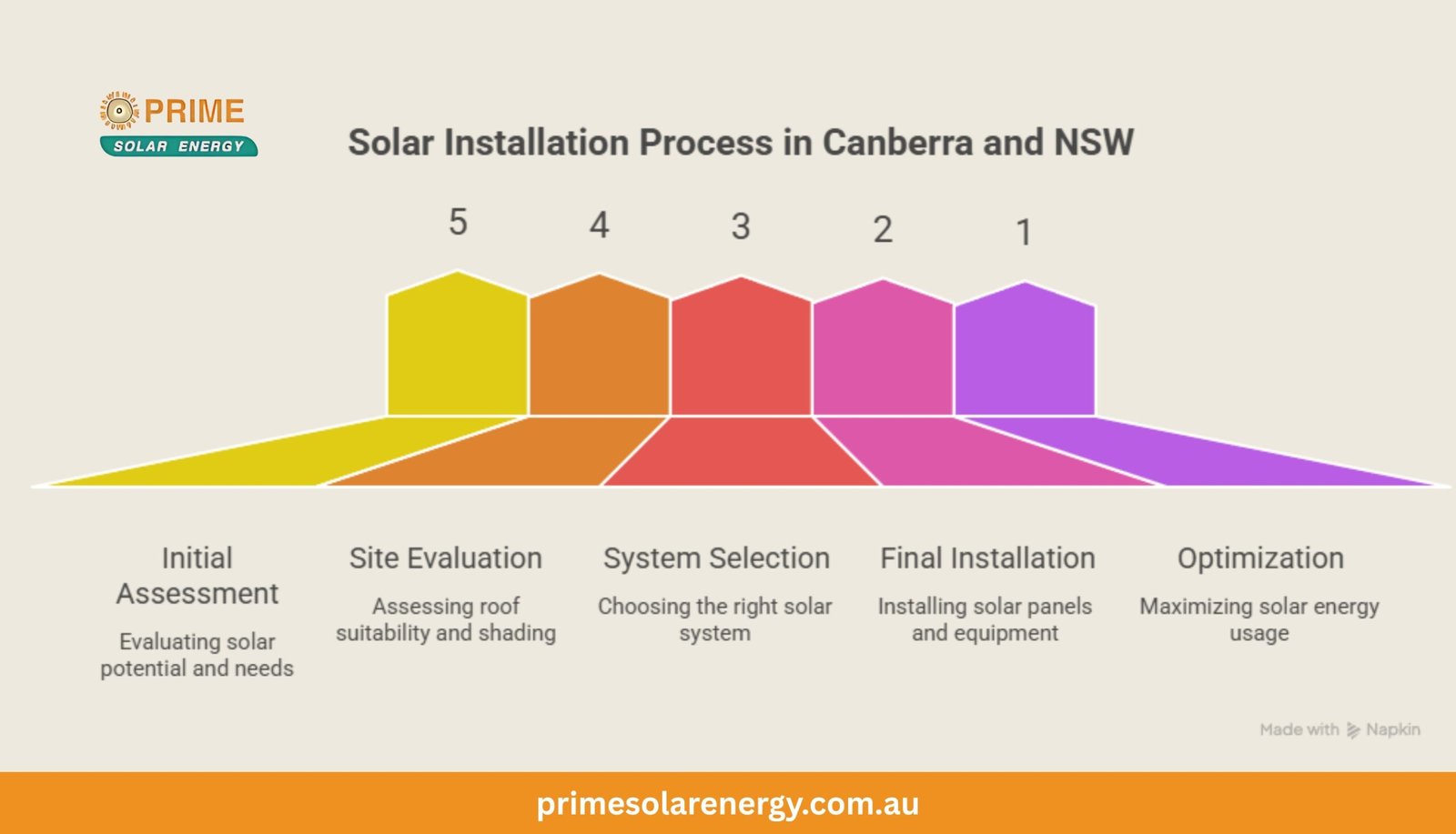
Solar installation in Canberra and NSW involves several regulatory steps that your installer typically manages on your behalf. Understanding the process helps you avoid delays.
Development Approval (DA)
Most residential solar installations in the ACT and NSW are exempt from development approval under complying development provisions. However, heritage-listed properties or those in certain zones may require a DA. Check with your local council or the ACT Planning Authority before proceeding.
Electrical Work Approval
All electrical work associated with solar installation must be completed by a licensed electrician. In NSW, a Certificate of Compliance for Electrical Work (CCEW) must be issued. In the ACT, compliance is governed by the Electrical Safety Act.
Network Connection Application (NCA)
To export solar energy to the grid and receive feed-in tariff credits, your installer must submit a Network Connection Application to your local Distribution Network Service Provider (DNSP). In ACT/NSW, this is typically Evoenergy (ACT) or Ausgrid/Essential Energy (NSW). Approval can take 5–20 business days.
Table 3: Solar Installation Timeline Canberra and NSW
| Step | Who Is Responsible | Estimated Timeframe |
| Site Assessment | Solar installer | 1–2 days |
| Quote and Contract | Homeowner + installer | 1–3 days |
| Permit/DA (if required) | Homeowner + council | 2–8 weeks |
| Physical Installation | CEC-accredited installer | 1–2 days |
| Electrical Compliance Certificate | Licensed electrician | Same day as install |
| Network Connection Application | Installer / DNSP | 5–20 business days |
| Meter Upgrade/Reconfiguration | Electricity retailer | 5–15 business days |
| System Activation + Monitoring Setup | Installer | Same day as meter upgrade |
6. The Installation Day Checklist
Once all approvals are in place, installation day typically takes 4–8 hours for a standard residential system. Here is what to expect and verify before your installers leave.
Before Installation Begins
- Confirm the panels and inverter model match your contract
- Check that all workers are CEC-accredited and wearing ID
- Ensure safe access to the roof, meter box, and switchboard
- Review the proposed panel layout and mounting positions
During Installation
- Mounting rails are secured to roof rafters, not just tiles or cladding
- All cabling is protected and neatly routed no exposed DC cables
- Inverter is installed in a shaded, well-ventilated location
- AC isolator and DC isolator switches are correctly labelled and accessible
After Installation
- Request and review the system commissioning report
- Confirm the inverter is displaying live generation data
- Obtain the Electrical Compliance Certificate
- Download the manufacturer’s monitoring app and test connectivity
- Inspect roof for any damage to tiles or flashing
7. Battery Storage Considerations for Canberra and NSW
Adding a battery to your solar system allows you to store excess daytime generation for use at night further reducing your grid dependence and electricity bills. The ACT’s Sustainable Household Scheme and NSW’s Empowering Homes Program both include battery-specific financing options.
Popular Battery Options in Australia
The Tesla Powerwall 2 (13.5 kWh), Sungrow SBR (modular, 9.6–25.6 kWh), and BYD Battery-Box are among the most installed residential batteries in Canberra and NSW. When choosing a battery, consider usable capacity (kWh), round-trip efficiency (aim for >90%), warranty (minimum 10 years), and compatibility with your inverter. More info
8. Post-Installation Monitoring and Maintenance
A solar system requires minimal maintenance but regular monitoring to ensure peak performance over its 25+ year lifespan.
Monitoring Your System
Most modern inverters (SolarEdge, Fronius, Sungrow, Enphase) come with free cloud-based monitoring apps. Check your system’s daily output and compare against expected generation figures provided by your installer. A sudden drop in output often indicates a fault, shading issue, or soiling.
Annual Maintenance Tasks
- Clean panels with water and a soft cloth (avoid abrasive cleaners)
- Inspect mounting hardware for corrosion or loosening
- Check inverter display for error codes
- Review annual energy production report from monitoring software
- Trim any trees or vegetation causing new shading
Frequently Asked Questions (FAQ)
Q: Do I need council approval to install solar panels in Canberra or NSW?
In most cases, no. Standard residential solar installations are exempt from development approval under complying development rules in both the ACT and NSW. Heritage-listed properties or unique zoning situations may be exceptions always confirmed with your local authority.
Q: How long does the solar installation process take from start to finish?
From the initial quote to system activation, the process typically takes 4 –10 weeks, with the physical installation itself completed in one to two days. The longest delays usually occur during the network connection application phase.
Q: What size solar system do I need for a typical Canberra home?
A 6.6 kW system is the most popular choice for average Canberra households consuming 18–22 kWh per day. If you own an electric vehicle or plan to add battery storage, consider sizing up to 8 –10 kW.
Q: Can I install solar panels myself in NSW or the ACT?
No. Australian law requires all solar PV electrical work to be performed by a CEC-accredited installer and a licensed electrician. DIY solar installation is illegal, unsafe, and will void any STCs or government rebates.
Q: What happens to my solar system during a blackout?
Standard grid-connected solar systems automatically shut down during a blackout for safety reasons (to protect linesmen). A battery storage system with a backup function such as the Tesla Powerwall with Backup Gateway can keep your home powered during outages.
Conclusion
Going solar in Canberra or NSW is one of the best financial and environmental decisions an Australian homeowner can make in 2025. With generous federal and state incentives, world-class sunlight hours, and a thriving industry of CEC-accredited installers, the path to clean energy has never been clearer. Follow this step-by-step solar installation checklist, work with a trusted installer, and you will be generating your own clean electricity and reducing your bills for decades to come. The sun is shining: it is time to use it.