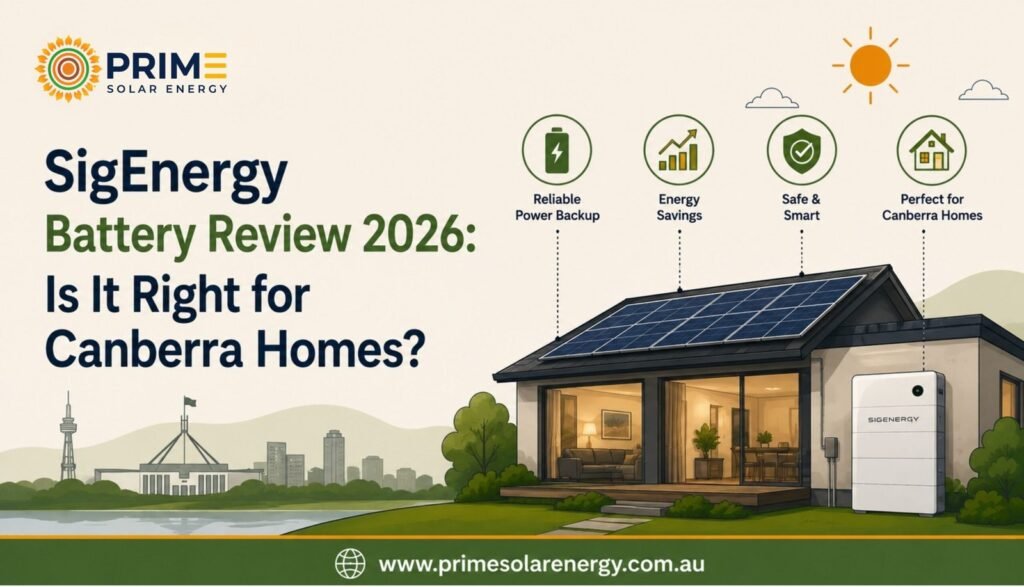
SigEnergy Battery Review 2026: Is It Right for Canberra Homes?
If you’ve been comparing solar batteries lately, you’ve probably noticed one name coming up again and again—this SigEnergy Battery Review takes an honest look at whether the SigenStor system actually makes sense for a Canberra home in 2026, not just what the marketing brochures promise. Between cold ACT winters, hot summers, and electricity prices that keep creeping up, more Canberra households are asking the same question: is this the battery worth putting on the wall, or is it just another shiny box riding a wave of hype? It doesn’t help that the market is crowded—Tesla, Sungrow, Alpha ESS, and now SigEnergy are all vying for space in your garage, each claiming to be the smartest, safest, or most future-proof choice. For homeowners trying to make sense of it all while also juggling quotes, rebate paperwork, and installer sales pitches, it’s easy to feel like you need an engineering degree just to compare two batteries properly.
That’s exactly the gap this review tries to close. SigEnergy went from a completely unknown name in Australia to the country’s best-selling battery brand in under three years, which naturally raises two very different questions at once: what is it doing right that’s winning over so many installers and homeowners, and is any of that hype actually backed up once you look past the sales copy? Canberra adds its own layer to the decision, too. ACT households deal with genuinely cold, foggy winter mornings and properly hot summer afternoons, which means both heating and cooling loads are heavier here than in milder coastal cities—and that changes how much a battery actually saves you and how much backup capacity is worth paying for. On top of that, the ACT’s incentive landscape has shifted recently, with the original Next Gen rebate now closed and newer schemes taking its place, so a lot of the “Canberra battery rebate” advice floating around online is already out of date.
This guide breaks down the specs, real 2026 pricing, the recall history, how it stacks up against a Tesla Powerwall, and—most importantly—whether it’s worth it once you factor in what’s actually available to ACT residents right now.
Company Background: Who Is Behind SigEnergy?
SigEnergy was founded in 2022 by Tony Xu, a former president of Huawei’s solar inverter division. In under three years, the brand went from a market newcomer to Australia’s top-selling battery brand: SunWiz reports SigEnergy held around 25% market share across 2025 and topped the monthly rankings for 10 consecutive months, overtaking Sungrow and Tesla in blended capacity sold.
The flagship product, SigenStor, is what most people mean when they talk about a Sigenergy home battery. Rather than pairing a battery cabinet with a separate wall-mounted inverter, SigenStor stacks five components into one tower: a solar hybrid inverter, a battery power conversion system, the battery modules, an energy management system, and an optional DC EV charger—a genuinely different approach to the usual “panels plus box on the wall” setup and a big part of why this Sigenergy solar battery keeps showing up in comparison shortlists.
Being a relatively young company is worth flagging, honestly. SigEnergy doesn’t yet have the decade-plus on-roof track record of Tesla or Sungrow, so long-term reliability is still being proven in Australian conditions.
Sigenergy Battery Sizes and Specification Table
| Specification | Details |
| Usable capacity | 5kWh to 48kWh (stackable modules) |
| Continuous power output | 2.5kW to 24kW |
| Battery chemistry | Lithium Iron Phosphate (LFP) |
| Phase compatibility | Single-phase or three-phase |
| Depth of discharge | 100% |
| Backup switchover | Near-instant (sub-10ms typical) |
| EV charging (optional) | Up to 25kW DC |
| Dimensions (per module) | H 910mm x W 850mm x D 260mm |
| Weight | Approx. 78kg per module |
| IP rating | IP66 (suitable for protected outdoor installation) |
| Warranty | 10 years on the battery and inverter, 5 years on the gateway |
How Does SigEnergy Perform in Real Australian Conditions?
The real value of any battery comes from how it performs in everyday conditions, and that’s exactly what this SigEnergy Battery Review aims to evaluate. For homeowners in Canberra and across Australia, the Sigenergy home battery delivers reliable performance through freezing winter mornings, hot summer afternoons, and unexpected power outages. Its Lithium Iron Phosphate (LFP) battery chemistry and advanced thermal management system help maintain stable performance throughout the year, while near-instant backup ensures essential appliances continue running during blackouts. The Sigenergy solar battery also charges and discharges efficiently, allowing households to maximize the energy generated by their solar panels and reduce reliance on the grid. The mySigen app provides real-time monitoring, energy insights, and remote control from a smartphone, making daily energy management simple and convenient. Quiet operation, high round-trip efficiency, and intelligent energy management further enhance its appeal. Based on its real-world performance, features, and reliability, this SigEnergy battery suggests the SigenStor is a strong choice for Australian households wondering, “Is the SigEnergy battery worth it in Australia?” The answer will be yes for many homes looking for a smart, future-ready battery storage solution.
Sigenergy Battery Price in 2026
The Sigenergy battery price varies depending on system size, phase configuration, and whether you’re adding EV charging, but as a general guide, a 16kWh single-phase system typically runs from around $14,000 to $17,000 installed before rebates. Once the federal Cheaper Home Batteries Program discount is applied at the point of sale, most households end up paying somewhere between $10,000 and $13,500 out of pocket.
Since 1 May 2026, the federal rebate structure changed to a tiered model: a full rate on the first 14kWh of usable capacity, roughly 60% of that rate from 14kWh to 28kWh, and around 15% of the rate from 28kWh to 50kWh. This makes mid-sized systems, like a 15–16kWh SigenStor, the most cost-effective option for most homes, since almost the entire capacity sits in the full-rate tier.
If you want an exact figure based on your roof, switchboard, and usage pattern, it’s worth reaching out to get a quote rather than relying on ballpark numbers—every site is a little different.
Sigenergy vs. Tesla Powerwall: Comparison
| Feature | SigEnergy SigenStor | Tesla Powerwall 3 |
| Built-in inverter | Yes, included | Yes, included |
| Three-phase backup | Yes | No (single-phase only) |
| EV DC charging | Optional, up to 25kW | Not built in |
| Modular expansion | 5kWh/8kWh stackable, up to 48kWh | Fixed 13.5kWh units, stackable |
| Warranty | 10 years | 10 years |
| Market track record | Since 2022 | Since 2015 |
| Typical 16kWh price after rebate | ~$10,500–$13,500 | Comparable, varies by installer |
SigEnergy Battery Review: Pros and Cons
Pros
- Modular battery design: Start with 5kWh or 8kWh modules and expand up to 48kWh as your energy needs grow.
- All-in-one system: Battery, hybrid inverter, energy management system, and optional DC EV charger are integrated into a single unit.
- True three-phase backup: A major advantage for many Canberra homes with three-phase power.
- Fast backup switching: Provides near-instant power during blackouts, helping keep essential appliances running.
- LFP battery chemistry: Uses lithium iron phosphate cells, known for safety, long cycle life, and thermal stability.
- Smart monitoring: The mySigen app offers real-time energy tracking and easy system management.
Cons
- Relatively new brand: SigEnergy entered the market in 2022, so it doesn’t yet have the long-term track record of Tesla or Sungrow.
- Higher upfront cost: Premium features often require a higher initial investment than entry-level battery systems.
- Recall history: Some early single-phase energy controllers were included in a 2025 voluntary recall, although affected units have since been updated.
- Installer quality matters: Because SigenStor combines multiple components into one system, proper installation is essential for optimal performance.
Is the Sigenergy Battery Worth It in Australia—Especially in Canberra?
So, is the Sigenergy battery worth it in Australia, and specifically for a Canberra property? For most ACT households, the answer leans toward yes, largely because of how the local incentives stack.
The ACT’s original Next Gen Energy Storage rebate has closed after reaching its 5,000-battery target, but Canberra households still have solid support available. The ACT Government’s home battery page outlines current options, including the Sustainable Household Scheme, which offers eligible homeowners a low-interest loan of up to $20,000 to help cover battery costs. Concession card holders may also access the Home Energy Support Program, which can be stacked with the federal rebate for further savings—full eligibility details are on the Sustainable Household Scheme page.
Combine that with the federal Cheaper Home Batteries Program rebate, and a household installing a mid-sized SigenStor system can bring the net cost down considerably. Given Canberra’s cold winters, hot summers, and reliance on evening heating and cooling, a battery that provides real three-phase backup is genuinely useful here—not just a nice-to-have.
Sigenergy Battery Recall: What You Should Know
No honest SigEnergy Battery Review would skip this. On 19 November 2025, the ACCC published a voluntary recall covering SigEnergy’s single-phase 8 kW, 10 kW, and 12 kW energy controllers with quick-connect AC plugs, sold between 4 March and 18 November 2025. The plugs could overheat and pose a fire risk; the Clean Energy Regulator noted that around 100 inverters nationally were affected, and no property damage, injuries, or deaths were reported. SigEnergy said the issue was linked to installation practices rather than a core product defect, rolled out a firmware update to limit output on at-risk units, and has been proactively replacing affected inverters with a redesigned plug (plus a two-year warranty extension on the replacement). It’s still a legitimate point of caution for a newer brand, and if you already own an affected unit, it’s worth checking your serial number with your installer or through the mySigen app.
Sigenergy Battery Review Australia: Common Complaints
Across Sigenergy battery review Australia feedback: the most repeated themes are the upfront price tag, the plug recall mentioned above, and the brand’s relatively short track record compared to Tesla’s or Sungrow’s. On the positive side, owners consistently praise the fast backup switchover, the compact all-in-one design, and the app-based monitoring, which many find more intuitive than competing systems.
Frequently Asked Questions
Is SigEnergy a good battery brand in Australia?
Yes, SunWiz data shows it was Australia’s top-selling battery brand by market share through 2025, though as a company founded in 2022, it’s still newer than Tesla or Sungrow.
What size Sigenergy battery does a typical Canberra home need?
Most Canberra households do well with a 10–16kWh system, depending on household size and evening energy use.
Does the Sigenergy battery work with three-phase power?
Yes, and it’s one of the few residential batteries offering true three-phase backup during outages.
Was there a Sigenergy battery recall?
Yes, a voluntary recall published by the ACCC in November 2025 covered specific single-phase energy controllers (8/10/12 kW) due to an AC plug issue linked to installation practices, affecting around 100 units nationally. It’s since been addressed with a redesigned plug and firmware update.
How do I find out what a Sigenergy system would cost for my home?
The best way is to contact us with your address and rough energy usage, and we can put together an accurate, site-specific price.
Considering a home battery for your Canberra property? Get a quote today or contact us to talk through whether the Sigenergy SigenStor is the right fit for your home