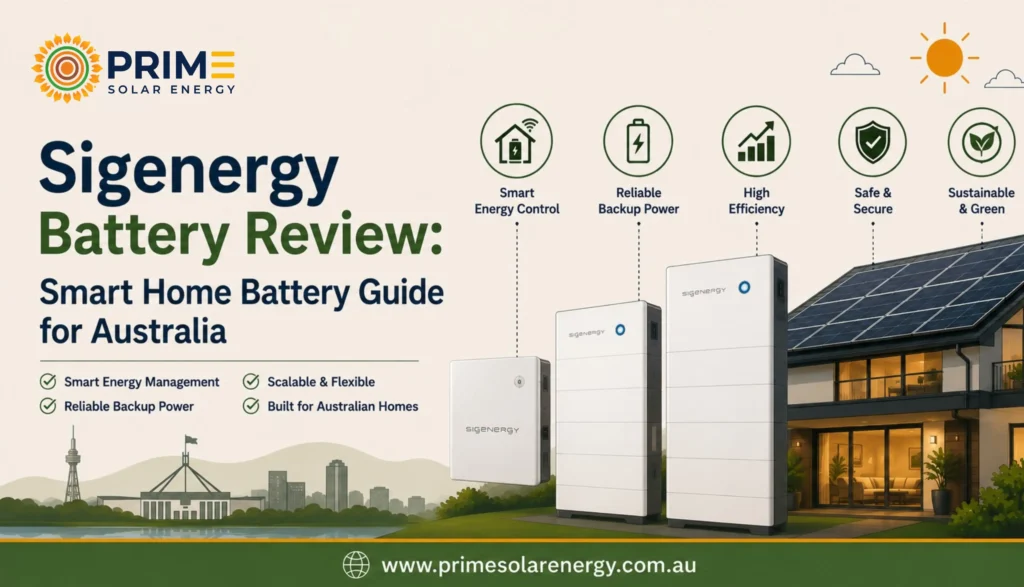
If you’ve spent any time comparing home battery brands lately, you’ve probably noticed the same name popping up again and again, and this Sigenergy Battery Review exists because so many Canberra homeowners keep asking about it. In just a few years, Sigenergy has gone from a name almost nobody in Australia recognized to one of the most talked-about battery brands on the market, and it hasn’t done that by being just another storage box bolted next to the switchboard. The SigenStor combines a hybrid inverter, stackable battery modules, an optional backup gateway, and an optional EV charger into a single tower, all run from one app. For households across the ACT and southern NSW, where cold winter evenings push electricity use up, and the odd summer storm can knock the grid out for hours, that kind of integration genuinely matters, not just as a marketing line. This guide walks through how the Sigenergy solar battery actually works, what the different models offer, how the brand handled a real safety recall, how it stacks up against Tesla and Sungrow, and what to check before getting a Sigenergy battery installed at your home.
Sigenergy Battery Review: What Makes the SigenStor Different
People often call the Sigenergy SigenStor a “5-in-1” energy system, and that’s a fair description. Instead of buying a separate inverter and separate battery boxes, you get one vertical stack that houses the solar inverter, the battery’s power conversion system, the battery modules, the energy management brain, and an optional EV charging interface. This modular approach is a big part of why Sigenergy Australia has grown so fast, because an installer can size a small system for a townhouse in Gungahlin just as easily as a larger family home in Weston Creek, simply by adding or removing modules from the stack.
The battery itself uses lithium iron phosphate (LFP) chemistry, which trades a bit of energy density for thermal stability and a longer cycle life, a sensible compromise for a climate that swings from frosty Canberra mornings to properly hot, dry summer afternoons. On top of the hardware, Sigenergy runs AI-based energy management through its app, which learns household usage patterns and adjusts charging and discharging around time-of-use tariffs and solar generation, rather than just following a fixed schedule.
Sigenergy Battery Specifications
Sigenergy currently sells more than one hardware family in Australia, so it’s more useful to look at the Sigenergy battery specifications model by model rather than treating “the SigenStor” as a single product.
SigenStor SP (Single Phase)
| Specification | Detail |
| Battery chemistry | Lithium Iron Phosphate (LFP) |
| Module sizes | 5.0 kWh, 6.0 kWh, 8.0 kWh and 10.0 kWh stackable modules |
| Typical capacity range | Around 8 kWh up to roughly 40 kWh with a DC EV charger fitted |
| Round-trip efficiency | Around 98% (as quoted in Sigenergy’s product documentation) |
| Ingress protection | IP66 (dust-tight, protected against powerful water jets) |
| Backup switchover | Under 10 milliseconds, so sensitive electronics generally don’t flicker |
| Fire protection | Internal fire suppression built into each module |
| Optional add-on | Bi-directional DC EV charger with V2H support |
SigenStor TP (Three Phase)
| Specification | Detail |
| Battery chemistry | Lithium Iron Phosphate (LFP) |
| Phase configuration | Three-phase, suited to larger homes and heavier continuous loads |
| Capacity range | Scales up to around 48 kWh in a single tower |
| Ingress protection | IP66 |
| Monitoring | Real-time app monitoring with AI-driven usage optimisation |
| EV charging | Optional 25 kW bi-directional DC charger module |
SigenStor Neo
| Specification | Detail |
| Status in Australia | Launched globally in 2026, expected to reach the Australian market in the second half of the year.r |
| Positioning | A more compact, more accessible companion to the original SigenStor, not a replacement |
| Battery modules | Larger 6.0 kWh and 10.0 kWh modules built on 314 Ah cells |
| Depth of discharge | Rated at 100% |
| Cycle life | Quoted up to 10,000 cycles |
| Capacity | Modular, scaling up to around 48 kWh |
| Trade-off | Does not support DC fast EV charging or vehicle-to-home backup, which remain exclusive to the original SigenStor |
Whichever tower ends up on your wall, the modular design is the standout feature. A household can start with a smaller configuration and bolt on extra battery modules later, which is genuinely useful if you’re not yet sure how much storage you’ll want once an EV or a heat pump enters the picture.
The Sigenergy Battery Recall Explained
A fair Sigenergy Battery review has to cover the less flattering chapter too, and glossing over it wouldn’t do you any favors. On 19 November 2025, the ACCC published a voluntary recall covering certain single-phase SigenStor energy controllers rated at 8, 10, and 12 kW, sold in Australia between March and November 2025. The fault was with a quick-connect AC plug that needed careful crimping and ferruling during installation; where that wasn’t done correctly, the connection could develop resistance and overheat, and Sigenergy has confirmed at least one small fire was linked to the issue.
Sigenergy pointed to installation practices rather than a defect in the battery chemistry as the underlying cause and responded by pushing a firmware update that throttled output on affected units, rolling out a free replacement AC plug design, and extending the product warranty on every affected inverter by an extra two years as a goodwill gesture. The recall was run openly through the ACCC and Clean Energy Council rather than quietly, which is worth weighing when you think about how much confidence to place in the brand’s after-sales support. If you already own a Sigenergy system, or you’re being quoted on one now, it’s worth checking your model and installation date against the official recall listing before you sign anything.
Sigenergy vs Tesla Powerwall vs Sungrow Battery
For Canberra homeowners weighing up their options, a straight Sigenergy vs Tesla Powerwall vs Sungrow battery comparison is usually the quickest way to see where each system actually earns its keep.
| Feature | Sigenergy SigenStor | Tesla Powerwall 3 | Sungrow SBR |
| Chemistry | LFP | LFP | LFP |
| Capacity range | Roughly 8–48 kWh, fully modular | 13.5 kWh per unit, expandable to around 54 kWh across 4 units | 6.4–25.6 kWh per tower, expandable further in parallel |
| Inverter | Integrated hybrid inverter built in | Integrated hybrid inverter built in | Requires a separate, compatible Sungrow hybrid inverter |
| EV charging | Optional bi-directional DC EV charger add-on (original SigenStor only) | Not built in | Not built in |
| Ingress protection | IP66 | Outdoor rated | IP55 |
| Warranty | 10-year standard (extended to 12 years on recall-affected units) | 10-year, 70% capacity retention guarantee | 10-year, 70% capacity retention guarantee |
| Best suited for | Homes wanting an all-in-one stack with future EV integration | Homes wanting a well-established, single-unit system | Budget-conscious homes already using, or planning to use, a Sungrow inverter |
None of these three is a poor choice, honestly, and the right pick comes down to priorities rather than any of them being clearly “the best.” If an EV is somewhere in your plans, the Sigenergy solar battery’s built-in charging option is hard to match. If a long, proven local track record matters more to you than the newest hardware on the block, the Powerwall 3 still has that edge. If price-per-kWh flexibility and straightforward expansion are what count most, the Sungrow SBR remains a solid, no-frills option.
Pros and Cons of the Sigenergy Battery
Pros
- Fully modular design, so you can start small and expand storage as your needs change
- Integrated hybrid inverter, meaning no separate inverter purchase
- Optional bi-directional EV charging built into the same tower
- Fast, sub-10 millisecond backup switchover during blackouts
- IP66 rating, suiting both sheltered garages and more exposed outdoor spots
- AI-based energy management that adapts to real household usage and tariff structures
Cons
- Shorter track record in Australia compared with more established brands
- The 2025 AC plug recall affected some single-phase units, so correct installation really matters
- Larger or three-phase homes need more careful system design to get the sizing right
- As a relatively new entrant, long-term local parts and servicing availability is still being proven over time
Government Support for Battery Storage in Canberra and the ACT
Battery incentives are genuinely worth checking before you commit to any brand, whether you’re looking at a Sigenergy solar battery or something else entirely. At a federal level, the Cheaper Home Batteries Program provides a discount on the upfront cost of an eligible small-scale battery system installed alongside new or existing rooftop solar, delivered through the Small-scale Renewable Energy Scheme.
On top of the federal discount, ACT residents can access the Sustainable Household Scheme, a low-interest loan that can go toward a battery as part of a broader home energy upgrade. Eligible concession card holders may also be able to pair this with the Home Energy Support Program, which offers rebates for households holding a Pensioner Concession Card, Health Care Card, or DVA Gold Card. If you’re specifically considering a Sigenergy system, it’s also worth checking the Clean Energy Council’s approved products list and, given the recall history above, the official Product Safety Australia recall notice so you know exactly which model years and configurations were affected.
Program rules, discount rates, and loan caps do shift from year to year, so it’s worth double-checking current eligibility before you finalize any quote.
Getting a Sigenergy Battery Installed in Canberra
For ACT and southern NSW households, sizing and positioning a SigenStor correctly matters just as much as which model you pick. Canberra’s cold winter mornings and hot, dry summers both put real demands on a battery’s thermal management, and a CEC-accredited installer who understands the local climate and Evoenergy’s network requirements will get more consistent performance out of the system over its lifetime. A correctly sized SigenStor, whether that’s the SP, TP or the newer Neo range once it lands here, should be matched to your actual evening usage rather than just the biggest tower on the price list.
If you’re weighing up a Sigenergy solar battery against other brands for your Canberra home, the team at Prime Solar Energy can talk you through system sizing, backup options, and current government support before you commit to anything. You can get a quote tailored to your roof, your usage, and your budget, or simply contact us with any questions about how the SigenStor compares to what you already have installed.
Frequently Asked Questions
Is the Sigenergy battery any good for homes in Canberra?
Yes, for most households. The LFP chemistry handles Canberra’s temperature swings well, the IP66 rating suits both indoor and sheltered outdoor installs, and the modular design makes it straightforward to size correctly for ACT-sized blocks and townhouses.
What is the Sigenergy battery warranty?
The standard warranty is 10 years. Sigenergy extended this to 12 years on inverters affected by the November 2025 recall as part of its remediation response.
Can a Sigenergy battery work with an existing solar system?
Yes. The SigenStor is designed to integrate with both new and existing rooftop solar installations, not just new builds.
Was every Sigenergy battery affected by the recall?
No. The recall applied specifically to certain single-phase 8, 10, and 12 kW energy controllers with quick-connect AC plugs sold between March and November 2025. Three-phase units and later production were not part of the recall.
How does Sigenergy compare to Tesla and Sungrow in terms of capacity?
Sigenergy’s modular range scales from roughly 8 kWh up to 48 kWh in a single tower, a wider span than either the Tesla Powerwall 3 or the Sungrow SBR series offers as standalone units.
Do I need a three-phase connection to install a SigenStor?
No. The SP range is built for single-phase homes, while the TP range is designed for three-phase properties, so there’s an option for either connection type.