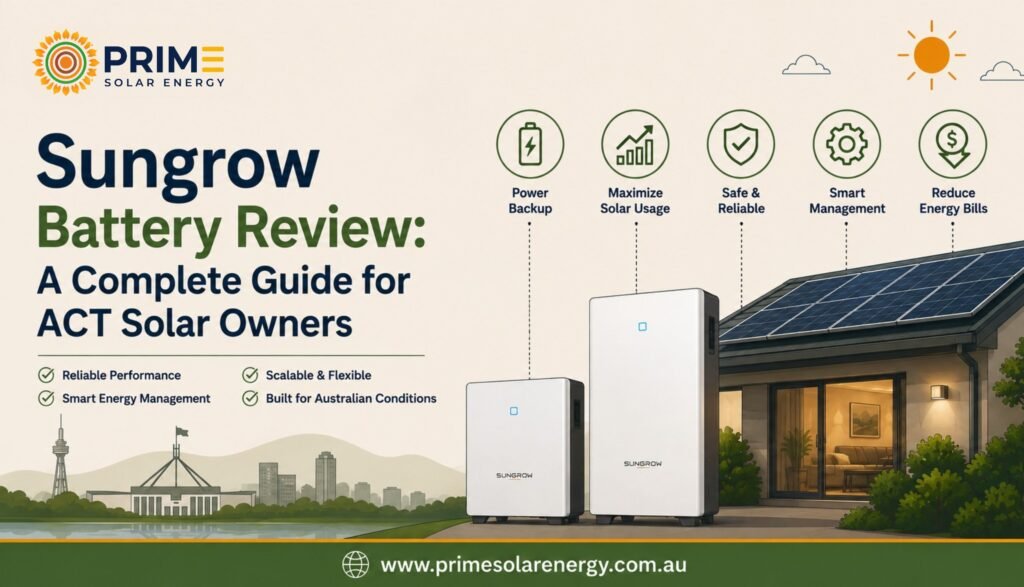
If you’ve spent any time comparing home battery brands for your Canberra property, you’ve probably run into Sungrow more than once. It’s one of those names that keeps coming up in installer quotes, forums, and comparison sites, and for good reason. This Sungrow Battery Review walks through what the brand actually offers ACT households right now—capacity options, warranty terms, real backup performance, and how it holds up against other popular systems—so you’re not just going off a spec sheet when you decide whether it’s right for your home.
Sungrow is one of the world’s largest energy technology manufacturers, and its home battery range has become a go-to recommendation for installers across Australia, especially when paired with a Sungrow hybrid inverter. That popularity is well-earned in many cases, but it doesn’t automatically mean it’s the best fit for every roof. A proper Sungrow battery review needs to go beyond the marketing numbers and look at warranty conditions, how backup actually behaves during an outage, and whether local installers know the product well enough to size it correctly. So let’s get into what’s actually in the range.
What’s in the Sungrow Battery Range
Sungrow currently sells two main battery families in Australia — the SBR series and the SBH series. Both use lithium iron phosphate (LFP) chemistry, which is pretty standard now across most solar battery Sungrow systems because it copes well with daily cycling and carries a lower fire risk than older lithium-ion chemistries.
The SBR series is the modular, stackable range that most Canberra homes end up looking at. It expands in 3.2 kWh increments, so you can start with what suits your current usage and add more capacity down the track without ripping out the whole system.
The SBH series sits above that — a higher-voltage line built for bigger homes, three-phase properties, or small commercial sites that pull more power overnight than a standard SBR setup is designed for.
One thing worth flagging: Sungrow’s model naming in Australia has shifted a few times over the past couple of years. If you’re comparing quotes or reading older reviews, it’s worth double-checking the exact configuration against the current datasheet rather than assuming older naming still applies.
Sungrow Battery Capacity: Specifications by Model
Here’s where the numbers actually sit across the current lineup.
SBR Series Specifications
| Model | Usable Capacity | Chemistry | Expansion | Max Continuous Output* |
| SBR064 | 6.4 kWh | LFP | 2 modules | Inverter-dependent |
| SBR096 | 9.6 kWh | LFP | 3 modules | Inverter-dependent |
| SBR128 | 12.8 kWh | LFP | 4 modules | Inverter-dependent |
| SBR160 | 16.0 kWh | LFP | 5 modules | Inverter-dependent |
| SBR192 | 19.2 kWh | LFP | 6 modules | Inverter-dependent |
| SBR224 | 22.4 kWh | LFP | 7 modules | Inverter-dependent |
| SBR256 | 25.6 kWh | LFP | 8 modules | Inverter-dependent |
*Output depends on which Sungrow SH-series hybrid inverter it’s paired with, since the SBR is DC-coupled and only works with compatible Sungrow inverters — not third-party ones.
SBH Series Specifications
| Model | Usable Capacity | Chemistry | Stacking | Best Suited For |
| SBH200 | 20.0 kWh | LFP | Stackable | Larger family homes |
| SBH250 | 25.0 kWh | LFP | Stackable | Larger family homes / dual EVs |
| SBH300 | 30.0 kWh | LFP | Stackable | Small commercial/rural |
| SBH350 | 35.0 kWh | LFP | Stackable | Small commercial/rural |
| SBH400 | 40.0 kWh | LFP | Stackable up to 4 stacks | Large properties, three-phase |
Both ranges use a stack-and-connect style build, which keeps the wiring simple and usually makes for a quicker install day. For a fairly typical Canberra household shifting evening usage onto stored solar, the SBR160 to SBR224 range tends to hit the sweet spot—enough to get most homes through the night without paying for capacity that just sits there unused.
How It Performs in ACT Conditions
Canberra’s climate throws a fair bit at a battery—properly cold, still winter nights, then long stretches of high-UV summer heat. Sungrow rates its SBR units for thousands of charge cycles at strong capacity retention, which in practice should see the battery comfortably outlast its warranty period under normal daily use.
Backup is the part people often assume comes standard, and it’s worth being clear on this: Sungrow batteries do support backup mode, but only when paired with a compatible hybrid inverter, and your installer needs to wire up a dedicated backup circuit at the time of installation. It’s not something that just switches on by default. If riding out a blackout matters to you — and after a Canberra hailstorm season, it’s a fair thing to want — bring it up during your site assessment rather than assuming it’s covered.
Pros and Cons
Pros:
- Genuinely modular—both the SBR and SBH ranges expand in small steps, so you’re not stuck with one fixed size
- LFP chemistry holds up well through the cold-to-hot swing Canberra puts batteries through each year
- Pairing it with a Sungrow hybrid inverter makes for a cleaner, more integrated install
- Compact, stackable modules generally mean less time on site for your electrician
- Backed by a large, established manufacturer with decades in solar inverters and storage
- More local installers are getting comfortable with the product across the ACT and NSW
Cons:
- Locked into Sungrow’s own SH-series hybrid inverters — no flexibility if you’re already running a different brand
- Backup isn’t automatic; it needs proper configuration at install, which adds a step.
- Naming has changed a few times in the Australian market, so it’s easy to end up comparing outdated specs.
- Doesn’t carry quite the same name recognition as Tesla, which can make it a harder sell if you’re shopping around with family or friends who’ve only heard of one brand
Sungrow vs Tesla Powerwall
This is the comparison that comes up more than any other in Canberra inquiries, so here’s how the two actually stack up.
| Feature | Sungrow SBR/SBH | Tesla Powerwall 3 |
| Chemistry | LFP | LFP |
| Modularity | Highly modular, stackable in small increments | Fixed capacity per unit, expandable by adding units |
| Inverter compatibility | Sungrow SH-series hybrid inverters only | Integrated inverter, more standalone flexibility |
| Best fit | Homes already on, or installing, a Sungrow inverter | Homes wanting an all-in-one, inverter-agnostic system |
| Backup capability | Yes, with compatible inverter and backup circuit | Yes, built-in |
| Local support | Growing installer network across NSW and ACT | Established, wide installer network |
Neither one is a flat-out winner — it really comes down to what’s already sitting on your roof. If you’re doing solar and battery as one package, Sungrow’s tight inverter-and-battery integration is hard to beat for simplicity. If you’ve already got a non-Sungrow inverter and don’t want the extra cost of replacing it, Tesla’s more flexible setup might work out better for you.
Finding a Sungrow Battery Installer in ACT
Not every installer has the same depth of experience with Sungrow, and because of the inverter-pairing requirement, getting the sizing right matters more here than with some other brands. When you’re looking for a Sungrow battery installer ACT homeowners can actually trust, check for Clean Energy Council accreditation and ask directly whether they’re comfortable setting up backup circuits—not just a standard grid-connected installation.
Our team at Prime Solar Energy has installed a growing number of Sungrow systems across Canberra and the surrounding NSW region, and we’re happy to talk through whether the SBR or SBH range makes more sense for your home before you commit to anything.
If you want to go through the specifics for your property, contact us and we’ll set up a site assessment
Government Support for ACT Battery Installations
Rebates and loan schemes shift around fairly often, so it’s worth checking the current terms before you lock anything in.
- The federal Cheaper Home Batteries Program, run through the Department of Climate Change, Energy, the Environment, and Water, applies a discount to eligible small-scale battery systems between 5 kWh and 100 kWh installed alongside solar.
- The ACT Government’s Sustainable Household Scheme offers eligible Canberra households a low-interest loan that can go toward battery storage as part of a wider energy upgrade, with extra support available to concession card holders under the same scheme.
- If you’re just over the border in Queanbeyan, Yass, or Googong, you’re under NSW rules rather than ACT ones—the NSW Energy Savings Scheme is the equivalent pathway to look into.
- The Clean Energy Council keeps the approved battery and installer lists that most rebate programs require you to install against.
These criteria and loan caps do get revised now and then, so it’s worth confirming the current terms directly with the relevant government site before you settle on a system size.
Sungrow Battery Review: Is It Worth It for Canberra Homes?
Taking it all together, Sungrow holds up as a genuinely solid option for ACT households, particularly if you’re pairing it with a Sungrow inverter from the start. The SBR range suits most standard Canberra homes without much fuss; the SBH series covers bigger properties or heavier evening loads, and the LFP chemistry across both is well matched to the kind of temperature swings this region sees year-round.
The part that actually matters isn’t the brand — it’s getting the size right. Go too small, and it won’t cover your evening use; go too big, and you’re paying for hardware and roof space you don’t need. Working through your real usage patterns with an installer who knows the product, rather than just picking a number off a brochure, is what makes the biggest difference to how it performs day to day.
Thinking about adding a Sungrow battery to your home in Canberra? Get a quote from the Prime Solar Energy team, and we’ll help you determine the right size and setup for your property.
Frequently Asked Questions
Is Sungrow a reliable battery brand for Australian conditions?
Yes. Its LFP chemistry is built to handle high-cycle daily use and performs well through Australian summer heat, which makes it a solid fit for the ACT’s seasonal extremes.
Can I install a Sungrow battery with a non-Sungrow inverter?
Generally, no. Sungrow batteries are DC-coupled and built to pair specifically with Sungrow’s own SH-series hybrid inverters, so compatibility comes down to what’s already on your roof.
How long is the warranty on a Sungrow battery?
Sungrow batteries typically carry a multi-year product warranty, with cycle-life ratings that stretch well past the standard warranty period under normal daily use. Confirm the exact terms for your specific model with your installer, since coverage can vary a little between the SBR and SBH ranges.
Does a Sungrow battery provide backup power during a blackout?
Yes, but only when it’s paired with a compatible hybrid inverter and a properly configured backup circuit. That setup happens at installation — it’s not something every system comes with automatically.
What size Sungrow battery does a typical Canberra home need?
Most ACT households land somewhere in the SBR160 to SBR224 range, though the right size really depends on your evening electricity use, your existing solar system size, and whether you’re planning for things like an EV charger.
Are there rebates available for Sungrow batteries in the ACT?
Yes. ACT households can generally access the federal Cheaper Home Batteries Program discount and may also qualify for the ACT Sustainable Household Scheme loan, depending on individual circumstances and current program settings.